


The Zhitong Finance App learned that the South Korean government promised to take more and more active measures to stabilize the South Korean stock market, which has recently fallen into frequent break-outs, and restrict retail investors from participating in leveraged exchange-traded funds (so-called leveraged ETFs); previously, this unprecedented round of collapse in the Korean stock market had caused retail investors to lose billions of dollars in their positions.
The Korean government's latest policy statement undoubtedly has an obvious short-term hemostasis and tail risk reduction effect on the semiconductor sector in the global stock market. According to some senior financial market analysts, the possibility that the South Korean government will directly bail out the market has clearly increased. In particular, the South Korean government stated in a statement that it “establishes a legal basis so that regulators can take urgent measures to stabilize the market,” reserving institutional space for direct government intervention in the future. Meanwhile, South Korea's finance minister has made it clear that the government is studying measures to stabilize the market.
At the level of financial market transactions, the South Korean government's latest promise is more like a comprehensive upgrade of the policy response function from “regulatory deleveraging” to “providing price and liquidity support when necessary.” If forced liquidation continues to cause a liquidity vacuum, continuously trigger a breakdown in the entire market, and begin to impact the financing market and financial institutions' balance sheets, the Korean government may use or restart the “Stock Market Stability/Equalization Fund” to purchase KOSPI 200 index assets through financial institutions. South Korea has a clear precedent: it established a 10.7 trillion won stock market stabilization fund in 2020 and plans to directly invest in the KOSPI 200 index; in 2024, regulators also indicated that a 10 trillion won production stabilization fund could be deployed at any time.
However, the policy currently being officially implemented still focuses on restricting extreme leveraged ETFs that focus on a single share: raising the cash threshold, setting portfolio exposure limits, suspending new product listings, increasing transaction costs, and introducing flexible leverage, rather than directly buying stocks with government funds.
The Philadelphia Semiconductor Index has fallen about 25% from its June 22 high and has entered a technical bear market; on July 28, SMH (US semiconductor ETF) fell about 3.6%, while South Korea's Samsung Electronics and SK Hynix plummeted 13.4% and 14.7% respectively. Artificial intelligence-related semiconductor stocks in the Asian and US markets plummeted again on Wednesday. The Korean stock market triggered a meltdown for two consecutive trading days. On Wednesday, Korea's benchmark stock index, the KOSPI Index, once plummeted by more than 12%, triggering the market fusing mechanism for two consecutive trading days. At one point, it fell below 5,300 points, which meant a cumulative decline of more than 43% from the recent all-time high.
Continuous fuses force a sharp regulatory brake: the South Korean government tightens single-share leveraged ETFs, and the “casinoization” dispute in the Korean stock market sparks a battle to defend market stability
Although the South Korean government has sent a strong signal that “direct bailout tools have entered the list of alternatives,” it is still a policy option at this stage rather than a confirmed action. True confirmation of “leveling the fund bailout” requires further official disclosure of the name of the fund, funding agency, capital collection arrangement, and the start time for the direct purchase of ETFs related to Korea's KOSPI Benchmark Index; before these details are revealed, it should be characterized as “prioritizing regulatory hemostasis and financial support.”
After South Korea's Finance Minister Koo Yun-chul presided over an emergency market meeting, the government issued a major regulatory and policy forward-looking statement on Wednesday evening, announcing a series of measures. The conference was attended by all of the country's top financial regulators.
South Korea's Ministry of Finance said in a recent statement: “Participants agreed that transactions are highly concentrated on products related to single-stock leveraged ETFs, which has increased market volatility, and promised to respond quickly and decisively.” The statement also said that all financial regulators in South Korea plan to restrict retail investors from participating in leveraged ETFs, including setting maximum exposure limits for such products in investors' overall investment portfolios and increasing transaction costs.
The statement said, “The supervisory authorities will seek to establish a legal basis to allow regulators to take urgent market stabilization measures and draw on overseas precedents such as flexible leverage systems in the Hong Kong stock market, China.” The statement also said that Seoul will carry out “round-the-clock surveillance” of the market with the highest alert level.
Earlier this year, due to optimism about demand for artificial intelligence computing chips and memory chips, the KOSPI index, the benchmark stock index of the Korean stock market rose 100%, making the Korean stock market the best performing stock market in the world. However, since then, as the stock price fluctuations of Samsung Electronics and SK Hynix spread to the entire market against the backdrop of deleveraging and extremely bullish and crowded positions, the Korean stock market was drastically sold off.
The Korea Composite Stock Price Index has plummeted by about 40% from its June high. The results announced by SK Hynix on Wednesday were weaker than expected, triggering market questions about the AI investment boom and accelerating retail sell-off, further worsening the decline. This fall caused the Korean stock market to trigger a market-wide fusing mechanism for the second consecutive trading day.
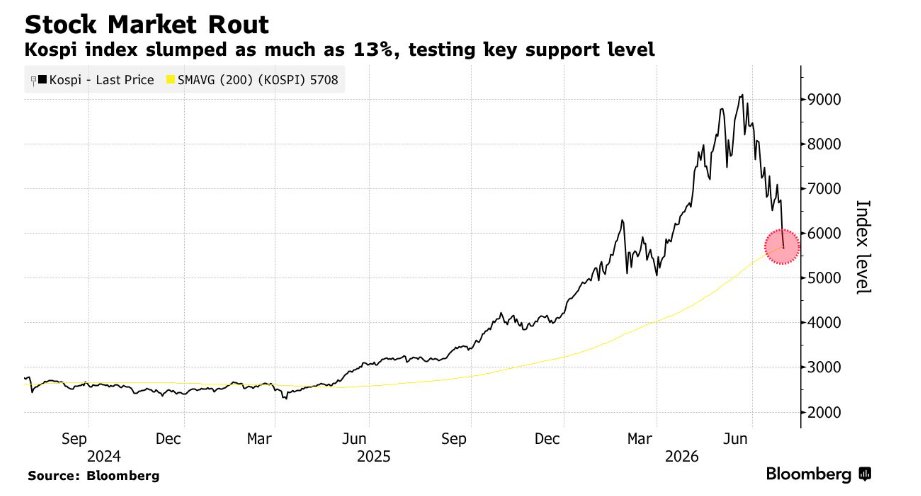
As shown in the chart above, the South Korean stock market can be described as having experienced frequent sharp declines recently. At one point, the Korea Composite Stock Price Index fell sharply by 13%, testing the key support level at the technical level.
After South Korea announced these measures, the exchange rate of the Korean won against the US dollar was basically flat.
Most members of parliament in South Korea generally believe that the single-stock leveraged ETF introduced domestically in May amplified market fluctuations. Since speculative trading is concentrated on a few blue-chip stocks, the volatility of the Korean stock market is significantly higher than that of similar global markets.
Koo Yun-cheol apologized at a congressional hearing on Wednesday and acknowledged that regulators should have carried out a more careful evaluation of these products before they were launched.
Wednesday's hearing further evolved into criticism of the government's approach to policy. Opposition lawmakers questioned why, in the face of widespread concerns expressed by the asset management industry, these products were approved to launch at an unusually rapid pace; they believe that government officials are putting boosting stock prices above maintaining market stability.
Lee Jong-wook, a member of the National Power Party, told Ku Yun-chul at the hearing: “This country has become a casino.” “These products should not have been allowed to enter the market in the first place. I think this is a policy failure.”
Faced with opposition lawmakers questioning whether he will resign if the consequences of the policy worsen, Ku Yun-cheol said that speculating on the resignation issue is irresponsible, adding that his current focus is stabilizing the market.
The head of South Korea's top financial regulator also publicly apologized on Wednesday over the ongoing escalation of single-stock leveraged ETFs.
Wreath protests forced a sharp regulatory brake: South Korea cut off the “death spiral” of leverage, and global semiconductor and AI computing power chains ushered in a policy liquidity backlash?
The “wreath of condolences” before the South Korean National Assembly escalated a financial deleveraging incident into a political and regulatory crisis: Samsung Electronics and SK Hynix together account for nearly half of KOSPI's market value, and retail investors also placed highly concentrated bets through double-daily leveraged ETFs. The decline in the target price forced the fund to reduce its exposure to derivatives, forming positive feedback on “falling stock prices — rebalancing sales of ETFs — margin recovery — falling stock prices again.” As a result, the Korean government plans to limit individual investment in such products to less than 20% of total investment assets, increase transaction costs and simulated transaction requirements, and raise the minimum cash threshold to 30 million won from July 31; previously, it had also suspended new product launches and product advertisements, and began establishing a legal basis for emergency market stabilization measures. These measures are not equivalent to the announced use of “equalization funds,” but they mean that the policy response function has been upgraded from investor education to directly suppressing the increase in leverage and providing market support tools when necessary.
Judging from global market transmission, this policy poses an important market structure benefit to the semiconductor and AI computing power chain, rather than favoring industry demand itself. KOSPI plummeted 10.84% on July 28, and fell by up to 12.6% and 5.98% in the intraday session on July 29. SK Hynix once fell nearly 20% even after announcing record profits; the US Philadelphia Semiconductor Index had previously retreated 20% from the record high on June 22, and fell close to 6% on July 28. This shows that South Korea is not an isolated epicenter, but is part of the joint cancellation of crowded global AI transactions, cross-market quantitative momentum, and semiconductor high-beta positions.
Therefore, overall, limiting Korean leveraged ETFs can reduce the cross-market price transmission of Samsung and Hynix's passive rebalance to the TSMC, Micron, Nvidia, and Philadelphia Semiconductor Index at the end of the session, helping to narrow liquidity discounts, but it cannot automatically repair the near historical highest percentile valuation of core stocks in the global AI computing power industry chain.
As far as the global semiconductor sector and AI computing power trading topics are concerned, the most destructive passive selling market caused by severe deleveraging and extremely bullish position clearing in the Korean stock market is probably already in the second half, rather than the Korean financial system undergoing a full-scale balance sheet crisis. According to the J.P. Morgan Chase research report, the size of leveraged ETFs has been reduced from about 50 billion US dollars to 17 billion US dollars. Hedge fund deleveraging has been completed by about 90%, and foreign capital outflows are also highly concentrated in two storage-weighted stocks.
Meanwhile, losses in the Korean market were mainly concentrated on a few AI-weighted stocks, and not all industries collapsed at the same time. As a result, the government's tightening of leverage at this time may not only trigger a small amount of remaining position reduction, but also reduce the marginal intensity of the next round of forced sell-off, causing the global stock market to shift from mechanical indiscriminate liquidation of the AI computing power industry chain to profit, valuation, and industrial competitiveness pricing related to the AI computing power theme.
The South Korean government's latest promise to stabilize the market can be described as a major hemostatic catalyst for the severely damaged global semiconductor and AI computing power industry chain. It can reduce tail liquidity risks, ease the forced selling pressure transmitted by leveraged ETFs to global chip stocks, and create conditions for an oversold rebound, but it is not a sufficient condition for the AI super bull market to restart. The bottom of the policy may already be in place, and the bottom of the position is approaching, and the industrial bottom must be confirmed by cloud vendor capital expenses, storage contract prices, and strong free cash flow brought about by AI computing power requirements.