


- BHP Group Limited recently reported its fourth-quarter and full-year 2026 production results, highlighting lower copper and iron ore output but higher steelmaking and energy coal volumes across its portfolio.
- At the same time, BHP issued production guidance for fiscal 2027 that points to broadly steady group volumes, giving investors clearer visibility into expected copper, iron ore, and coal output.
- We’ll now examine how BHP’s new 2027 production guidance for copper and iron ore may influence the company’s existing investment narrative.
AI is about to change healthcare. These 8 stocks are working on everything from early diagnostics to drug discovery. The best part - they are all under $10b in market cap - there's still time to get in early.
BHP Group Investment Narrative Recap
To own BHP, you generally need to be comfortable with a diversified but still commodity heavy portfolio anchored in iron ore and copper, supported by coal and emerging potash. The new 2027 production guidance suggests broadly steady volumes, so it does not materially change the near term catalyst, which remains execution on growth projects, or the key risk around operational and regulatory challenges in core regions.
The most relevant recent announcement here is the FY2027 production guidance itself. It frames how much copper and iron ore BHP expects to produce after a year where copper output slipped and iron ore was only slightly higher. For investors focused on catalysts, this guidance sits alongside the Jansen potash spend and other growth projects, helping you judge whether BHP is balancing volume, cost pressures and capital commitments in a way you are comfortable with.
But set against BHP’s heavy reliance on Chinese steel demand and iron ore pricing, investors should be aware that...
Read the full narrative on BHP Group (it's free!)
BHP Group's narrative projects $56.1 billion revenue and $13.3 billion earnings by 2029. This requires 1.3% yearly revenue growth and an earnings increase of about $3.1 billion from $10.2 billion today.
Uncover how BHP Group's forecasts yield a A$61.02 fair value, in line with its current price.
Exploring Other Perspectives
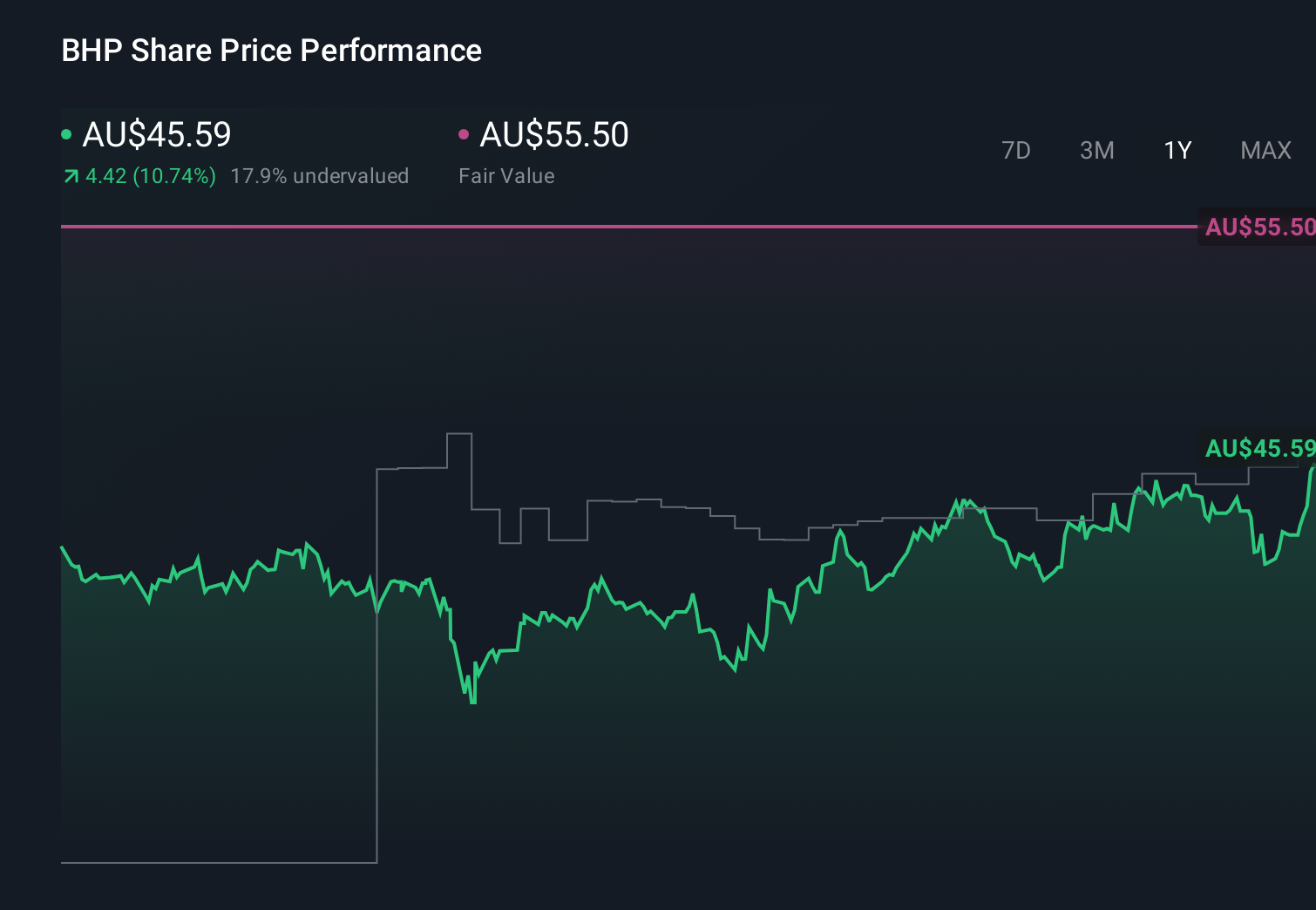
Some of the most optimistic analysts were assuming revenue of about US$61.8 billion and earnings near US$16.9 billion before this guidance, so if you are drawn to that more upbeat story, it is worth asking how those expectations stack up against the latest production outlook and whether your own view of BHP’s project pipeline and cost risks is closer to that optimistic camp or something more cautious.
Explore 17 other fair value estimates on BHP Group - why the stock might be worth over 2x more than the current price!
Reach Your Own Conclusion
Don't just follow the ticker - dig into the data and build a conviction that's truly your own.
- A great starting point for your BHP Group research is our analysis highlighting 1 key reward and 1 important warning sign that could impact your investment decision.
- Our free BHP Group research report provides a comprehensive fundamental analysis summarized in a single visual - the Snowflake - making it easy to evaluate BHP Group's overall financial health at a glance.
Contemplating Other Strategies?
Our top stock finds are flying under the radar-for now. Get in early:
- Find 7 companies with promising cash flow potential yet trading below their fair value.
- We've uncovered the 4 dividend fortresses yielding 5%+ that don't just survive market storms, but thrive in them.
- This technology could replace computers: discover 26 stocks that are working to make quantum computing a reality.
This article by Simply Wall St is general in nature. We provide commentary based on historical data and analyst forecasts only using an unbiased methodology and our articles are not intended to be financial advice. It does not constitute a recommendation to buy or sell any stock, and does not take account of your objectives, or your financial situation. We aim to bring you long-term focused analysis driven by fundamental data. Note that our analysis may not factor in the latest price-sensitive company announcements or qualitative material. Simply Wall St has no position in any stocks mentioned.
Have feedback on this article? Concerned about the content? Get in touch with us directly. Alternatively, email editorial-team@simplywallst.com