


The Zhitong Finance App learned that after the Federal Reserve kept interest rates unchanged for the fifth time in a row, the market lowered expectations for the September rate hike, and the US dollar recorded its biggest decline in two weeks on Wednesday. Although three officials within the Federal Open Market Committee (FOMC) voted for interest rate hikes, the market believes that Federal Reserve Chairman Walsh viewed the recent rise in US Treasury yields as part of the tightening of monetary policy, easing expectations of short-term interest rate hikes.
After the Federal Reserve announced the interest rate decision, the Bloomberg US dollar spot index fell by about 0.3%, the biggest one-day decline since July 15. It was also the weakest performance of the US dollar in the past two years since the Federal Reserve announced that interest rates would remain unchanged. The US dollar weakened against most major currencies. Among them, the Norwegian krone rose by about 0.8%. Apart from the weakening US dollar, the situation in the Middle East was once again tense, driving up international oil prices, and also provided support for the currencies of oil producers.
The market trend further expanded after the Walsh press conference. Walsh said that since the last interest rate meeting, US Treasury yields have risen markedly, which means that the financial market has actually completed some of the austerity effects that would have required the Federal Reserve to raise interest rates. This statement was interpreted by the market as a decrease in the urgency for the Federal Reserve to raise interest rates further in the short term.
Yusuke Miyairi, a foreign exchange strategist at Nomura Securities in London, said that Walsh actually sees the recent rise in US Treasury yields as an alternative to interest rate hikes, which is weakening market expectations for further interest rate hikes and putting pressure on the US dollar.
The interest rate derivatives market also reflected changes in expectations. Before the interest rate meeting was held, in the context of the Iran war driving up energy prices, traders generally believed that there was a one-third chance that the Federal Reserve would raise interest rates at this meeting, and by the close of Tuesday, the market had even almost completely measured expectations for the September rate hike. After the resolution was announced, the market's expectations for the September rate hike fell to slightly above 50%, and the Federal Reserve is not expected to complete this round of rate hikes until December.
However, hawkish signals from within the Federal Reserve still attracted market attention. At this meeting, all three local Federal Reserve presidents voted to raise interest rates by 25 basis points, and the Federal Open Market Committee ultimately decided to keep the federal funds rate target range unchanged at 3.5% to 3.75% by a 9-3 decision, and reiterated in a statement that they would continue to “achieve price stability.”
Bob Michele, chief investment officer of asset management and global head of fixed income at J.P. Morgan Chase, said that compared to the decision to keep interest rates unchanged, the three negative votes are more worthy of market attention. It indicates that the Federal Reserve is gradually shifting to support further policy tightening, and the pressure to raise interest rates may continue in the future.
Bianco Research President Jim Bianco also believes that the objections of the three officials are the most important message of this conference. In the context of Walsh's reduction in forward-looking guidance and diluting hints about future policy paths, the press conference reflected more the Chairman's personal views than the consensus of the entire FOMC, so the members' voting results more reflected the true positions within the committee.
KPMG chief economist Diane Swonk also said that these three negative votes are no accident, which means that some Federal Reserve directors are likely to have begun preparations to support further interest rate hikes in the future.
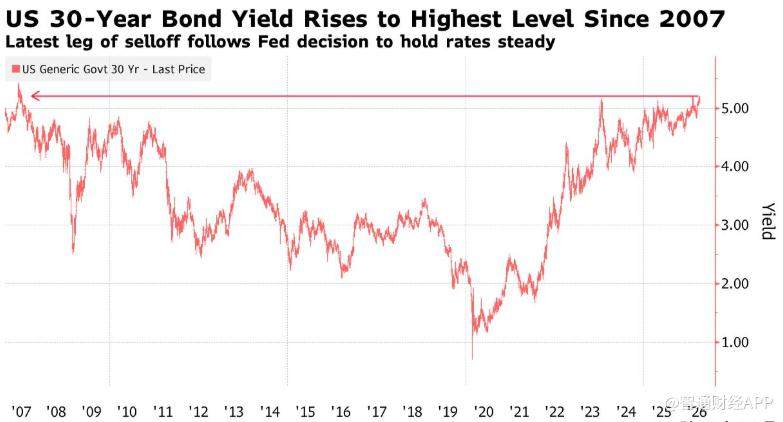
Asset prices fluctuated drastically after the resolution was announced. US stocks fluctuated and rebounded; US Treasury yields quickly rebounded after a brief decline, and the 10-year US Treasury yield rose again to about 4.63%. It is worth noting that after Walsh's speech, the yield on 30-year US Treasury bonds once rose to the highest level since 2007, reflecting that the market is still wary of long-term inflation and financial pressure.
Although the US dollar declined significantly on Wednesday, analysts believe that its long-term trend still depends on the performance of the US economy and inflation. Nathan Thooft, senior portfolio manager at Manulife Investment Management, said that the lack of interest rate hikes alone is enough to push the US dollar to adjust by about 0.5%, but in the longer term, the current upward cycle of the US dollar may have peaked, but the subsequent pullback process is expected to be slow rather than a rapid decline.