


The Zhitong Finance App learned that on the eve of the Bank of Japan announcing the interest rate decision, the Japanese government is suspected of interfering again in the foreign exchange market. During the New York trading session on Thursday, the yen rose sharply by 3.3% to 157.98 yen to 1 US dollar, the biggest one-day increase since December 2023. Spot gold once topped 4,100 US dollars/ounce.
People familiar with the matter revealed that the Japanese government intervened to support the yen exchange rate, while the US authorities carried out an exchange rate check at around 2:30 a.m. Tokyo time.
US intervention has made this intervention more influential and may also make traders more cautious. US Treasury Secretary Scott Bessent said in an interview that he believes the yen is “seriously undervalued” and that “excessive fluctuations” are not good for market health. Japan's top foreign exchange official Jun Mimura said on Friday that Japan received more than just moral support from the US.
The media reported earlier that Japan has intervened and that the US authorities have also requested a quote on the USD/JPY exchange rate. As of press time, the exchange rate of the yen to the US dollar is about 160.56 yen to the US dollar. Over the past 12 months, the exchange rate of the yen against the US dollar has declined by about 6%, making it the worst performing G10 currency.
Sudden rise in yen sparks speculation of intervention
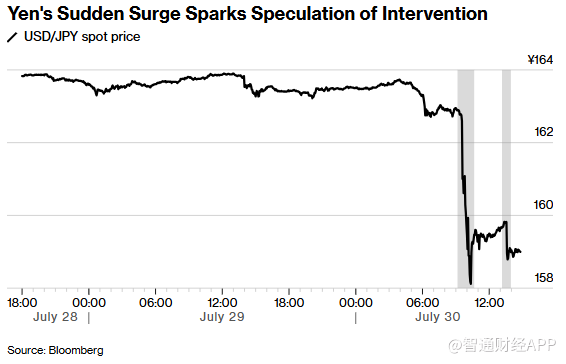
Japan's finance minister for Katayama Satsuki said that she was unable to answer questions about whether she had interfered in the foreign exchange market. She reiterated that the authorities were always prepared to respond with a high sense of urgency. The US Treasury declined to comment.
The yen recently fell to its lowest level in about 40 years due to factors such as rising oil prices, fiscal concerns, and the Japan-US spread remaining high. Despite the Japanese authorities' cumulative investment of a record 11.73 trillion yen (about 73.4 billion US dollars) to interfere in the foreign exchange market last quarter, the yen continues to be under pressure. According to reserve data from Japan's Ministry of Finance, Japan may have used foreign exchange securities reserves, including US treasury bonds, to provide financial support for this intervention.
On the one hand, Japan's unprecedented scale of intervention highlights the serious risks facing the country, and on the other hand, it also reflects the difficulty of counteracting the trend in the global foreign exchange market with an average daily transaction volume of 9.5 trillion US dollars.
In 2022, Japan supported the yen for the first time since 1998, and acted again in 2024 to curb the depreciation of the yen against the US dollar. Global inflation heated up after the COVID-19 pandemic, and major central banks raised interest rates one after another. At the time, the Bank of Japan still maintained negative interest rates to stimulate the domestic economy, and the depreciation of the yen began.
After the violent rise in yen, the market focused on the Bank of Japan's interest rate decision
As the yen ushered in a new round of fluctuations, the Bank of Japan will announce the interest rate decision on Friday. Markets expect the Bank of Japan to keep interest rates unchanged this week following last month's rate hike. The interest rate hike last month raised Japan's policy benchmark interest rate to the highest level since 1995. Investors previously worried that the Bank of Japan is lagging behind in dealing with inflation.
TS Lombard economist Rory Green said, “After previous interventions, the Bank of Japan often followed up with interest rate hikes, most recently in mid-2024.” He said that if the Bank of Japan takes action today, “it would still be surprising, but there is already a possibility of policy adjustments at this meeting.”
Strategist Mark Cranfield said, “This sharp fluctuation between the US dollar and the yen is rare. The single-day fluctuation range has crossed the 7-integer mark. Market traders were surprised at the moment when news of Japan's intervention came out. However, only if the yen exchange rate effectively breaks through the 155 mark can it really boost the confidence of the yen bulls.”
Before the Bank of Japan's decision came out, the Citigroup strategist team led by Daniel Tobon advised investors to bet on the continued weakening of the yen against the US dollar in the options market layout. The team pointed out that Bank of Japan Governor Ueda Kazuo is unlikely to send a more hawkish signal than market expectations.
The Federal Reserve kept interest rates unchanged this week, but traders are still betting that the US will still raise interest rates later this year. This keeps the spread between the US and Japan high, putting a continuous pressure on the yen.
“Intervening now may cause investors to think twice when selling yen,” said Takeru Yamamoto, a trader at Sumitomo Mitsui Trust Bank.
Rinto Maruyama, senior foreign exchange and interest rate strategist at SMBC Nikko Securities, said, “Compared to the April intervention, which was more transparent and easily identifiable, the Japanese authorities intervened before the central bank's monetary policy meeting, probably to unexpectedly expand their influence.” He added that the sharp rise in Japanese and US long-term bond yields is “a key factor behind Japan's foreign exchange intervention and US exchange rate check operations.”
Geoffrey Yu, senior strategist at Bank of New York Mellon, said, “Such large fluctuations indicate that the Japanese authorities probably intervened in the foreign exchange market. However, the effects of the intervention remain to be seen.”
Japan's market intervention depressed the dollar, and gold once broke through 4,100 US dollars
The Japanese authorities' intervention in the market boosted the yen and caused the dollar to fall, helping the price of gold to rebound.
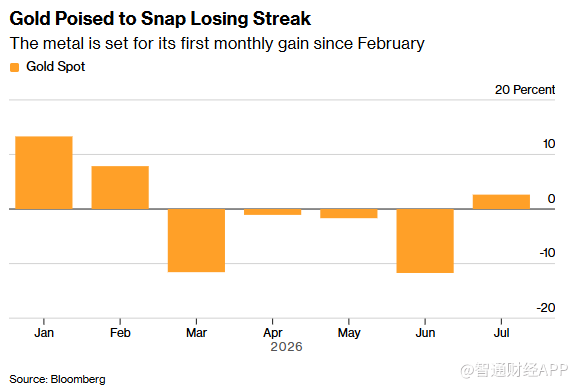
In early trading on Friday, the price of gold once surpassed 4,100 US dollars per ounce, and is expected to achieve its first monthly increase since February. Despite inflationary pressure brought about by the Middle East war, the Federal Reserve decided to keep interest rates unchanged this week, which also played a role in supporting the price of gold. Higher borrowing costs adversely affect precious metals that do not pay interest.
Gold is expected to achieve monthly gains for the first time since February
On Thursday, the US dollar fell nearly 1% against a basket of currencies, mainly because the Japanese authorities interfered in the foreign exchange market to support the yen, making dollar-denominated gold cheaper for most buyers.
Since the outbreak of the US-Iran war more than five months ago, the price of gold has fallen by more than one-fifth. High energy prices have increased inflationary pressure and increased the possibility that interest rates will remain high for a long time. However, bargain buying in recent weeks has helped keep the price of gold above the $4,000 per ounce mark and is expected to achieve a monthly increase of more than 2%.
The Federal Reserve decided to keep interest rates unchanged on Wednesday, providing support for gold. In particular, some traders had previously bet that the Fed would raise interest rates. However, the 9-3 vote also shows that some policymakers are convinced that in the end, interest rates will still need to be raised to meet the 2% inflation target.
Federal Reserve Chairman Kevin Walsh insisted that the latest decision is not a sign of the Fed's slow action. He said, “If inflation remains high during the forecast period, interest rates are likely to be part of the solution, but I wouldn't say this is an isolated measure.”
Helen Amos, an analyst at BMO Capital Markets Ltd., said Walsh's remarks “meant that apart from the impact of energy prices, inflation is not a cause for concern.” She pointed out that “the level of market concerns about inflation may have peaked,” and added that the Jackson Hole World Central Bank Annual Meeting held at the end of August may become an important catalyst for gold prices, and the Federal Reserve Chairman will often deliver major policy speeches at this conference.
The situation in the Middle East remains unclear. This week, there was another exchange of fire between the US and Iran. Meanwhile, Saudi Arabia is discussing the formation of a multinational alliance to protect the safety of shipping in the Red Sea and surrounding regions.
As of press release, spot gold fell below 4,090 US dollars/ounce, falling 0.35% during the day. The Bloomberg Dollar Spot Index rose 0.1% and fell 0.9% the previous trading day.