


The Zhitong Finance App learned that at a time when the increasingly concentrated market structure of the Australian stock market has attracted investors' attention, the Australian pension fund Cbus Super is reducing its investment exposure to domestic stocks and instead increasing the allocation of global markets and emerging markets, becoming the latest major institutional investor to reduce its dependence on the local stock market.
Christian Fokke, CEO of Cbus Super, said in an interview that the fund has cut the domestic stock portfolio ratio by 1 percentage point. The fund's size is 115 billion Australian dollars (about 81 billion US dollars), and Australian stocks currently account for 22.5% of its main investment portfolio. At the same time, the global stock allocation ratio increased by 0.5 percentage points to 28.5%; the share allocation ratio in emerging markets also increased by 0.5 percentage points to 3%.
Fokker said that although the fund is still an “active and determined player” in the Australian market, the Australian stock market “has long been highly concentrated, particularly on a few banks and resource companies.” He added that the appeal of emerging markets comes not only from artificial intelligence (AI) related stocks, but also from other industries such as biotech companies. “As our size continues to expand, we really need to allocate assets across a wider portfolio.”
The fund's investment team believes that emerging markets “provide more opportunities” and are more cost-effective. Fokker also said that “a significant portion” of the capital transferred from the domestic market to the global stock market went to the “Big Seven US stocks.”
Australia's benchmark stock index, the PP/ASX 200 Index, is highly dependent on large companies such as mining giants BHP Billiton and Commonwealth Bank of Australia. Even though AI-driven sell-offs impacted US and Asian stock markets over the past two months, the index's performance continues to lag behind its international market peers.
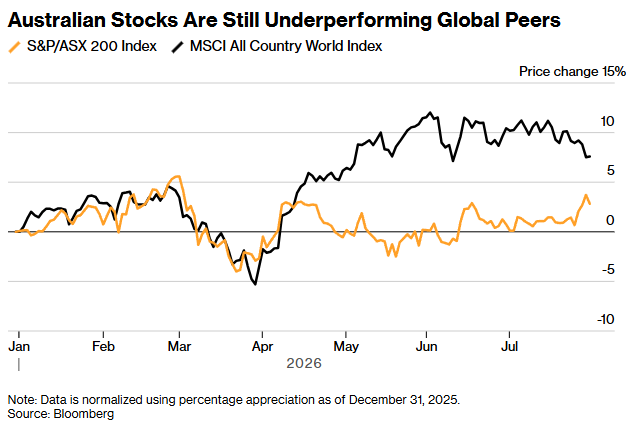
The Australian stock market still outperforms its global peers
This fluctuation is likely to continue. The Korean, Japanese, and Taiwanese markets are particularly vulnerable to changes in market sentiment, as the previous rise in these markets was largely dependent on investors' optimistic expectations of the strength of demand from chipmakers.
However, investors may be lured by stronger earnings prospects in markets outside of Australia. The profit expectations of Australian companies have stagnated over the past three months, while the profit forecasts of overseas companies have continued to rise. As the August earnings season arrives, these expectations will be further tested as companies need to announce their operating performance over the past year in an environment of high oil prices and sharp market fluctuations.
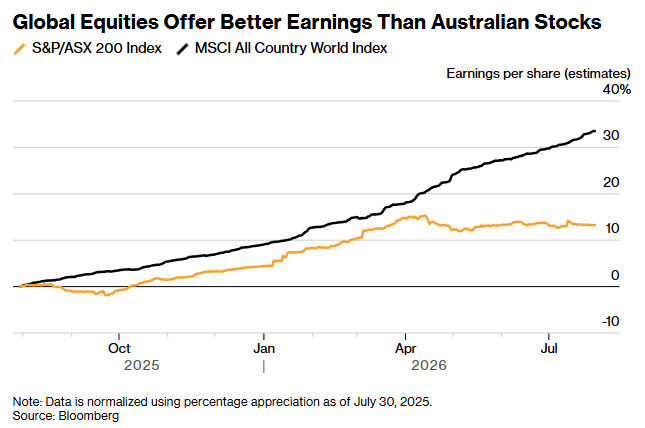
Global equities provide stronger earnings growth expectations
According to research firm Chant West, international equities helped drive Australia's 4.4 trillion Australian dollar pension industry's major balanced portfolio to achieve a return of around 9.5%. This type of portfolio is the main way most Australians use to save money for retirement. Currently, around half of Australia's total pensions are invested in overseas markets.
Another Australian pension fund, Brighter Super, recently stated that it is reducing its local stock market allocation and shifting to the global stock market because the US artificial intelligence investment trend continues.