


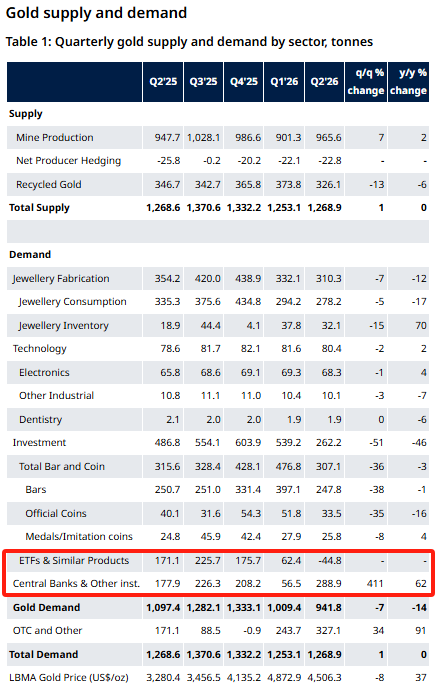
The Zhitong Finance App learned that after experiencing the weakest first quarter in more than a decade, central banks around the world are embracing gold again at a record speed. According to the latest “Global Gold Demand Trend Report” for the second quarter of 2026 released by the World Gold Council (WGC), the world's central banks and other official institutions increased their total net gold reserves by 289 tons in the second quarter, an increase of 62% over the previous year, setting a record high for the second quarter of previous years. This figure is more than five times the revised data for the first quarter (57 tons).
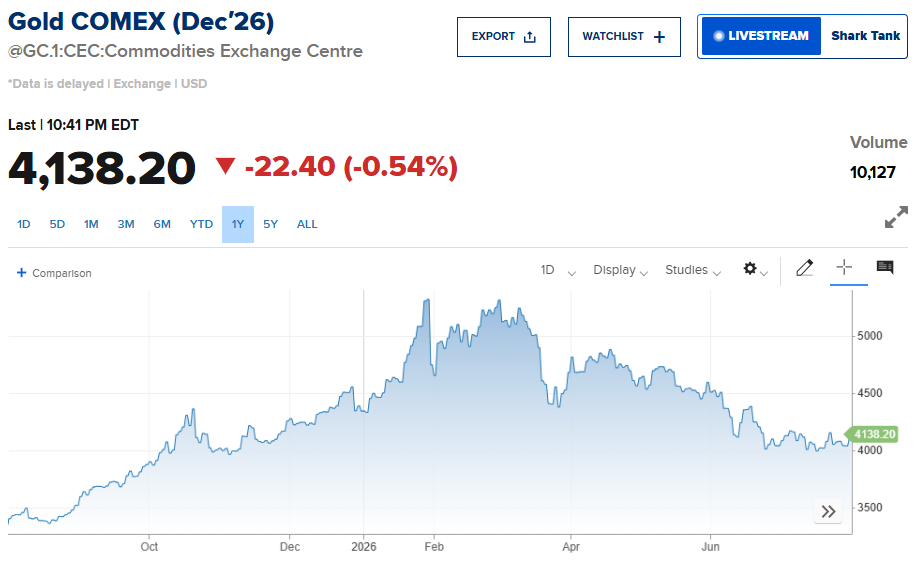
Meanwhile, the price of gold rebounded strongly due to the double benefit of the Federal Reserve keeping interest rates unchanged and the US PCE inflation cooling in June — COMEX gold futures for August delivery rose 1.58% to close at $4100.10 per ounce on Thursday, the biggest one-day increase since July 22. Spot gold closed at $4100.34 per ounce. There was a V-shaped reversal in the intraday period, pulling from an intraday low of $4,028 to above $4,100.
From 57 tons to 289 tons: a “demand reassessment” triggered by a data correction
The most notable adjustment in the World Gold Council's report is the drastic reduction in the central bank's gold purchase data for the first quarter. The industry group lowered the amount of gold purchased by the central bank in the first quarter from the previously estimated 244 tons to 57 tons — this meant a reduction of 187 tons, the lowest first-quarter gold purchase level in more than a decade.
This amendment reflects the reclassification of gold previously belonging to central banks and other official institutions to the “OTC and others” category. After the revision, the central bank's total net demand for the first half of the year was 345 tons, the lowest level for the same period since 2022.
 However, the rebound in the second quarter far exceeded expectations. The net purchase volume of 289 tons was not only five times that of the first quarter, but also surpassed all previous two-quarter records. The World Gold Council said that the strong rebound in the second quarter was due to weakening gold prices and continued geopolitical uncertainty. Louise Street, a senior market analyst at the World Gold Council, stated in the report: “Gold prices have been consolidated after recovering from historically high levels, but the market is still well supported, reflecting the established role of gold as a diversified tool and a means of storing value.”
Looking at specific buyers, the National Bank of Poland was the world's largest official gold buyer in the second quarter, increasing its holdings by 51 tons, with a cumulative net purchase of 82 tons in the first half of the year. The People's Bank of China followed suit and purchased 33 tons in the second quarter, continuing the trend of increasing holdings. According to the “2026 Global Central Bank Gold Reserve Survey” released by the World Gold Council last month, 45% of the central banks surveyed expect to increase their gold reserves within the next year.
The World Gold Council said in its report: “Supported by the need to diversify portfolios and hedge against inflation and risk, the central bank is still expected to usher in another strong year of net purchases, but full-year demand is expected to fall below the total volume of 2025.”
PCE cooling was compounded by the Federal Reserve's standstill, and the price of gold broke through 4,100 US dollars
The rebound in gold prices is inseparable from the “coincidence” of macro data. On the Federal Reserve side, the FOMC meeting on July 29 decided to keep the federal funds rate unchanged at 3.50% to 3.75% for the fifth time in a row with a 9-3 vote. Although the three regional Federal Reserve presidents voted against interest rate hikes, the decision to keep interest rates unchanged has itself provided a breathing room for gold. After the announcement of the resolution, gold rose rapidly, breaking through 4,116 US dollars during the intraday period.
In terms of inflation data, data released by the US Department of Commerce on July 30 showed that the overall PCE price index fell 0.1% month-on-month in June, the first negative monthly increase since 2020; the year-on-year increase narrowed to 3.7% from 4.1% in May. Core PCE rose only 0.1% month-on-month, lower than market expectations of 0.2%, and the year-on-year growth rate fell from 3.4% to 3.3%.
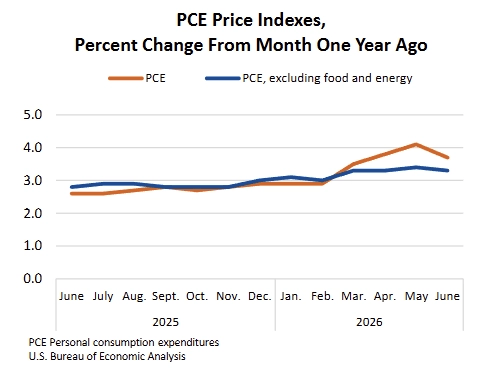
Bart Melek, head of global commodity strategy at TD Securities, said, “PCE data looks slightly better than market expectations, so the current inflation environment is generally stable.” But at the same time, he warned that the war in the Middle East does not seem to end in the short term, and inflationary pressure that has subsided in the past few months is likely to return.
Affected by this, COMEX gold futures closed up 1.68% to 4166 US dollars/ounce on Thursday, and spot silver rose 2.07% to $58.93 per ounce. During the Asian trading session on Friday, the price of gold consolidated above 4,100 US dollars.
Demand structure differentiation: central bank backing, ETF outflow, jewellery under pressure
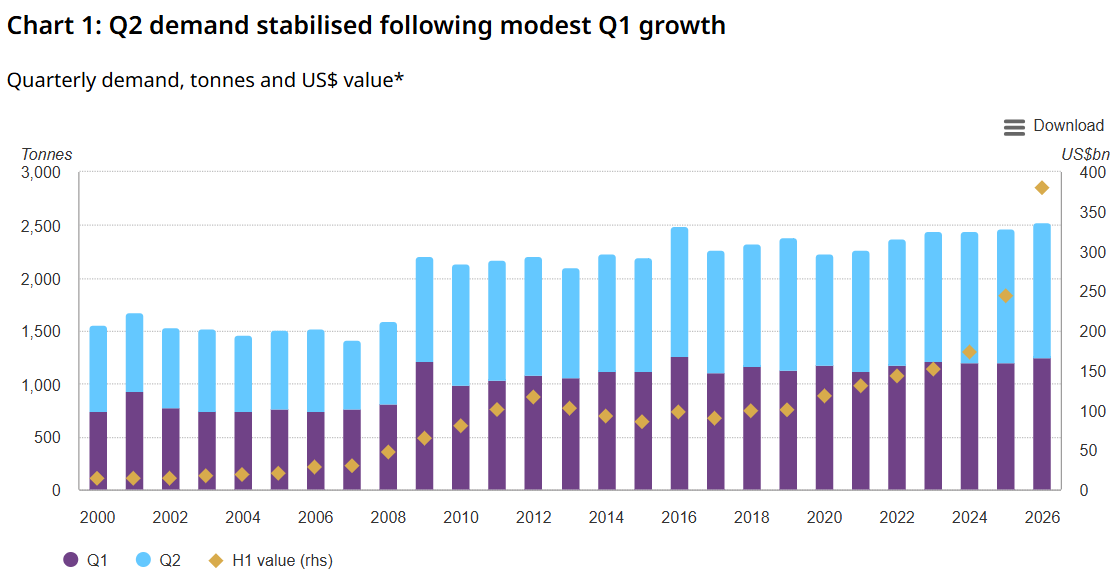
Total global demand for gold remained flat at 1,269 tons year on year in the second quarter. Total demand rose 2% year on year to 2,522 tons in the first half of the year, with a total demand value of about 380 billion US dollars, a record high.
However, the internal structure of requirements showed significant differentiation:
Investment demand is cooling down. The net outflow of 45 tons of global gold ETFs in the second quarter was the main reason for the decline in investment demand during the quarter. Demand for gold bars and coins fell by only 3% year over year, and the first half of the year was still 21% higher than the same period last year.
OTC trading is active. Driven by Asian investment demand, OTC investment reached 327 tons in the second quarter, and demand in this sector reached 571 tons in the first half of the year, showing steady performance.
Demand for jewellery is under pressure. High gold prices continued to suppress jewellery consumption. Global jewellery demand fell to 278 tons in the second quarter, down 17% year on year. Consumers switched to lightweight products, but jewellery spending increased 14% year over year to $40 billion.
The supply side is stable. Gold mine production increased 2% year over year to 966 tons in the second quarter, but the supply of recycled gold fell 6% year over year to 326 tons, indicating that consumers prefer to hold rather than sell gold.
Future Market Divergence: Is $4,100 the Starting Point or the End?
After gold reached 4,100 US dollars, the market still had significant differences in future market trends. The World Gold Council predicts that investment demand will remain the core engine of global gold demand growth during the year, supported by demand such as diversification of asset allocation and inflation hedging, but the unusually strong demand performance in 2025 is unlikely to be repeated.
The bullish camp is represented by Wells Fargo, which reaffirms its long-term forecast for gold prices: it is expected to reach 5,300 to 5,500 US dollars by the end of 2026, and further rise to 5,800 to 6,000 US dollars by the end of 2027.
State Street Bank expects the price of gold to fluctuate between 4,750 and 5,500 US dollars over the next 6 to 9 months. Morgan Stanley is also optimistic about the future market, predicting a gold price of 5,200 US dollars in the second half of 2026. Bernstein raised the target price for the second half of the year to 4,375 US dollars.
The bearish camp is represented by the Bank of America. The bank recently warned that gold still has plenty of room for correction this year. Investors are advised to complete the allocation only when the price of gold falls to the range of 3,250 to 3,450 US dollars. J.P. Morgan is relatively conservative and lowered its gold price forecast for the fourth quarter of 2026 to 4,500 US dollars.
Jia Shuchang, head of Asia Pacific research at the World Gold Council, said at the press conference that the current price of gold already reflects investors' expectations that the Federal Reserve will raise interest rates once during the year. Considering the midterm election pressure faced by the Trump administration in the second half of the year, the Federal Reserve is expected to raise interest rates for the first time in the year or postpone it until December. However, if the Federal Reserve raises interest rates by 25 basis points in September and December, respectively, it will put further pressure on the price of gold.