


The Zhitong Finance App learned that at the monetary policy meeting that ended on Friday, the Bank of Japan decided to keep the policy interest rate unchanged at 1% with an 8-1 vote, which is in line with the market's previous consensus expectations. Last month, the Bank of Japan just raised the benchmark interest rate to its highest level since 1995. The decision to stay on hold was made against a complex backdrop of heightened geopolitical tension in the Middle East, sharp fluctuations in the yen exchange rate, and subtle changes in domestic inflation prospects.
Resolution Details: “Hawkish Dissent” in Unanimous Expectations
There is no doubt about the outcome of this interest rate decision. The 52 economists previously surveyed by the media all predicted that the Bank of Japan would keep interest rates unchanged. The Bank of Japan said in a statement that it will continue to gradually raise interest rates according to economic and price trends and financial conditions. Currently, basic inflation is close to 2%, the financial environment remains relaxed, and the risk of both economic downturn and upward price increases has been reduced.
However, the calm in the policy statement was broken by a negative vote. Member of the review, Hajime Takada, voted against the resolution, advocating an interest rate hike of 25 basis points to 1.25%. Takada Hajime believes that the situation has entered a new stage, and the Bank of Japan needs to adopt a flexible approach to deal with the risk of rising prices and changes in the overseas financial environment. Earlier market analysis indicated that Takada Hajime, who is regarded as a “hawk,” and another member of the review committee, Naoki Tamura, may vote against it, and eventually Takada Hajime's objections became reality. This is the second time in a row that the Bank of Japan has had an objection vote. At the June meeting, Takada Hajime also proposed a rate hike.
Economic outlook: Lowering inflation and increasing growth, “reducing risk in both directions”
The conference released the quarterly “Economic and Price Situation Outlook Report”. The core adjustments include:
Inflation forecast lowered: The core CPI (excluding fresh food) forecast for FY2026 was lowered to 2.5% from 2.8% forecast in April. Inflation in the second half of FY2026 will be significantly higher than 2% due to wage transmission, oil prices, and the depreciation of the yen. The 2027 inflation forecast was slightly raised from 2.3% to 2.4%. The Bank of Japan expects the underlying inflation rate to reach the 2% target around the 2027 fiscal year.
Growth forecast raised: The real GDP growth forecast for the 2026 fiscal year was raised from 0.5% to 0.6%. Strong demand for AI is the key support for raising growth forecasts. The GDP growth rate for the 2027 and 2028 fiscal years is expected to be 0.8%.
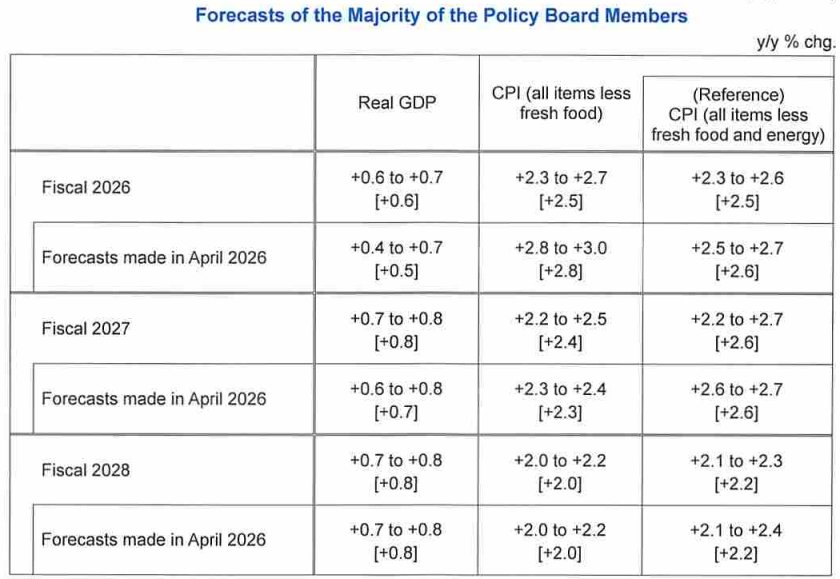
The Bank of Japan pointed out in its report that the risk of inflation is biased upward. Despite lowering the short-term inflation forecast, the central bank emphasized that in view of loose financial conditions, it will continue to raise policy interest rates and adjust the degree of easing. Earlier, people familiar with the matter revealed that the central bank raised the 2026 GDP forecast and lowered the core inflation forecast, providing data support for the current standstill.
The Bank of Japan judged that underlying inflation is close to 2%, the financial environment remains relaxed, and both the major downside risks faced by economic activity and the major upward risks faced by prices have been reduced. At the same time, the central bank adjusted its assessment of the economic growth risk balance, indicating that the risk is in balance rather than in a downward direction — this shows that the drag effect of the Middle East conflict is not as serious as the authorities initially feared, and that the global demand for artificial intelligence is buffering growth.
Foreign exchange market intervention: US and Japan join forces to “sneak attack”, yen soars 500 points
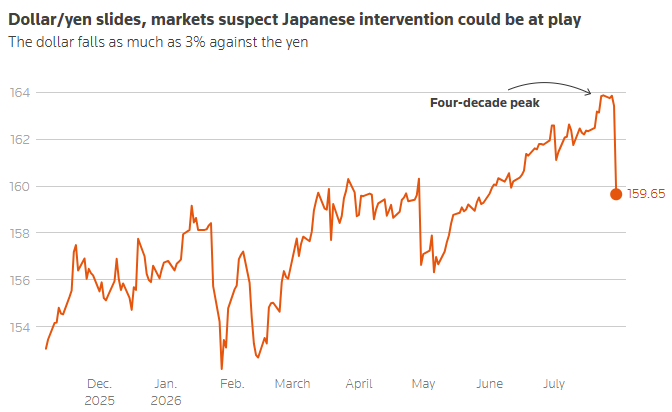
The biggest background variable in this interest rate decision comes from the foreign exchange market. During the New York trading session on Thursday, the exchange rate of the yen soared more than 500 points against the US dollar, rising as high as 3.3%, hitting 157.98 yen to the US dollar, the biggest one-day intraday gain since December 2023. According to media quoting relevant market sources, the Japanese government and the Bank of Japan implemented exchange rate intervention to buy yen and sell US dollars. At the same time, the US monetary authorities also carried out “exchange rate checks” as a pre-intervention stage — this means that Japan and the US have joined forces to curb the depreciation of the yen.
US Treasury Secretary Vincent publicly stated in an interview before the intervention that the yen “appears to be seriously undervalued” and believes that “excessive fluctuations” are unhealthy. The Federal Reserve Bank of New York, under the direction of the US Treasury Department, asked several banks about exchange rates for trading currencies. Market analysis points out that Federal Reserve Chairman Walsh's speech after keeping interest rates unchanged was interpreted by the market as being dovish, which may have created a favorable opportunity for the Bank of Japan to take steps to support the yen.
TS Lombard economist Rory Green pointed out that after Japan's previous intervention in the foreign exchange market, it was often accompanied by the central bank's interest rate hike. Rinto Maruyama, senior foreign exchange and interest rate strategist at SMBC Nikko Securities, said that Japan's intervention before the central bank's policy decision was “probably to surprise and maximize the effects of the intervention.”
As of Friday afternoon in Tokyo, the yen had fallen back to the 160.49-160.69 range. When asked whether to intervene, Japan's Finance Minister Katayama Satsuki said “it is currently impossible to disclose,” but reiterated that the authorities have always maintained a high level of vigilance. Japan's top foreign exchange official, Atsushi Mimura, said that Japan received “more than just moral support” from the US.
Market attention: Kazuo Ueda's “hawkish test”
After the interest rate decision was announced, the market's focus quickly turned to the afternoon press conference by Governor Kazuo Ueda. Since Ueda was absent from the June conference due to illness, this was his first time attending the post-conference press conference after a lapse of two months.
Investors expect Ueda to give clues on three core issues: first, the time window for the next rate hike — most economists still expect interest rate hikes to 1.25% before the end of the year, and October is the most popular time; second, comments on Thursday's suspected foreign exchange market intervention — the market expects the central bank governor to take a stand on the joint action between the US and Japan; third, the degree of hawkish depreciation of the yen and the risk of inflation — in the context of the yen falling to a 40-year low and Tokyo inflation accelerating towards the 2% target, can Ueda use sufficient hawkish communication to calm the yen depreciation expectations No Shocks the fragile economic recovery.
Daiwa Securities's chief foreign exchange strategist pointed out that although the market generally expects the Bank of Japan to keep interest rates unchanged, the market's attention is focused on its policy statement and the message conveyed by the governor's press conference. Investors will focus on the updated economic forecast and Ueda Kazuo's remarks to determine whether the central bank's policy outlook can consolidate the yen's rebound.
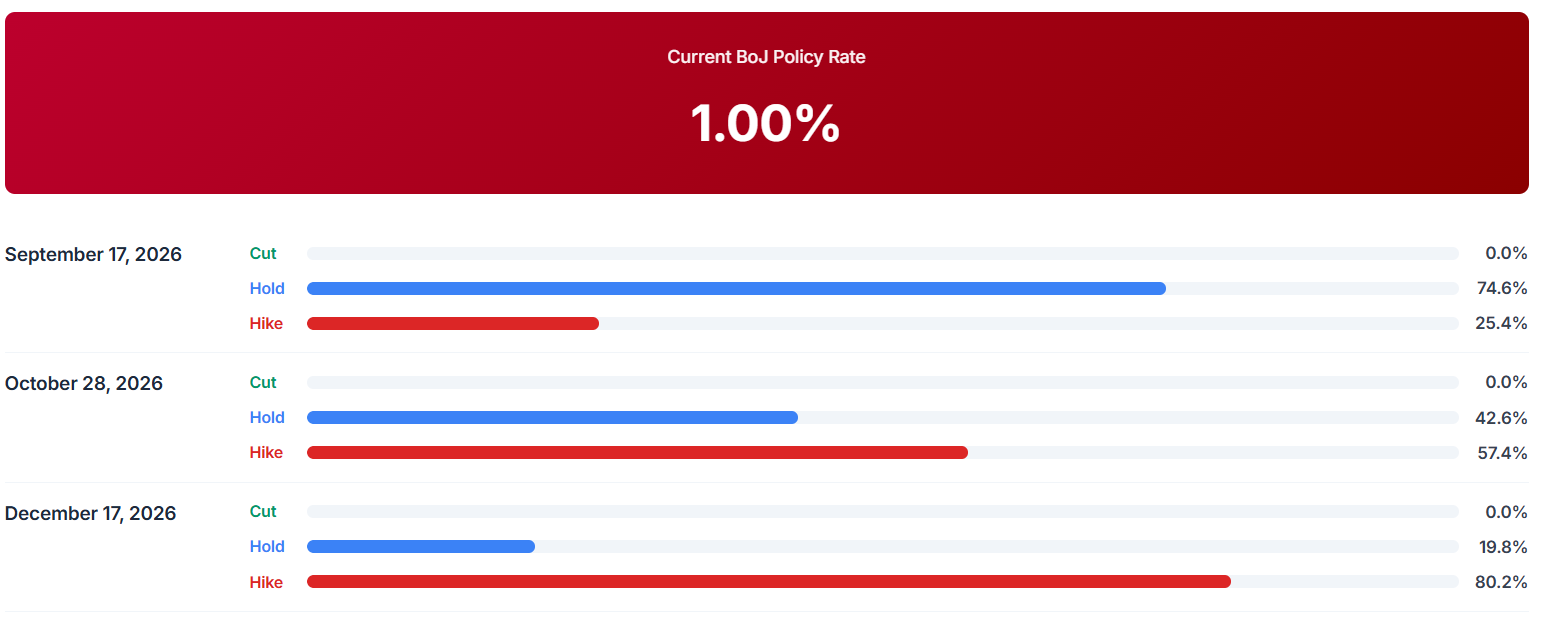
According to the survey, most economists expect the Bank of Japan to raise interest rates again before the end of the year, possibly as early as October. Currently, the market generally expects the Bank of Japan to raise interest rates in December, but the probability of raising interest rates in October is still over 57%.
Citigroup strategists had anticipated that the yen would weaken before the decision, and suggested increasing USD/JPY before the Bank of Japan's decision. The reason was that they did not think Ueda would send a more hawkish signal than expected by the market. SMBC strategists said that as the volatility of the dollar against the yen increases, the further depreciation of the yen may prompt the market to price and raise interest rates ahead of schedule. And the market's tests on this will be revealed one by one at Ueda's press conference.