


The Zhitong Finance App learned that under the combined impetus of soaring energy prices and the acceleration of rising service costs, France's inflation rate unexpectedly rebounded sharply in July, which not only far exceeded market expectations, but also made the picture of the ECB raising interest rates again in September becoming more clear.
According to data released by the French National Institute of Statistics and Economics (Insee) on Friday (July 31), as the second-largest economy in the Eurozone, France's EU Harmonized Consumer Price Index (HICP) rose 2.4% year on year in July, a significant increase from 2.0% in June. This reading is far above the expectations of all economists in a survey — the market generally expected inflation to remain stable at 2%. In fact, inflation in France only fell back to the ECB's 2% target level in June, and for more than a year before, inflation mostly hovered around 1% or even lower.
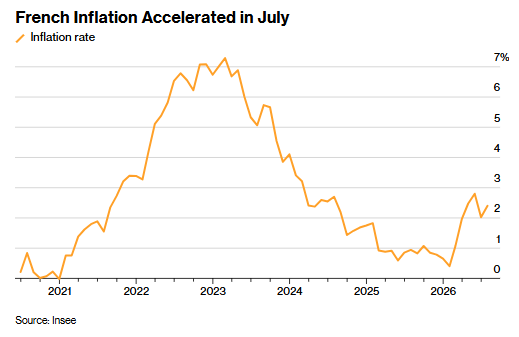
The disaggregated data revealed the main drivers of this round of rebound. The rise in energy prices was particularly strong. The year-on-year increase accelerated to 12.4% in July, showing rapid double-digit growth. Meanwhile, service inflation, which has attracted the attention of policy makers, is also clearly rising, rising 2.3% year over year, 0.4 percentage points faster than 1.9% in June.
Economist Jean Dalbard said, “France's inflation in July exceeded expectations because the escalation of the Middle East conflict once again boosted gas station prices, while the heatwave probably supported accommodation prices. However, potential price pressure remains moderate, which is consistent with the situation reflected in recent cyclical surveys.”
Expectations of austerity strengthened rapidly, and interest rate hikes continued to heat up in September
France is no exception. Data released the day before showed that Germany's inflation rate climbed to 2.8% in July, with rising energy prices and the expiration of a fuel tax refund program being the main drivers. Spain's inflation figures are also higher than expected. This has attracted much attention to the Eurozone overall inflation data to be released at 17:00 Beijing time.
Analysts currently expect the overall inflation rate in the Eurozone to rise slightly to 2.9% in July from 2.8% in June due to the Middle East geopolitical conflict.
The unexpected jump in inflation data, combined with better-than-expected economic output data released on Thursday, further increased the possibility that ECB policymakers will continue to tighten their policies at the September meeting. At the beginning of this month, the ECB chose to keep the key interest rate unchanged, but most investors are already betting that the next meeting will restart interest rate hikes.
Currently, economists and the market generally expect the ECB to raise interest rates by 25 basis points in September and raise the deposit facility interest rate again. The performance of French inflation in excess of expectations this time has undoubtedly added significant weight to this expectation. However, the market is also cautious, because a new round of inflation readings will be announced before the September interest rate meeting. If the data falls significantly at that time, the current assumption of interest rate hikes may still be overturned.
In addition to price pressure, the French government is also increasingly concerned about public finance. In an interview on Friday, Budget Minister David Amill echoed the warning previously issued by Finance Minister Roland Lescure.
Amir said, “France's public debt is like a powder keg. Without action, France's fiscal deficit will rise from 5.1% of GDP in 2025 to nearly 6% in 2027, to nearly 7% in 2030 — this would be a veritable deficit explosion.”