


The Zhitong Finance App learned that the US dollar is heading for its worst week in three months. Doubts about the new Federal Reserve leadership's determination to curb inflation continue to ferment, compounded by the Japanese authorities' suspicions that they are interfering with the yen on a record scale, and together push the dollar to a low level for more than a month. The Bloomberg Dollar Spot Index had a cumulative decline of 1.2% this week. Although it rebounded slightly on Friday, driven by capital flows at the end of the month, the overall fatigue was evident.
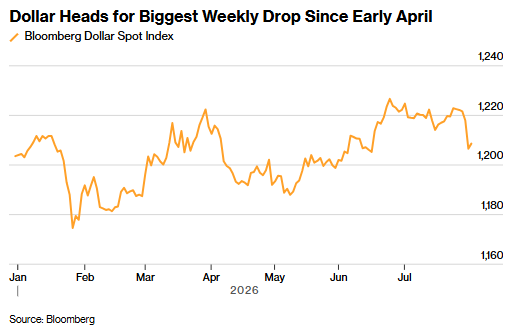
The core of this round of dollar decline is market unease over the leadership of Federal Reserve Chairman Kevin Walsh. Walsh's recent statement has worried investors. The central bank may hesitate and postpone interest rate hikes while inflation is still above target. This concern is directly reflected in asset prices: long-term US bond yields, which are seen as a weather vane for inflation expectations, have climbed to their highest level since 2007, but the dollar, which usually strengthens with it, bucked the trend.
This unusual linkage of debt remittances was described by Gavekal Wealth Managing Director Randhir Prakash as “quite an 'emerging market' feeling.” He pointed out that investors are beginning to express dissatisfaction with the US policy path; this situation “is bad for both US debt and the US dollar.”
Although the latest economic data released on Thursday provided a reason for the Fed to stay on hold — the US economy slowed in the second quarter, and the central personal consumption expenditure price index favored by the Federal Reserve fell 0.1% month-on-month — it did not dispel the clouds that loomed above the dollar.
As of Friday, the swap market is still pricing the Federal Reserve will raise interest rates by a total of 34 basis points for the rest of the year, which is basically the same as Thursday. Francesco Pesole, foreign exchange strategist at Dutch International Group, said: “We are still in no hurry to judge that this round of dollar sell-off has bottomed out. Any US data that falls short of expectations could result in a larger scale of dovish repricing than before.”
Japan “raided” the foreign exchange market, hitting 53 billion US dollars in a single day
At a time when the dollar's own momentum is weakening, the strong intervention suspected of being launched by the Japanese authorities has become another straw to crush the dollar. During Thursday's New York trading session, the yen surged 3.3% against the US dollar in just a few hours. The single-day increase was the biggest increase since December 2023, hitting an intraday high of 158.34, far from the 40-year low of around 164 set earlier this week. The US dollar then recorded its biggest one-day decline since the end of 2022.
Although Japan's Ministry of Finance officials declined to confirm whether to intervene, there is multiple evidence that it was a well-planned raid. According to the comparison between Bank of Japan account changes and currency brokers' forecasts, the analysis estimates that the scale of this intervention is about 8.45 trillion yen, or about 52.8 billion US dollars. This is likely to set the record for the largest single-day intervention in Japan's history. Citigroup's sales and trading department pointed out in a report sent to institutional customers that within 10 minutes of 9:30 a.m. to 9:40 a.m. EST on Thursday alone, its electronic trading platform recorded sales of about 8.1 billion US dollars against yen.
Daisaku Ueno, chief foreign exchange strategist at Mitsubishi UFJ Morgan Stanley Securities, said, “It's hard to imagine anything other than monetary intervention that could cause the yen to plummet by 5 points in such a short period of time.” He believes that the authorities deliberately chose to move between the Federal Reserve and the Bank of Japan meetings in order to “catch the market by surprise.”
According to some market sources, the South Korean authorities also sold dollars during the New York period, causing the won to rise to its strongest level since mid-October last year, triggering speculation about coordinated actions between the two countries. Japan's top foreign exchange official, Jun Mimura, hinted that the authorities' actions are being supported by other countries, including the US. According to an insider, the US authorities carried out an “exchange rate review” at around 2:30 a.m. on Friday morning Tokyo time. This move is usually seen as a precursor or auxiliary action for coordinated intervention.
After the intervention, the market focused on the prospects of the Bank of Japan and the US dollar
After a brief period of artificial appreciation, the sustainability of the yen's trend is still being tested. On Friday, the Bank of Japan kept interest rates unchanged as scheduled, and the yen took back some of the overnight gains. As of press time, it was trading around 160. This intervention is Japan's second major intervention this year. Previously, during Golden Week from the end of April to the beginning of May, the authorities interfered with the foreign exchange market by a record amount of 11.73 trillion yen in a single month, but the yen quickly returned to gains.
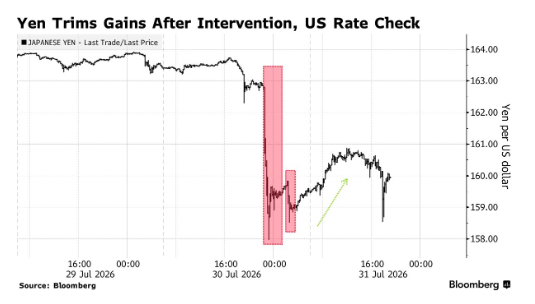
As far as the yen is concerned, the real duel between long and short will unfold in the Bank of Japan's policy communication. If the market interprets that the central bank's future rate hikes will be slower than expected, the current benefits of the yen's intervention are likely to evaporate quickly. SBI FX Trade Executive Advisor Yuji Saito said, “The key is whether the authorities will continue to push the dollar below the 155 mark against the yen. We hope to use this to determine how determined the government is to defend the currency.”
As far as the overall trend of the US dollar is concerned, as the market re-evaluates the Federal Reserve's policy path and sensitivity to US economic data increases, any fundamental changes may increase fluctuations. After Japan clearly draws a “red line” with real money, the US dollar may face double pressure from the policy side and overseas official forces in the short term.