


The Zhitong Finance App learned that some media quoted information revealed by people familiar with the matter as reporting that US Federal Reserve Chairman Kevin Walsh, who was nominated by Trump and took office after confirmation by the US Senate, proposed the possibility of adjusting the frequency of the Fed's regular monetary policy meetings. People familiar with the matter said that one of the key ideas proposed by Walsh is that Fed policymakers hold FOMC monetary policy meetings in the traditional sense six times a year instead of the current eight FOMC meetings per year to decide the benchmark interest rate and other monetary policy matters, and also hold brief meetings with clear goals twice a year to discuss a substantive economic issue.
Among the 2 conferences on the real economy revealed by people familiar with the matter, Walsh's idea was to hold another two separate meetings each year, not to focus on immediate interest rate adjustments, but to focus on in-depth discussions on a specific substantive macroeconomic topic. At present, the Federal Reserve has not made any decisions or issued any major statements. The Federal Reserve, under Walsh's helm, can be described as accelerating the formation of a new policy framework summarized as “clear goals, deliberately blurred paths, market-first pricing, and re-evaluation of policy tools.”
The “policy framework and system changes” led by the US Federal Reserve after Walsh took office were not simply raising interest rates higher, but rather an attempt to shift from “the central bank's continuous and long-term management of market expectations” in the Powell era to a shift from economic data, bond yields, exchange rates, and risk asset prices to first give signals, and then the Federal Reserve makes a judgment. Walsh clearly welcomes the market's own adjustments without forward-looking guidance. He believes that the recent sharp rise in nominal and actual treasury yields indicates that financial conditions have changed; his policy philosophy is closer to “making the market look at the economic ball rather than the referee of the Federal Reserve.”
People familiar with the matter said that the Federal Reserve Chairman raised the issue of reconsidering the FOMC meeting schedule at the meeting of the Federal Open Market Committee (the Federal Open Market Committee) of the Federal Reserve (the Federal Open Market Committee), the monetary policy and interest rate voting and setting agency held last week.
The Federal Open Market Committee, composed of 12 FOMC members, currently holds eight monetary policy meetings every year in Washington, D.C., to set the benchmark interest rate and monetary policy path; this practice has continued since the early 1980s. Reducing the number of interest rate and monetary policy meetings will mark a major shift in the way the Federal Reserve operates at the bottom.
One of the people familiar with the matter said that last week's FOMC monetary policy meeting also focused on whether the timing of monetary policy decisions can be better adjusted to connect them with the release of important economic data and other important economic-level information. The goal is to improve the overall quality of monetary policy decisions.
A Federal Reserve spokesperson declined to comment on the latest information from people familiar with the matter quoted by the media.
Walsh is planning to reshape the pace of the Federal Reserve: eight interest rate discussions or “six plus two,” and market pricing may usher in a brand new FOMC meeting clock
The plan proposed by Walsh is to adjust the current eight annual policy meetings to about six formal interest rate decision meetings, and to arrange two additional thematic economic discussions; no final decision has yet been made. The Federal Reserve has maintained eight regular meetings a year since 1981, and temporary meetings can still be held during times of crisis, so reducing regular meetings does not mean that the central bank has lost its ability to respond urgently.
If meeting time can better cover employment, CPI, PCE, and quarterly economic data, reducing meetings can reduce the risk of making hasty decisions around individual noisy data, and also leave more room for internal research and strategic discussions. The problem, however, is that Walsh is also inclined to reduce press conferences, reduce statements, and withdraw from forward-looking guidance. Fewer meetings alone do not necessarily increase risk; fewer meetings, less communication, and long-term unclear policy response functions only increase risk systemically.
Under this system, the global market will shift from “continuous policy navigation” in the past to a “discrete information jump”: every CPI, non-agricultural, oil price shock, and FOMC meeting may become a point of greater market repricing. The lengthening time between meetings also means that the market must infer the central bank's attitude on its own. The implied volatility of interest rate options, US Treasury bond maturity premiums, and stock index risk premiums may all remain at higher levels.
The move to reconsider the Fed's monetary policy meeting schedule highlights that Walsh is thinking about how to change the underlying logic and methodology of the Fed's policy formulation and use of data. Walsh was nominated by US President Donald Trump and officially took charge of the Federal Reserve in May of this year.
The new chairman has proposed the possibility of reducing the number of daily press conferences after the Fed's interest rate and monetary policy decisions, drastically shortening the monetary policy statement issued by the Federal Reserve after the meeting and refusing to provide any forward-looking guidance as usual. Walsh also recently announced the establishment of five working groups to study major reform initiatives the Federal Reserve may take, covering areas ranging from how the Federal Reserve communicates with financial markets to how to manage the central bank's balance sheet path.
The Federal Open Market Committee has scheduled meetings for the remainder of 2026 — scheduled for September, October, and December, respectively — and has announced the 2027 meeting schedule. The Federal Reserve website reads: “The date of each FOMC monetary policy meeting is tentative and will not be officially determined until the previous meeting confirms it.” This disclaimer existed long before Walsh was appointed chairman of the Federal Reserve.
According to the FOMC rules of procedure, the FOMC meets at least four times a year in Washington, D.C., and may hold more meetings.
Specific rules of procedure and regulations state: “A meeting may be convened by the President of the Council or at the request of any three members of the Committee.”
During periods of intense global economic and market turmoil, the Federal Reserve also held temporary FOMC monetary policy meetings from time to time. For example, the Federal Reserve held temporary meetings in the early stages of the COVID-19 outbreak in 2020.
The Federal Reserve Interest Rate Committee (the Federal Reserve FOMC) consists of 12 members: seven officials of the Washington Federal Reserve Board of Governors, including Walsh; the New York Federal Reserve Chairman, who is the vice chairman of the Federal Open Market Committee; and four of the 12 Federal Reserve Regional Federal Reserve Chairs. Each year, these regional Federal Reserve presidents take turns as FOMC committee members who have the right to vote on monetary policy.
Before officially taking the helm of the Federal Reserve, Walsh also proposed adjustments to the central bank's policy meeting schedule.
In 2014, he conducted a review of the Bank of England's monetary transparency practices and policy procedures, known as the “Walsh Assessment,” which ultimately prompted the Bank of England to reduce the number of meetings per year from 12 to 8.
The ECB, on the other hand, adjusted the frequency of monetary policy meetings in the central bank system to be held every six weeks in 2015, replacing the previous practice of holding meetings on Thursday of the first working week of each month.
Less talking, fewer meetings, and more extreme fluctuations! Walsh reshaped global financial markets from “Federal Reserve Navigation” to “Market Pricing Everything”
According to some economists, the core of Walsh's monetary policy philosophy is to refuse to provide forward-looking guidance from the Federal Reserve, reduce the intensity of communication, and allow bonds, exchange rates, and risk assets to form price signals more directly based on economic data. Walsh himself has also made it clear many times that he hopes to reduce the “answers” to the market so that the market can provide less independent judgments guided by the Federal Reserve.
The Federal Reserve, under Walsh's helm, can be described as accelerating the formation of a new policy framework summarized as “clear goals, deliberately blurred paths, market-first pricing, and re-evaluation of policy tools.” In July, the FOMC maintained the federal funds rate at 3.50% to 3.75% at 9-3. Three members of the committee advocated an immediate interest rate hike of 25 basis points; Walsh repeatedly confirmed that 2% was an unsoftenable inflation target, but declined to tell the market exactly how to achieve it next. At the same time, he removed the predictive forward-looking guidance language from traditional statements, reduced the intensity of forward-looking language, and formed five working groups to re-examine communication, balance sheets, data, AI and productivity, and the inflation framework.
Walsh clearly welcomed the market's own adjustments in the absence of forward-looking guidance, believing that the recent sharp rise in nominal and actual treasury yields indicates that financial conditions have changed; his policy philosophy is closer to “making the market keep an eye on the economy rather than on the referee of the Federal Reserve.”
As of July 30, the market's pricing for the Fed's September rate hike had fluctuated between 57% and 65%, and there was no “full pricing”; Wall Street forecasts were also highly fragmented: Bank of America tends to raise interest rates in September, and J.P. Morgan's benchmark scenario is a December rate hike. At the same time, they acknowledge that September is still risky, while Goldman Sachs and Barclays are not expected to change during the year.
Walsh's biggest logical risk right now is to regard any increase in long-term yields as an effective monetary contraction. After the July meeting, short-term yields declined due to market cuts in recent interest rate hikes, but the 30-year yield rose above 5.2% and reached a 19-year high, forming an obvious steeper curve. This combination is not a standard “the Federal Reserve successfully guides the market to contract ahead of schedule,” and more likely means that the market has raised compensation requirements for long-term inflation, fiscal supply, and policy uncertainty.
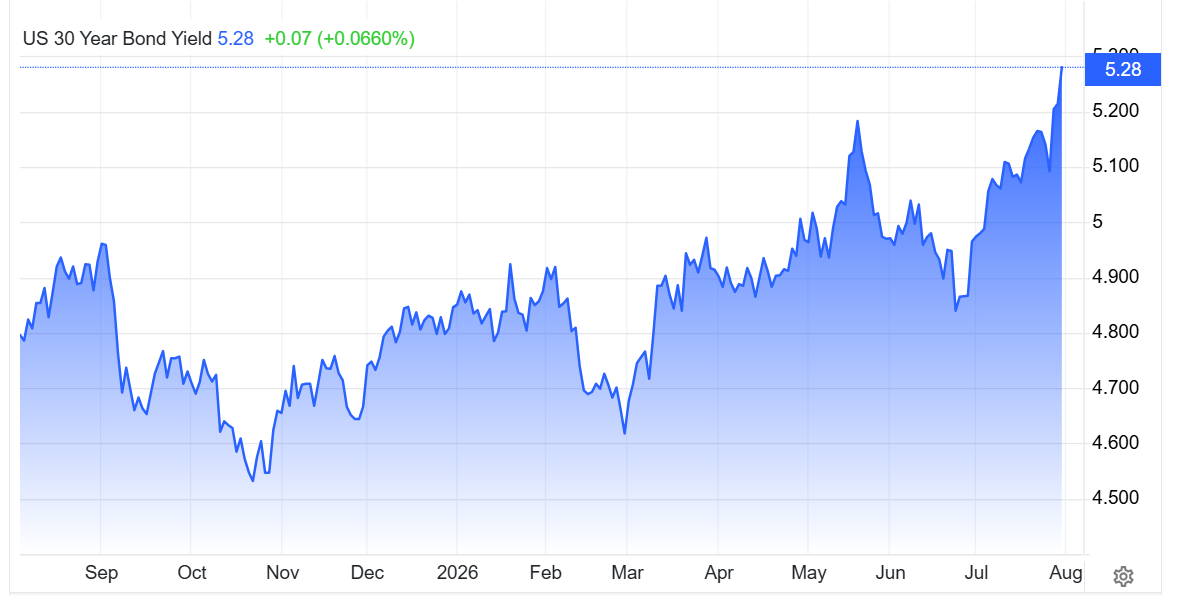
This is the meaning of the so-called “Anna Karenina Principle” of monetary policy: successful price stability requires a combination of policy tools, central bank credibility, inflation expectations, fiscal environment, and financial stability, and failure in any link may damage the overall outcome. If the bond market sells due to concerns that the Fed is not responding enough, and the Fed also interprets the bond sell-off as “the market has raised interest rates for us,” it will create a dangerous cycle: the market is concerned about the fuzzy policy path of the Federal Reserve and increasing inaction — the long-term risk premium rises — the Fed sees rising yields as an alternative austerity — continues to be inaction — and the market further questions the anchor of inflation.
This kind of “credit yield increase” is more detrimental to the stock market than a normal increase in growth yield, because it not only increases the discount rate of valuation, but is not necessarily accompanied by higher real profit expectations. The Federal Reserve will no longer promise to eliminate uncertainty for the market; the market will require every overvalued asset to prove itself. Its profit growth is sufficient to overcome the new environment of higher interest rates, less communication, and weaker “Fed put options.”
As far as global stocks are concerned, the most direct impact of the Walsh framework is not policy interest rates themselves, but rather long-term real interest rates and policy uncertainty rising at the same time. The global stock market is more likely to enter a new stage of “high index fluctuations, strong industry differentiation, and profit dominance rather than valuation dominance.” When actual financing costs for the 10-year and 30-year periods rise, even if the most critical logical support for the current stock market capitalization — that is, actual orders related to AI computing power infrastructure — are still strong, the market will require companies to more quickly prove that capital expenditure can be converted into revenue, profit, and free cash flow. Relatively speaking, high-quality basic stocks with abundant cash flow, stable balance sheets, and positions that are not as crowded as AI popular technology stocks can withstand the uncertain macroenvironment brought about by Walsh.