


The Zhitong Finance App learned that on Monday, a sharp rise in the yen triggered a sell-off in the Japanese stock market, but the yen exchange rate failed to break through the key levels used by many companies to make profit forecasts, leaving room for a rebound in the stock market. Currently, there is still room for about 5 yen in the yen exchange rate from the US dollar to the 151.49 yen mark. This exchange rate is a weighted average expected value obtained by the Bank of Japan from a survey of more than 800 companies. The strategist said that this buffer should limit the impact of exchange rate fluctuations on the profits of export companies, thus leaving room for these companies to rise in stock prices after announcing their results.
Yugo Tsuboi, chief strategist at Daiwa Securities, said, “Unless the exchange rate of yen against the US dollar rises further to around 150 yen, there should be little risk that corporate profit expectations will be lowered.” He pointed out that although uncertainty about the room for yen appreciation has put pressure on the stock market, “from a fundamental point of view, the current appreciation of the yen will not damage corporate profits.”
Affected by the sharp rise in yen after the joint intervention of the US and Japan, Japan's benchmark Tokyo Stock Exchange Index fell 1.1%. Generally, the strengthening of the yen is not good for the Japanese stock market, but the correlation between Japanese stocks and yen has weakened in recent months, and investors are focusing more on AI. The market also increasingly believes that the profit-boosting effect brought about by the weakening yen is difficult to offset its negative impact of boosting inflation and curbing foreign purchases.
This divergence in the market occurred in July: at that time, the yen fell to a low level of nearly 40 years against the US dollar, yet the Japanese stock market was still under pressure due to the sharp decline in the AI sector.
The correlation between the Tokyo Stock Exchange Index and the depreciation of the yen weakens
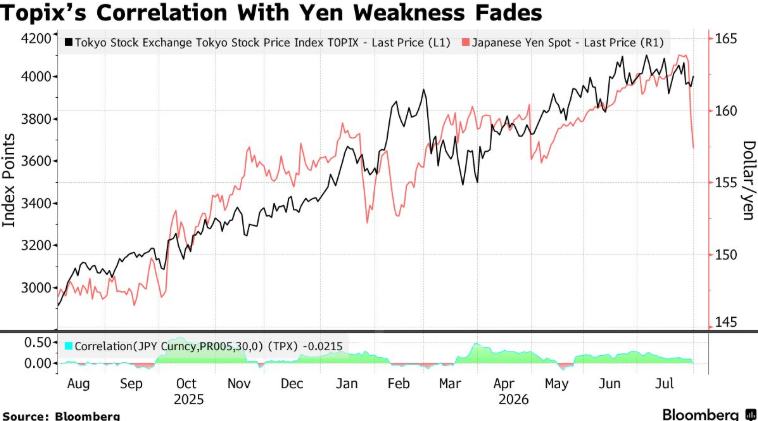
Fujiwara Naoki, senior fund manager at Tokyo Shinkin Asset Management, said, “The initial rise in the Japanese stock market was not simply driven by the depreciation of the yen.” He pointed out that as long as the exchange rate remains close to the company's expectations, it is unlikely to drag down profits, and automobile manufacturers may experience a “reset” of sentiment when announcing financial reports.
Despite this, sharp fluctuations in the yen exchange rate in the short term may continue to suppress market sentiment, as coordination between Japan and the US heightens the risk of further intervention.
Nomura Securities strategist Maki Sawada said that as the benefits brought about by the depreciation of the yen continue to exist and the year-on-year impact of US tariffs gradually subsides, the profits of export companies are expected to improve year over year. She said, “Individual stocks that were previously sold due to the appreciation of the yen are expected to attract buying again after the disclosure of financial reports.”
As of press time, the yen exchange rate is approximately 156.96 yen to 1 US dollar. The news of the joint intervention between the US and Japan was compounded by official shouting, pushing the yen to rapidly strengthen to 157.57 last Friday, and once hit 155.23 in early trading this Monday, the highest level since the beginning of May.