


The Zhitong Finance App learned that Cui Dongshu, Secretary General of the Passenger Transport Association, published an article stating that in June 2026, Russian car sales reached 122,000 units, up 22% year on year; in January-June, Russian car sales reached a high level of 660,000 units, up 10% year on year. In June 2026, China exported 84,400 vehicles to Russia, and its own brand sold 67,000 units, which is 80% of China's exports; in January-June, China exported 448,000 vehicles to Russia, and its own brands sold 360,000 units. Local sales were 81% of China's exports, which is generally relatively balanced.
In 2026, the share of Chinese independent brands in Russia reached a high level of 54.6%, and the benefits were good. In 2026, a large number of models from international car companies will enter. German and Japanese companies will perform well, and the advantages of Korean cars will weaken. In June 2026, the share of autonomous car companies in Russia was still 54.9%, at the peak level in 2026. Facing Russia's complex environment, it is of great strategic importance for independent brands to have more children and fight. Various models, such as official export of own-brand vehicles, parallel export, bypass exit, localized factory construction, and joint venture assembly, have joined forces, and a large number of brands have fought to achieve good results.
The overall performance of China's autonomous NEV sales in the Russian car market is good. In particular, high-end models such as extended-range plug-in hybrids have achieved good performance in replacing European and American luxury cars. Among new energy vehicles, brands such as Changan, Jikrypton, and Rantu have outstanding performance. These brands have relatively strong characteristics. However, in the world, brands such as BYD and Xiaomi have also had a certain sales performance.
Chinese car companies are speeding up localized production and supply chain restructuring in Russia, and a number of measures have been taken to improve the situation. The first is to deepen the KD assembly model and establish a regional production base in response to the stepped increase in Russian import tariffs. Avoid tariffs and shorten delivery times through localized production. Build a regional parts center warehouse to increase the localization rate of core components to more than 60% to reduce supply chain risks; secondly, do a good job in product improvement, technology adaptation and special research and development for extremely cold environments.
In response to Russia's extremely cold climate of minus 50℃ and complex road conditions, low-temperature battery management systems, all-terrain chassis adjustment and anti-corrosion processes have been strengthened to reduce the failure rate through anti-corrosion processes; the third is to upgrade the omni-channel after-sales service system. In response to the problem of delayed maintenance response in remote regions of Russia, a three-level network of “central warehouse+mobile service vehicle+authorized repair point” was built to increase service coverage to more than 90%; fourth, brand value reshaping and accurate marketing. Establish a high-end image through technical endorsement and scenario-based marketing, develop a cross-border e-commerce platform between Europe and Asia, provide online matching+offline pick-up services, and use the RMB settlement system to reduce the impact of exchange rate fluctuations.
I. Overall trends in the Russian market
Monthly trend of the Russian car market
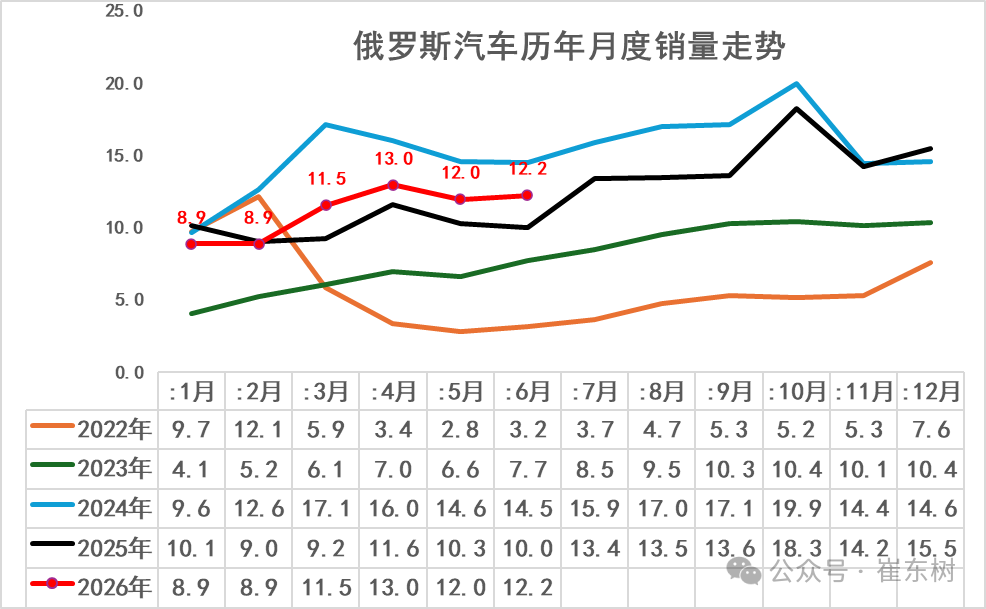
Sales in the Russian car market have fluctuated sharply, and there have been ups and downs in recent years. The monthly trend of the Russian car market in 2021 is relatively stable. In 2022, with the outbreak of the Russian-Ukrainian crisis, monthly sales reached a low level of less than 30,000 vehicles. With strong support from Chinese autonomous car companies, the Russian car market returned to a monthly sales level of around 100,000 vehicles in 2023. In 2024, the Russian car market will return to around 150,000 vehicles. The Russian car market gradually recovered in 2025, and the car market performance in the fourth quarter was close to its historical peak. The initial sales trend of 89,000 units in January 2026 was stable, then gradually strengthened. Sales of 122,000 units in June were better than in the same period in 2025.
Annual trends in the Russian car market
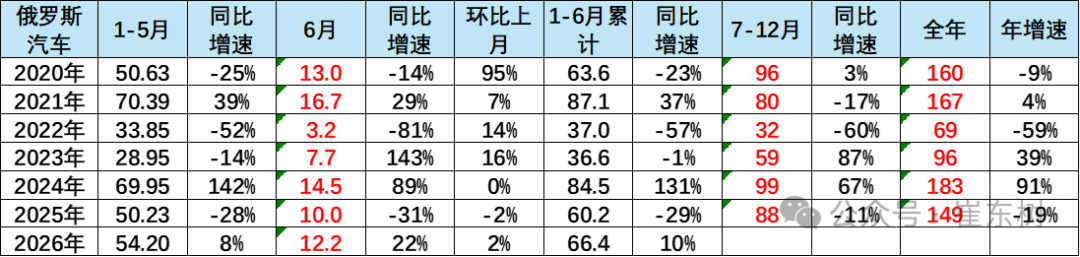
Russia is an established world superpower. With the rise in oil prices before 2008, Russian car sales reached nearly 3 million units; with the 2014 Crimean crisis, the annual sales volume dropped from 2.5 million to 1.5 million; after the 2022 Russian-Ukrainian conflict, sales bottomed out to 687,000 units in 2022; and Russian car sales rebounded to 960,000 units in 2023. With the guaranteed supply of Chinese cars, the overall sales volume of Russian cars in 2024 reached 1.83 million units, an increase of 91% over the previous year, and recently hit a new annual sales high. The cumulative sales volume of the Russian car market in 2025 was 1.49 million vehicles, a decrease of 19% over the previous year.
In June 2026, Russian car sales reached 122,000 units, an increase of 22% over the previous year. In January-June, Russian car sales reached a high level of 660,000 units, an increase of 10% over the previous year.
Export and local sales trends of independent brands in the Russian car market
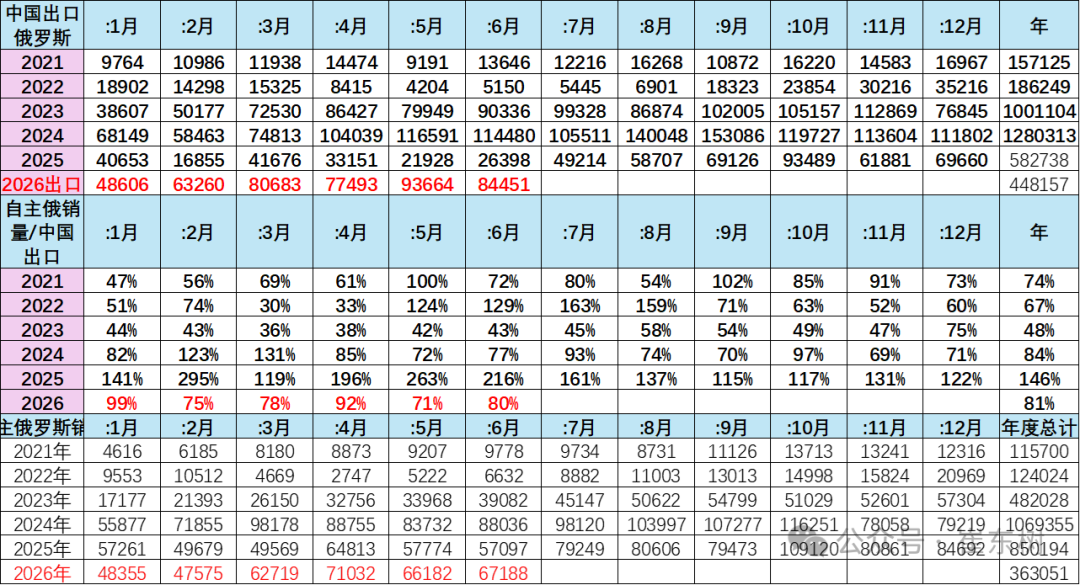
In 2021, Chinese car companies sold only 157,000 vehicles in Russia, and by 2024, 1.28 million vehicles, an increase of 1.12 million units. Strong exports from Chinese car companies are closely linked to gaps and opportunities in the Russian market.
In 2025, China exported 583,000 vehicles to Russia, and its own brand sold 85,000 vehicles. Local sales were 146% of China's exports, and finally achieved a sharp trend of inventory removal.
In June 2026, China exported 84,400 vehicles to Russia, and its own brand sold 67,000 units. The local sales volume was 80% of China's exports; in January-June, China exported 448,000 vehicles to Russia, and its own brand sold 360,000 units. Local sales were 81% of China's exports, which is generally relatively balanced.
II. Russian Market Structure
1. Market share trends in Russia
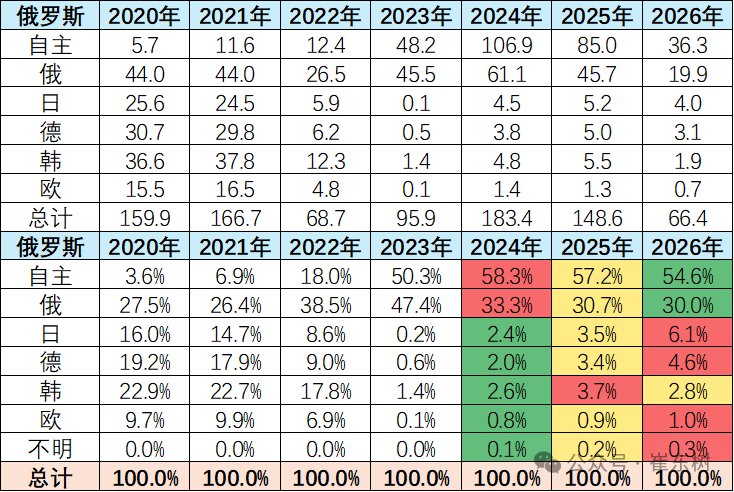
Before the Russian-Ukrainian conflict, the Russian automobile market was occupied by foreign investors for a long time, and the pattern was quite scattered. The main competitors in the Russian car market are European car companies, and Korean cars are relatively better than Japanese cars. The performance of Chinese autonomous car companies is relatively weak, with a share of less than 10%.
However, after 2022, many foreign car companies temporarily withdrew and agreed to sell shares to the Russian side. As a result, these joint ventures and foreign car companies switched to the concept of local Russian car companies, so the share of local Russian car companies quickly increased to around 40% in 2023. At the same time, autonomous car companies have seized the opportunity to quickly fill the gap in the high-end market where European and American car companies have left, reaching a high of 58.3% in 2024.
In 2026, the share of Chinese independent brands in Russia reached a high level of 54.6%, and the benefits were good. In 2026, a large number of models from international car companies will enter. German and Japanese companies will perform well, and the advantages of Korean cars will weaken.
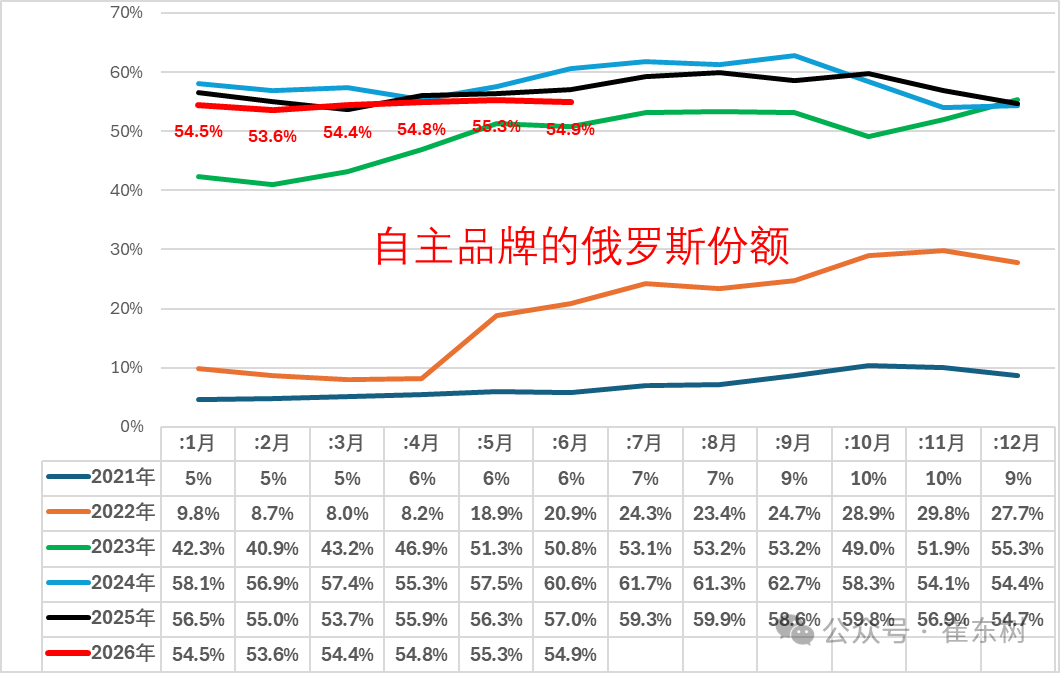
After the Russian-Ukrainian conflict, international car companies successively withdrew from the Russian market due to sanctions and material shortages. Chinese car companies have gradually risen in the Russian market in early 2021, but their share is around 5%; in 2023, Chinese autonomous car companies captured the relatively strong demand in the Russian domestic market and achieved a share of more than 50%; in 2024, the monthly share of independent brands in Russia broke through 60% in the second half of the year, achieving strong growth in Chinese car companies; in 2025, Russia's share of Chinese autonomous car companies rebounded to 57%; in June 2026, the share of autonomous car companies in Russia was still 54.9%, peaking at the peak in 2026 level.
2. Analysis of the structure of demand for new energy in Russia
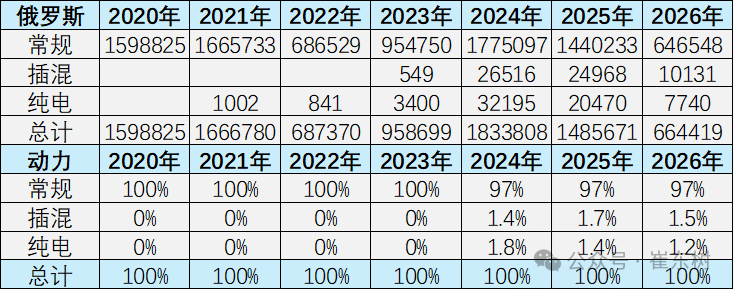
New energy sales in the Russian car market are relatively low. Since European, American, Japanese, and South Korean car companies are relatively poor in new energy, there were very few new energy sources in Russia before 2023. However, with the entry of Chinese car companies, new energy became the favorite of Russia's rich. Pure electric performance was excellent. Later, Ideal and other models sold well in Russia, bringing the characteristics of plug-in hybrid sales higher than pure electric ones in Russia since 2025. The Russian market improved in 2026, and showed that new energy sources resumed high growth in June.
III. Trends in Russian brand structure
1. The trend of major brands in Russia in 2026
Russian automobile imports currently have three methods: natural person imports, corporate batch imports, and corporate parallel imports. Parallel import policy adjustments benefit the official exports of Chinese car companies, and scrapping tax policy adjustments block the gray channel of low tariffs in neighboring countries. In terms of scrap tax, this year Russia stipulated that if cars are imported from the Eurasian Economic Union (EAEU) countries, the customs fees saved must be paid in Russia in addition to the “scrap tax”, blocking the gray channel of low tariffs in neighboring countries.
Parallel import or individual import routes are also gradually being tightened. Starting at the end of 2025, models with more than 160 horsepower will no longer be subject to the low personal import rate (originally about 3,400 rubles), but will have to pay the full commercial tax rate, which can reach 750,000 to 1 million rubles or more. The “power-linked” algorithm introduced in 2026 and the “full compensation” customs clearance formula for transit to Central Asia (such as Kyrgyzstan) have further reduced the space for grey trade channels. The sale of Chinese cars in Russia is suitable for mass import by legal entities. Russia prohibits Chinese cars from going through parallel import channels. In fact, it avoids low price competition from unauthorized dealers, which is beneficial to the official export sales of Chinese car companies. The ideal is to start an official distribution model in Russia soon.
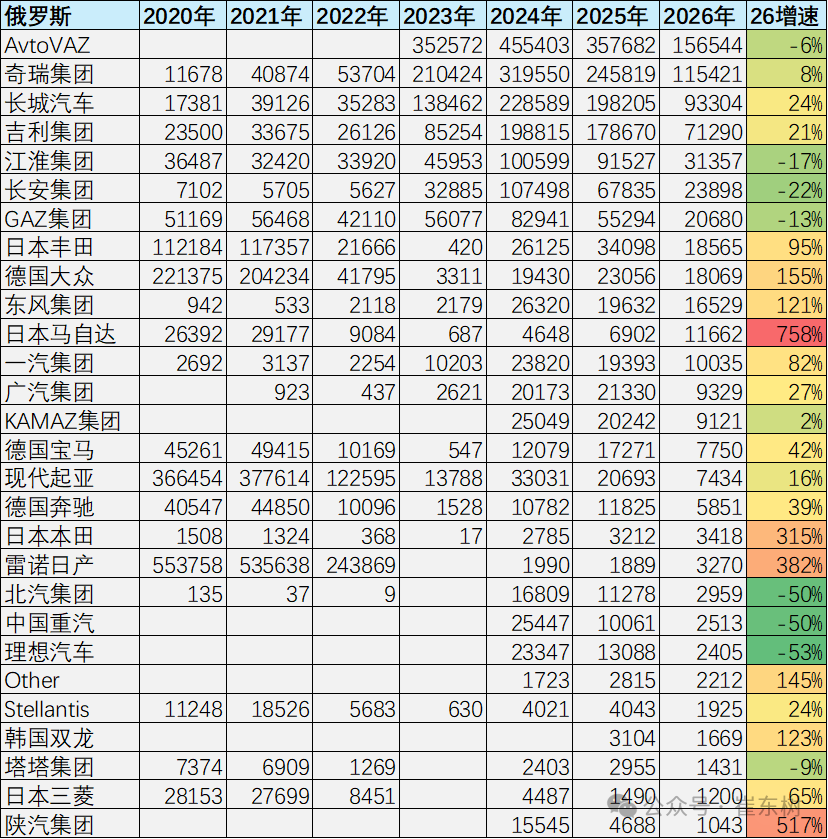
The overall sales volume of international car brands in Russia remains relatively high, and the performance of Japanese brands is relatively strong, especially Mazda and Toyota. The average monthly sales performance of BMW and Mercedes-Benz in 2026 is relatively good, while the performance of other international car companies also has specific sales requirements.
2. The trend of independent brands in Russia
Due to weak technology and product strength, Russian cars are mainly concentrated in the low-end market where the price segment is lower. The first sales champion in the Russian car market was Lada. The best seller was mainly due to its low price and policy protection, which met the needs of Russians for cars.
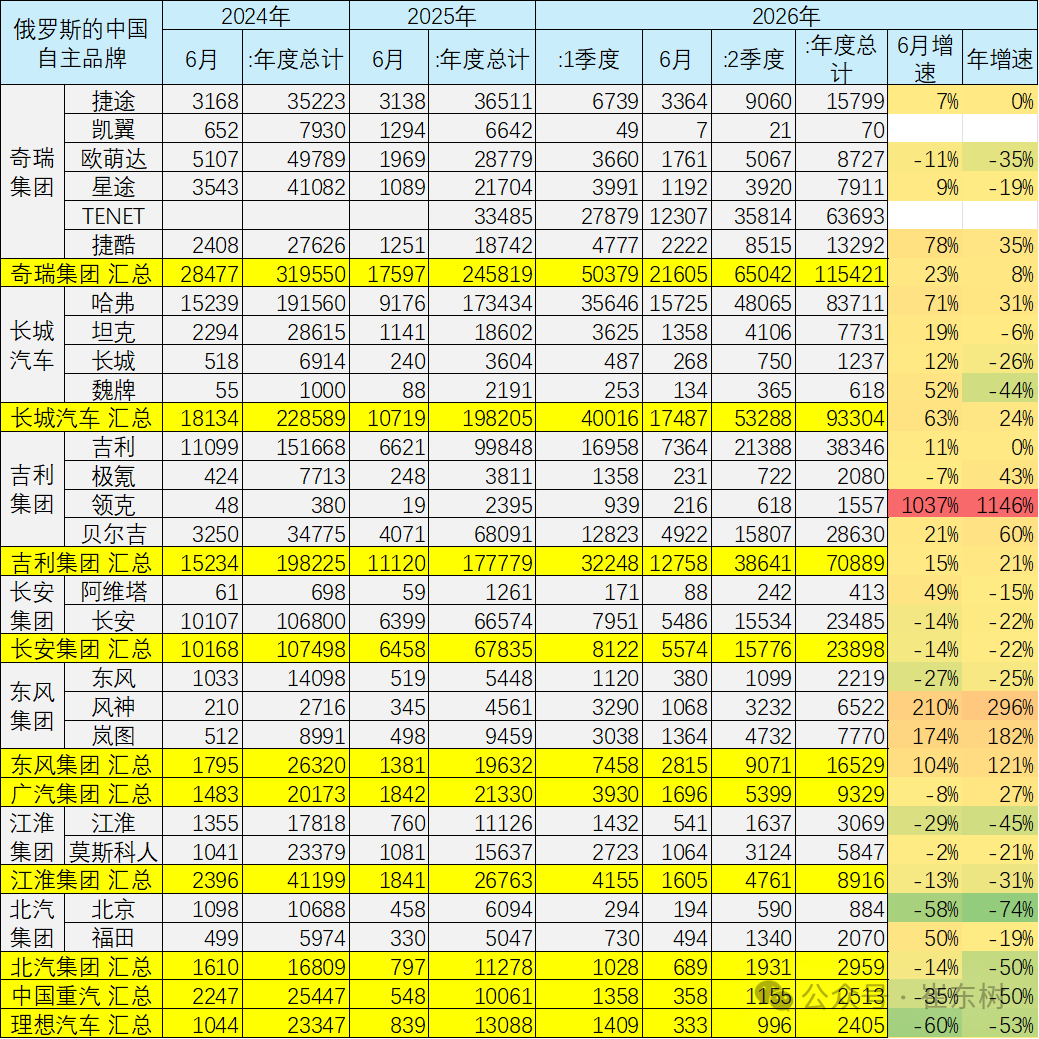
Relying on strong technological improvements and industrial chain advantages, Chinese autonomous car companies are characterized by relatively strong performance in Russia. Chery maintained an average monthly sales volume of nearly 20,000 units in 2026. In particular, Chery has achieved a good trend of localized production, OEM production, and comprehensive development of imported car portfolios in Russia with multiple brands, and has also achieved the trend of joint development of many children and good fights. Geely's performance in Russia has also achieved strong growth. Localized OEM products and imported models have performed relatively well. In particular, the performance of products such as Extreme Krypton is also relatively excellent. Other Chinese car companies are also strong, and the performance of products such as BAIC in Russia is also relatively strong.
3. The overall performance of Russian new energy vehicles is good
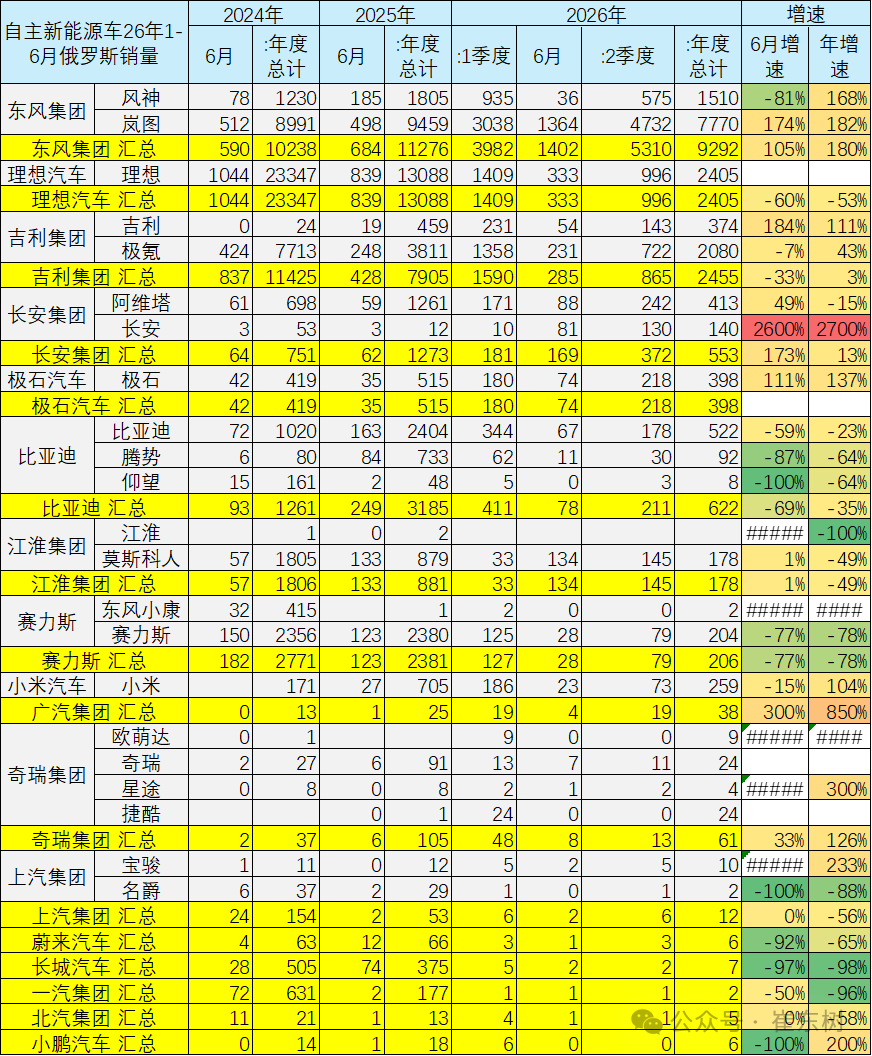
Chinese car brands occupy the middle and high-end market in Russia. Chinese car companies have significant advantages in technology and products. Combined with factors such as tariffs, transportation costs, and dealer sharing, Chinese brand models are more expensive in Russia than domestic ones. Recently, Russia included high-end fuel vehicles and electric vehicles made in China (including the luxury car tax list, covering models with a price of 10 million rubles or more).
The overall performance of China's autonomous NEV sales in the Russian car market is good. In particular, high-end models such as extenders and plug-in hybrids in the narrow sense have achieved good performance in replacing European and American luxury cars.
Among new energy vehicles, brands such as Changan, Jikrypton, and Rantu have outstanding performance. These brands have relatively strong characteristics. However, in the world, brands such as BYD and Xiaomi have also had a certain sales performance.
However, the latest products, such as Xiaomi, and high-end models with the most intelligent connectivity, also performed well.