


The Zhitong Finance App learned that Cui Dongshu, Secretary General of the Passenger Transport Association, said that in June 2026, the overall performance of the NEV market was weak. Among them, the trend of plug-in hybrid models continued to be sluggish, while ordinary oil-electric hybrid models achieved contrarian growth, becoming the core highlight of the market segment. Looking at the subregions, traditional fuel vehicles still maintain high market demand in the midwest and northern regions, and the fuel vehicle market share remains around 50%; while in the Eastern Plains region, southern provinces and cities, and first-tier developed cities, the NEV market share has reached more than 60%, and the characteristics of regional power structure differentiation are remarkable.
Cui Dongshu pointed out that the structural decline in the domestic car market and the beginning of differentiation in regional consumption policies are profoundly reshaping the development pattern of the domestic passenger car regional market. In an environment where the country's “two new” policies drive domestic demand and consumption of passenger cars and the impact of high oil prices, the national passenger car retail market showed a special trend of fragmented growth under the contraction of low-end consumption and the upgrading of passive consumption in the first half of 2026.
The operation of local car markets showed four core characteristics: first, the subsidy policy had a significant driving effect on high-end consumption. The economy car market continued to be sluggish, and the total number of regions with the greatest consumption potential in the central and western regions declined the most; second, regional consumption growth differentiation intensified under high oil prices. The growth potential of the northern region was impressive but the current market performance was weak, and the East China and South China markets improved markedly; third, the trend of oil-electric hybrid models became the main growth force in some regional markets, and the trend of plug-in hybrid models was significantly sluggish; fourth, the trend of plug-in hybrid models was significantly sluggish; 4. The large space three-row seat model performed relatively well. The growth in the large SUV market in Beijing, Shanghai, Guangdong and other provinces and cities is particularly prominent.
1. Analysis of regional market trends and characteristics
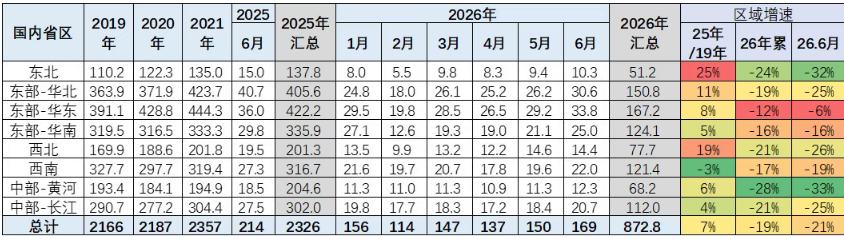
Since some corporate retail sales are difficult to split into regions, there is a slight difference between total regional volume and overall retail sales. The growth of the car market in recent years is characterized by a new pattern of “strong North strong South weak” pattern. The northern market at the beginning of 2026 was particularly poor. The Southern Auto Market was relatively poor. In particular, East China and South China performed relatively well, indicating that the overall auto market showed a good growth situation.

Judging from the development trajectory of the regional car market in recent years, the pattern of “strong in the north weak in the south” has basically been established. Compared with 2023, the market share of the northern region increased by 1 percentage point in 2025. Among them, the Northeast and Northwest car markets showed a particularly remarkable growth trend, driving the western car market to exceed expectations.
However, this pattern gradually changed in early 2026: in June 2026, the market share of the northern car market decreased by 2 percentage points compared to the same period last year; the southern and eastern coastal car markets performed relatively strongly in a single month. Judging from a full-year perspective, local financial subsidies in the southern region were stronger and implementation efficiency was higher, which became the core driving factor for the growth of the local car market. From January to June 2026, due to the adjustment of local subsidy policies, changes in the regional car market structure became more complicated. There is little potential for consumption upgrades, the market continues to shrink, and the share of the northern and central western regions needs to be improved in the future.
2. Analysis of policy impetus to regional structures

Judging from the passenger car sales growth performance in various provinces in June 2026, the car markets in Shanghai, Tianjin, Xinjiang and other provinces performed relatively well year over year, while the market performance in central provinces such as Tianjin, Ningxia, Shanxi, and Henan was weak. In 2025, economically developed provinces and cities and the northern core region became the core highlights of the growth of the national car market, and in 2026, some northern provinces that benefited greatly from trade-in declined significantly.
The northern car market has long-term growth potential. Currently, due to declining revenue, there is a lot of pressure to increase car purchase costs. The core driving factors come from two aspects: first, with the aging population, shrinking the scale of the construction industry, and the high-end transformation of the export industry, there is a marked trend of population return from the north, driving the expansion of the local consumption base; second, group consumption performance within the system has remained steady, which continues to drive car purchase consumption in the northern region. The main inhibited factor for you is still the effect of K-type differentiation.
3. Analysis of changes in the market structure of major car body categories

The body structure of domestic passenger car consumption showed a marked differentiation trend. The SUV category maintained a good growth trend, and regional performance differences were obvious. The growth of the SUV market is mainly concentrated in the central and western regions. The performance of the eastern region is relatively weak. Among them, demand for SUVs is particularly strong in the northwest and southwest regions. This characteristic is highly related to regional topography. The central and western regions are dominated by mountainous and hilly terrain, which require higher vehicle passability. Combined with the outstanding power performance advantages of new energy SUVs, they have jointly promoted the strong performance of the local SUV market.
The car market, on the other hand, showed very different regional characteristics. Since 2024, subsidies related to new energy have been strengthened under the country's “two new” policies, driving a phased recovery in the entry-level car market. In provinces such as Shandong, Henan, and Hebei in the North China Plain region, the pure electric car market is more mature. Mid-range and low-end car products have become the main force in the local market, driving the continuous deepening of the popularization process of private cars. In the future, it is expected that policies will continue to encourage the popularization of automobiles and that the car market will improve.
4. New energy power structure analysis

In June 2026, the overall performance of the NEV market was weak. Among them, the trend of plug-in hybrid models continued to be sluggish, while ordinary oil-electric hybrid models achieved contrarian growth, becoming the core highlight of the market segment.
Looking at the subregions, traditional fuel vehicles still maintain high market demand in the midwest and northern regions, and the fuel vehicle market share remains around 50%; while in the Eastern Plains region, southern provinces and cities, and first-tier developed cities, the NEV market share has reached more than 60%, and the characteristics of regional power structure differentiation are remarkable.
In addition, there are clear seasonal differences in consumer demand. The NEV market performance was relatively weak at the beginning of the year. Combined with the 2026 vehicle purchase tax exemption policy adjustments, the NEV market faced heavy phased growth pressure at the beginning of the year, and the pure electric market improved in March-June under high oil prices.
5. Analysis of changes in model grade structure

Judging from policy effects, state subsidies have the most direct driving effect on the consumption of mid-range and low-end models, and policy orientation that simply promotes high-end development is difficult to form a long-term sustainable growth engine. The return of consumption to rationality is still the core main line of industry development.

The 2026 “two new” subsidy policy has had a significant driving effect on high-end models, while subsidies for economical models have been drastically reduced, directly leading to the market share of economy models being only 16%, which is at an historically low level. At the same time, as the country's end-of-life, renewal and trade-in subsidy policies continues to advance, superimposed residents' income shows K-type differentiation. The purchasing power of low-end consumer groups has declined markedly, and demand for car purchases continues to weaken, further exacerbating structural differentiation at the model level.
6. Analysis of changes in the car market brand structure

Judging from the regional distribution of the brand pattern, first-tier cities such as Shanghai and Beijing have a steady high share of the luxury car market, and the share of luxury cars in Beijing, Shanghai, Zhejiang, and Jiangsu is already higher than that of mainstream joint venture brands. However, in the vast majority of provincial and municipal markets across the country, independent brands already account for two-thirds of the market share.
At the beginning of 2026, the growth pace of the own-brand market slowed down. This characteristic fully reflected the adjustment of vehicle purchase tax policies, which had a significant phased impact on the performance of the own-brand market. However, in June, the share of independent brands achieved a year-on-year recovery, showing that under high oil prices, the advantages of new energy sources are obvious, the share of the luxury car market has declined significantly, joint venture brands have declined sharply, and independent brands have recovered and strengthened.