


Why Republic Bancorp’s latest earnings matter for investors
Republic Bancorp (RBCA.A) is back in focus after its second quarter earnings on July 24, 2026, reporting net interest income of US$81.7 million and net income of US$32.87 million for the period.
The report also outlined six-month figures to June 30, 2026, along with recent leadership changes inside the Republic Processing Group, giving investors fresh information to reassess the stock’s recent share price performance.
See our latest analysis for Republic Bancorp.
Republic Bancorp’s recent second quarter report appears to have aligned with market expectations, with the share price up 1.12% on the day and a 30.49% share price return over the past 90 days pointing to building momentum. Over the longer term, total shareholder return of 51.20% over one year and 130.18% over three years suggests investors who stayed the course have been well rewarded. This comes as leadership changes within the Republic Processing Group add a new layer of interest to the story.
If Republic Bancorp’s move has you thinking about what else is working in the market, this could be a good moment to broaden your search with 18 top founder-led companies
Republic Bancorp’s mix of traditional banking and fee based processing looks solid, and the recent share price jump reflects that optimism. The next step is to ask whether that strength is already fully reflected in today’s valuation.
Price-to-Earnings of 15.3x: Is it justified for Republic Bancorp?
Republic Bancorp currently trades on a P/E of 15.3x, which sits above several reference points and suggests investors are paying a premium for its earnings.
The P/E ratio compares the company’s share price to its earnings per share. For a bank like Republic Bancorp, it is a simple way to see how much the market is willing to pay for each dollar of current profit. A higher P/E can sometimes reflect confidence that earnings will continue to grow, but it can also indicate that expectations are already built into the price.
In Republic Bancorp’s case, the 15.3x P/E is below the wider US market level of 19.2x. However, it is above the US Banks industry average of 11.9x and above the peer average of 12.7x. It is also above the estimated fair P/E of 11.4x that the SWS fair ratio suggests the stock could trend toward over time. Taken together, these reference points indicate a stock that is priced more richly than many banking peers, with the fair ratio pointing to a lower level the market might eventually move toward if sentiment cools.
Explore the SWS fair ratio for Republic Bancorp
Result: Price-to-Earnings of 15.3x (OVERVALUED)
However, investors should watch for shifts in Republic Bancorp’s processing segments, as well as any changes in analyst targets that could challenge the recent share price strength.
Find out about the key risks to this Republic Bancorp narrative.
Another view of Republic Bancorp’s value
Price can look expensive on a simple P/E check, yet our DCF model points to a fair value of about $96.41 per share compared with Republic Bancorp’s recent $99.54 price. That suggests the stock is modestly overvalued on this measure. Which signal should you pay more attention to?
For a closer look at the cash flow assumptions behind that estimate, including how sensitive the outcome is to small changes in inputs, Look into how the SWS DCF model arrives at its fair value.
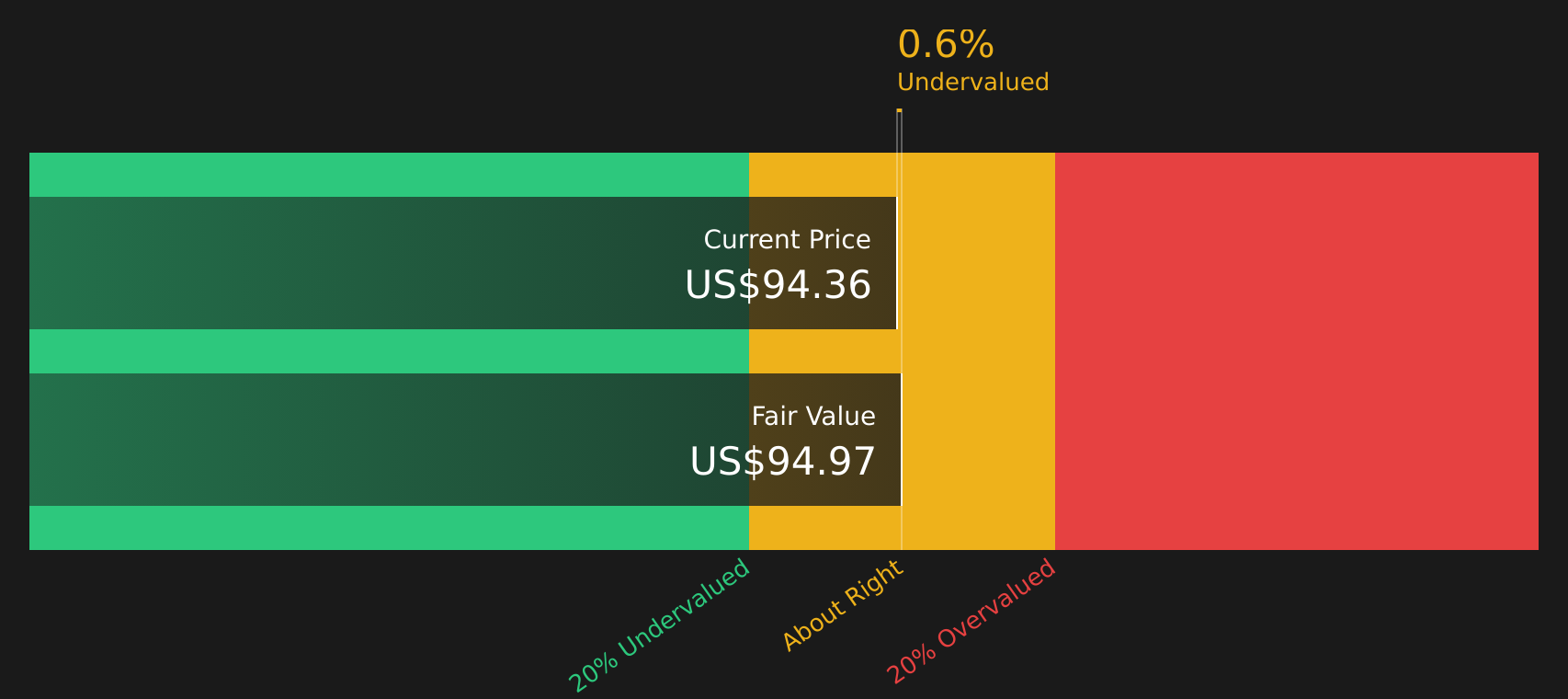
Simply Wall St performs a discounted cash flow (DCF) on every stock in the world every day (check out Republic Bancorp for example). We show the entire calculation in full. You can track the result in your watchlist or portfolio and be alerted when this changes, or use our stock screener to discover 55 high quality undervalued stocks. If you save a screener we even alert you when new companies match - so you never miss a potential opportunity.
Next Steps
If this mixed picture around Republic Bancorp leaves you curious, now is a good time to review the details and form your own stance using the 3 key rewards and 1 important warning sign
Looking for more Republic Bancorp investment ideas?
If Republic Bancorp has sharpened your focus, do not stop there. The right watchlist can shape your next move. Treat these curated stock ideas as essential research.
- Target potential mispricings by checking companies that appear underappreciated on key fundamentals with the 55 high quality undervalued stocks.
- Strengthen your income toolkit by reviewing companies that offer higher yields and focus on consistent shareholder payouts through the 9 dividend fortresses.
- Prioritize resilience by scanning companies with supportive balance sheets and healthy financial profiles using the solid balance sheet and fundamentals stocks screener (45 results).
This article by Simply Wall St is general in nature. We provide commentary based on historical data and analyst forecasts only using an unbiased methodology and our articles are not intended to be financial advice. It does not constitute a recommendation to buy or sell any stock, and does not take account of your objectives, or your financial situation. We aim to bring you long-term focused analysis driven by fundamental data. Note that our analysis may not factor in the latest price-sensitive company announcements or qualitative material. Simply Wall St has no position in any stocks mentioned.
Have feedback on this article? Concerned about the content? Get in touch with us directly. Alternatively, email editorial-team@simplywallst.com