


The Zhitong Finance App learned that CITIC Construction Investment released a research report saying that with 2026Q2, the capital expenditure of leading North American cloud vendors continues to rise high. The total capital expenditure guidelines for the four North American cloud vendors in 2026 are about US$720 billion to US$745 billion, reflecting that North American cloud vendors are still expanding around AI infrastructure.
Looking at it now, the AI computing power industry chain is still booming, but the market has recently undergone significant adjustments, and there is a situation where there is a sharp decline. Future suggestions to continue to pay attention: first, the big model ARR, especially the growth of ARR in the coding scenario. After all, the big model in North America has recently been reduced in price. If ARR growth hits a bottleneck in the short term, it may affect the market's expectations for future computing power demand; second, the implementation and development of the big model in other application scenarios other than coding; third, the price trend of the computing power inflation chain for some time; and fourth, the financing situation and market trends in various parts of the AI industry chain.
Furthermore, in view of the heavy holdings of the AI industry chain in the second quarter, the market recently adjusted, showing signs of being high or low. It is recommended to focus on undervalued and high dividend targets.
CITIC Construction Investment's main views are as follows:
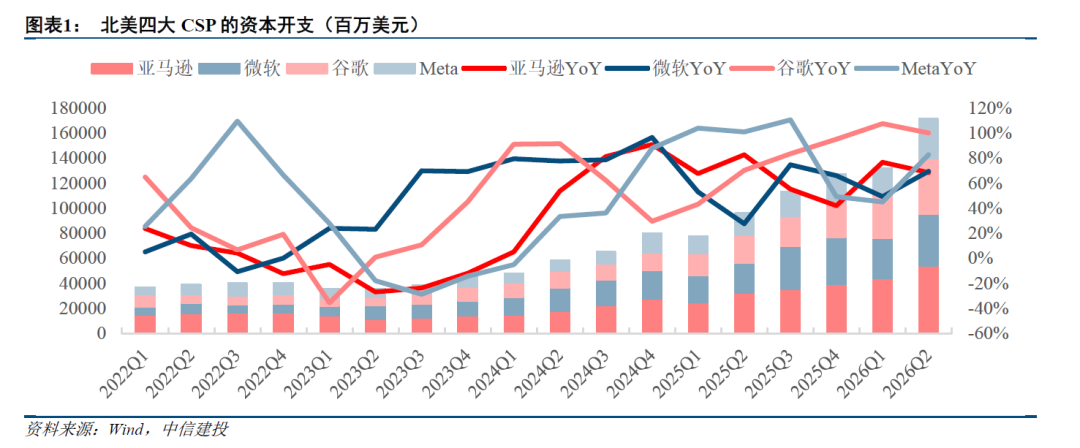
In the second quarter of 2026, capital expenditure of leading North American cloud vendors continued to rise. The capital expenditure of AWS, Microsoft (MSFT.US), Google (GOOGL.US), and Meta in a single quarter was approximately US$54.2 billion, US$41 billion, US$44.9 billion, and US$31.1 billion respectively, totaling US$171.2 billion, which maintained a relatively rapid growth trend from month to month.
Looking at the full year, Amazon's total capital expenditure guideline is about 220 billion US dollars, which is a further increase from the previous plan of about 200 billion US dollars. Microsoft is about 175 billion US dollars, which is the natural year 2026. The disclosure scale was adjusted due to the conversion of some data center leases from financial leases to operating leases. Alphabet's capital expenditure was between US$195 billion and US$205 billion, with a median value of US$200 billion. Meta's capital expenditure is approximately US$130 billion to US$145 billion, with a median value of US$137.5 billion, including repayment of financial lease principal. For the whole of 2026, the capital expenditure guidelines for the four North American cloud vendors totaled about US$720 billion to US$745 billion, a significant increase from the median value of US$710.5 billion in the first quarter. This shows that North American cloud vendors continue to expand around AI servers, GPU clusters, data centers, power and network infrastructure, and AI infrastructure construction is still in full swing.
In the second quarter of 2026, the cloud and AI-related business revenue of leading North American cloud vendors continued to grow at a high rate. AWS, Microsoft Intelligent Cloud, and Google Cloud achieved revenue of 42.2 billion US dollars, 39.3 billion US dollars, and 24.8 billion US dollars respectively, up about 37%, 32%, and 82% year over year, respectively. The total revenue of the three was about 106.3 billion US dollars, up about 43% year on year and 15% month on month. Among them, the growth rate of AWS hit a new high of nearly 18 quarters, and its AI business annualized revenue has exceeded 25 billion US dollars and maintained three-digit growth; Microsoft's broader Microsoft Cloud revenue reached 59.3 billion US dollars, up 27% year on year, and revenue from Azure and other cloud services increased 43%; Google Cloud was driven by the combined sales of GCP, AI solutions, AI infrastructure and TPU systems, and the revenue growth rate accelerated markedly. Meta's total revenue for the second quarter was US$60.8 billion, up 28% year on year, of which advertising revenue was US$59.4 billion, up 27% year on year, indicating that its AI investment at this stage is mainly achieved indirect monetization through improved recommendation algorithms, advertising efficiency, and user interaction. Overall, the AI revenue growth of North American cloud vendors is gradually expanding from computing power leasing to model services, enterprise AI applications, and improving advertising efficiency. The high revenue growth rate provides fundamental support for continued expansion of capital expenditure.
Looking at it now, the AI computing power industry chain is still booming, but the market has recently undergone significant adjustments, and there is a situation where there is a sharp decline. Future suggestions to continue to pay attention: first, the big model ARR, especially the growth of ARR in the coding scenario. After all, the big model in North America has recently been reduced in price. If ARR growth hits a bottleneck in the short term, it may affect the market's expectations for future computing power demand; second, the implementation and development of the big model in other application scenarios other than coding; third, the price trend of the computing power inflation chain for some time; and fourth, the financing situation and market trends in various parts of the AI industry chain.
Furthermore, in view of the heavy holdings of the AI industry chain in the second quarter, the market recently adjusted, showing signs of being high or low. It is recommended to focus on undervalued and high dividend targets.
Risk Alerts
Changes in the international environment have an impact on the security and stability of the supply chain, affecting the progress of related companies' overseas expansion; the impact of tariffs exceeded expectations; the development of the artificial intelligence industry fell short of expectations, affecting the needs of companies related to the cloud computing industry chain; market competition intensified, leading to a rapid decline in gross margin; exchange rate fluctuations affected the exchange earnings and gross profit margin of export-oriented enterprises, including enterprises in the ICT equipment, optical module/optical device sector; the digital economy and digital China's construction fell short of expectations; telecom operators' cloud computing business development fell short of expectations; operators' capital expenses fell short of expectations; cloud manufacturers' capital expenses fell short of expectations Unexpected; communication module and intelligent controller industry demand fell short of expectations.