


The Zhitong Finance App learned that the results and future outlook announced by chip manufacturing supergiant Ansemi Semiconductor (ON.US) for the automotive and industrial sector after the US stock market on Monday (that is, Tuesday morning Beijing time) showed that the third-quarter revenue outlook range given by the company was higher than Wall Street analysts' unanimous expectations, highlighting the complete explosion of the company's AI data center “power engine” business — that is, a surge in demand for power management chips used in AI data centers, driving the company's stock price to soar by more than 7% in the US stock after-market trading. Under the AI infrastructure frenzy, the company's performance for the second quarter ended July 3 was equally strong. In particular, PSG, the power solutions business unit covering automotive, industrial and AI data center businesses, achieved the strongest growth trend.
Since this year, Ansemi Semiconductor's stock price has shown a sharp rise in anticipation of a strong recovery in demand for analog chips/data center power chain-related chips driven by an unprecedented wave of AI data center construction. Although the company's stock price has adjusted since July following the clearance of global AI computing power theme deleveraging and extremely congested positions, the increase since 2026 is still as high as 50%. In comparison, the chip giant's stock price fell by as much as 15% for the full year in 2025.
The chip demand frenzy brought about by AI is spilling from the “computing power chip body (GPU/ASIC/HBM)” to the broader “data center power and signal chain,” and the spillover intensity has accelerated significantly, further verifying the so-called “power at the end of AI” logic relating to the bull market curve of the data center power chain. Under the AI wave, demand for what can be described as “endless” chip demand brought about by AI training/inference is being smoothly transferred from AI chips and memory chips to the analog chip side and power semiconductor side, thereby strongly driving the performance of analog chip leaders such as Texas Instruments, Infineon, and Ansemi Semiconductors to a strong recovery trajectory. The market also interprets these strong performance data as “the simulation chain is beginning to reap the super dividends of AI infrastructure.”
The $7 billion merger and acquisition combined with AI data centers ignited demand for power chips, and Ansemi began a new cycle of growth
As Ansemi Semiconductor announced strong performance and future prospects, the company is also striving to acquire Synaptics, a subsidiary of EDA chip design software supergiant Synopsys on an all-stock basis announced in June, to fully grasp the growing demand in the field of artificial intelligence equipment and robotics.
Ansemi Semiconductor management expects third-quarter revenue to be between $1.65 billion and $1.75 billion. According to data compiled by LSEG, the median expected range is higher than Wall Street analysts' average forecast of $1.67 billion.
Hassane El-Khoury, CEO of Ansemi, said in a performance statement: “The AI data center related business is still our fastest growing segment. We currently expect the business to at least double its revenue in 2026, which reflects the strength of our smart power product portfolio and the growing adoption of Ansemi by customers throughout the power tree architecture.”
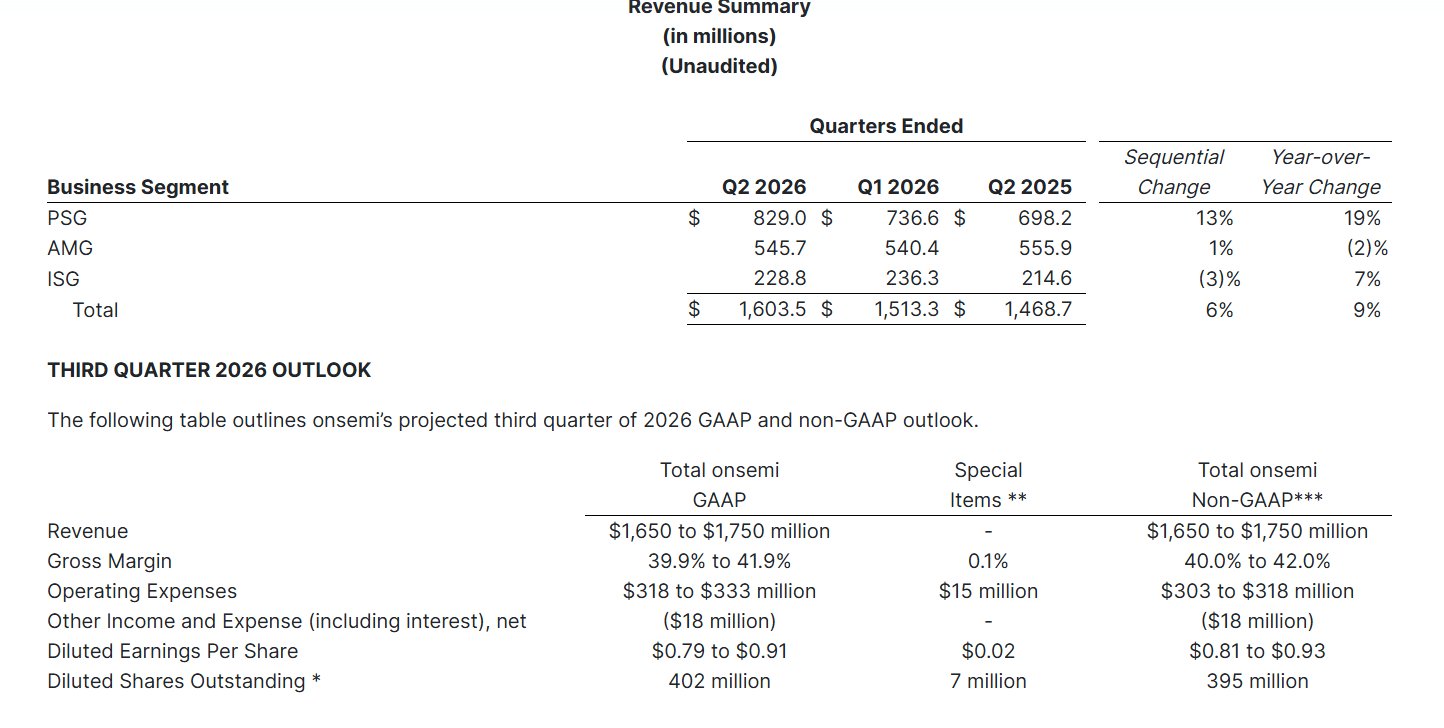
The company's revenue for the second quarter ended July 3 was $1.6 billion, up 9.2% year over year, slightly exceeding Wall Street analysts' unanimous expectations of about $1.59 billion. The company's adjusted earnings per share were $0.74, up about 40% year over year, above market expectations of $0.71.
The company's management expects the third-quarter adjusted earnings range of $0.81 to $0.93 per share, which is significantly higher than Wall Street analysts' unanimous expectations of about $0.83.
Ansemi is also continuing to advance its “Fab Right” strategy to significantly reduce costs and improve operational efficiency. In July, the company sold two manufacturing plants as part of this strategy.
In terms of other second-quarter results data, Onsemi's GAAP gross margin increased from 37.6% to 38.4%, non-GAAP gross margin to 39.3%; GAAP operating margin increased from 13.2% to 16.1%, and non-GAAP operating margin increased from 17.3% to 20.8%. Net profit attributable to mother increased from US$170.3 million to US$226.8 million, a significant year-on-year increase of 33.2%, while GAAP EPS rose from $0.41 to $0.56, an increase of 36.6%.
The company's operating cash flow data for July 3 increased by 149.4% year-on-year to US$459.7 million. Free cash flow increased wildly from US$106.1 million to US$425.4 million, about four times the same period last year. The free cash flow rate rose from about 7% to 27%; the company repurchased US$332 million of shares during the quarter. In other words, although revenue increased by only about 9%, profit, cash flow data, and shareholder returns expanded several times faster, indicating that Ansemi Semiconductors' Fab Right production capacity optimization, cost discipline, and product portfolio upgrades have begun to form real operating leverage.
Segment data further proves that growth is clearly being concentrated in the data center power semiconductor business. The PSG division's revenue of the power solutions business reached US$829 million, up 18.7% year on year and 13% month on month. The proportion of total revenue rose from 47.5% to 51.7% in the same period last year, becoming the source of more than half of the company's revenue; AMG's revenue for the analog and mixed signal business was approximately US$545.7 million, down 1.8% year on year; Intelligent Sensing Group ISG's revenue was US$228.8 million, up 6.6% year on year.
Ansemi's total revenue for the first half of the year was US$3.116.8 billion, up 6.9% year on year. After adjustment, EPS increased from US$1.08 to US$1.38, or 27.8% year on year, and free cash flow was US$642.6 million, up 14.6% year on year. The semi-annual results and segmental performance data together show that Ansemi has not experienced simultaneous prosperity in all of its businesses. Instead, PSG is being spearheaded by the demand for AI data centers, high-voltage power supplies, and electrification of some vehicles. AMG is still in a relatively moderate recovery phase.
The “chip demand frenzy” set off by the AI infrastructure frenzy spread from AI chips and memory chips to analog chips and power semiconductors
Ansemi's strong performance shows that demand for AI chips is being systematically spilled from GPUs, ASICs, and HBM units to power semiconductors, analog control, and monitoring signal chains; this is not a simple “AI concept” for analog chip companies, but rather a physical demand inevitably brought about by increased computing power density.
Ansemi has defined the AI data center business as the fastest-growing sector and expects related revenue to more than double in 2026; Texas Instruments data center business revenue increased by about 90% year-on-year in the first quarter of 2026, and growth continued to be led by industry, data centers, and automobiles; Infineon joined the Nvidia MGX ecosystem to provide a complete solution for converting from high voltage to GPU core power supply around 800V DC power supply, driving a huge increase in performance data for the first half of the year. As a result, the benefits of AI capital expenditure are expanding from a few advanced process chips to a large number of data center power chain basic simulation devices with relatively low unit price, large numbers, long life cycles, and reliability certification.
In the field of analog/power chips and power semiconductors/discrete devices, the underlying core logic of achieving strong demand expansion following the unprecedented wave of AI is that AI racks are jumping from tens of kilowatts of traditional servers to over 100 kilowatts, and evolving to 600 kilowatts or even 1 megawatt, that is, the power consumption of a single next-generation GPU/TPU/ASIC may reach 2-4 kilowatts. This is why traditional 48V/54V architectures will generate thousands of amperes of current, and copper loss, heat generation, and bus volume will rise rapidly. Yasumori Miyo ±400V or 800V DC architectures jointly promoted by Nvidia.
Before electricity enters the GPU from the power grid, it must go through AC/DC rectification, PSU, BBU, high voltage distribution, 800V to 50V intermediate bus conversion, and then the multi-phase VRM reduces the voltage to less than 1V required by the GPU core; each level requires Si, SiC, or GaN power switches, gate drivers, digital controllers, power management ICs, and electronic fuses. What Ansemi, Texas Instruments, and Infineon sell are these “must for every watt” devices, so the higher the rack power and the more complex the conversion stages, the greater the value of semiconductors in a single cabinet.
In this “grid-to-GPU” power tree, Ansemi can provide EliteSiC MOSFETs/JFETs, high and low voltage silicon MOSFETs, GaN devices, hot-plug smart fuses, multi-phase controllers, power levels, and PoL regulators, so that a single AI frame requires not only more chips, but also higher unit cost, higher voltage resistance, and higher efficiency power devices. The Nvidia NVIDIA MGX platform can be described as the core strategic entry point for Ansemi's AI data center business. Ansemi has supplied power FETs, multi-phase power supplies, SiC JFET and GaN solutions for existing MGX systems, and directly serves PSUs, BBUs, and future 800V distribution board suppliers in the Nvidia and MGX ecosystem; MGX's standardized server and rack design will also make it easier for a certified power device to be replicated and adopted by many OEMs and ODMs.