The Zhitong Finance App learned that CICC released a research report saying that in July, market performance was poor. Looking at the external environment, concerns about the Fed's interest rate hike fermented for a while. Repeated US-Iran clashes and the intensification of the control game between the two sides over the Strait of Hormuz led to a short-term rebound in oil prices. In July, the Federal Reserve kept its policy interest rate unchanged, and the 10-year US bond yield rose to 4.75%, and the US dollar index fluctuated high. Internally, the cumulative increase in hot themes and congestion in June soared for a while, and liquidity expectations are quite sensitive. In the process of market adjustment, the AI circuit represented by semiconductors, electronic hardware, communication equipment, etc. generally declined. After the adjustment, capital was rebalanced with the rest of the booming industries, such as non-ferrous metals, chemicals, new energy, electricity, power grid equipment, construction machinery, pharmaceuticals, and dividends. Looking at August, the overallocated industries were basic chemicals, communications equipment, electrical equipment, machinery, and securities; the underrated industries were construction and engineering, textiles and clothing, education, light and household goods, and retail.
CICC's main views are as follows:
The index has fluctuated and consolidated since late July, and the market may enter a recovery phase after a sharp correction
The Politburo meeting was held on July 30 to maintain positive statements on macro liquidity and the stock market, and proposed a “moderately loose monetary policy” and “enhance the resilience and confidence of the capital market.” We previously believed that most of the factors that triggered the adjustment were short-term, phased, and have been fully digested. Currently, A-shares have many favorable conditions — mid-term economic reports provide fundamental support, valuations are at a low level in major global markets, medium- to long-term capital entry and stability, etc., and risks at the level of short-term liquidity are also being clarified, so there is no need to be pessimistic about the future A-share market. From a medium-term perspective, we are firmly optimistic that the A-share market will continue its volatile upward trend since 924. The CICC Strategy Team pointed out last year that the restructuring of the international order and the resonance of China's industrial innovation trends are the core driving forces driving the current round of market growth and China's asset revaluation. Currently, these two major conditions have not wavered and will continue to support China's asset performance. Since July 20, the Shanghai Composite Index has fluctuated and consolidated in key positions. Style differentiation is obvious. The dividend sector has shown relative performance. Combined with the current internal and external environment, the August market may enter a recovery phase after a sharp correction.
Recent boom performance in major industries
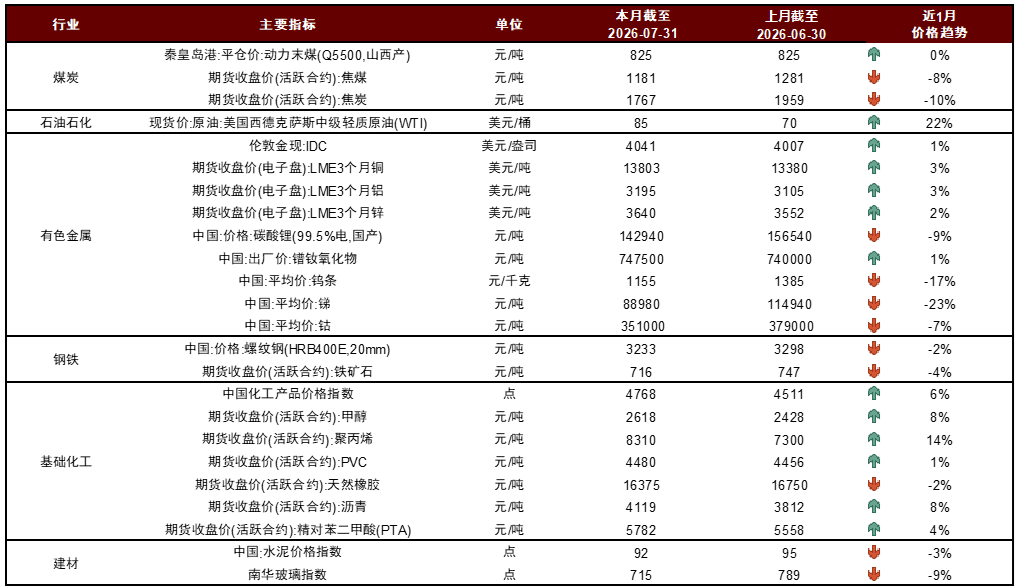
1) Energy and basic materials: Price performance differentiation of various commodities. As of the end of July, we observed differences in the price performance of the main commodities. The conflict between the US and Iran has been repeated, and the price of crude oil (up 22%) and the chemical index (+6%), which is highly correlated with it, rebounded. Influenced by factors such as strait traffic volume and crude oil inventories, high oil price fluctuations may become the norm for some time to come. The market waits on the Federal Reserve's monetary policy. Interest rates on 10-year US Treasury bonds rose to 4.75%, the prices of gold (up 1%), basic metals copper (+3%), aluminum (+3%), and zinc (+2%) rose slightly, and the prices of small metals such as tungsten bars (down 17%), antimony (-23%), and cobalt (-7%) fell. Prices of domestic real estate chain-related commodities such as coking coal (down 8%), coke (-10%), rebar (-2%), iron ore (-4%), cement price index (-3%), and Nanhua Glass Index (-9%) continued to decline.
2) Industrial products: export resilience supports demand. The current growth in external demand is stronger than domestic demand. In the first half of the year, China's exports increased 18% year on year. Among them, the “new three” exports increased 52% year on year, contributing more than 30% to export growth. In June, exports of lithium-ion batteries, electric manned vehicles, and solar cells increased 24% year on year, increased 109%, and fell 17%, respectively. In terms of machinery, domestic and foreign sales of construction machinery maintained a high growth rate. In June, domestic sales of excavators increased 20% year on year, and export sales increased 34% year on year. In terms of power equipment, due to rapid installation before May 31, 2025, the capacity of new power generation equipment dropped by 46% in the first half of the year. The decline in the capacity of new wind power and solar power generation equipment narrowed in June. Prices in all parts of the photovoltaic industry chain remained basically flat in July compared to the previous month, and demand showed marginal stabilization. In terms of automobiles, domestic sales of fuel vehicles and new energy vehicles declined by 34% and 7%, respectively, in June.
3) Consumer goods: The endogenous motivation for consumption needs to be improved. Consumption data for the second quarter did not perform well due to last year's trade-in policy, which led to a high sales base in related industries, which needed to be boosted. Entering the third quarter, the impact of the high base due to trade-in is expected to weaken marginally, and subsequent consumption performance remains to be seen. According to the sales situation of some products we have tracked, sales of washing machines, refrigerators, and air conditioners in June fell 10%, 3%, and 21% year-on-year, respectively, while food and beverage revenue and retail sales in the social zero segment increased by 1.2% and 0.9%, respectively. As of the end of July, Maotai's factory price and wholesale price had risen 0% and 5% month-on-month respectively, and the liquor industry was in the process of bottoming out. The average purchase price of pigs was 12 yuan/kg, up 9% from the previous month, and supply in the pig market was at an all-time high. From a medium- to long-term perspective, China has a large market. During the economic transition period, the contribution of consumption, especially service consumption, to economic growth has the potential to increase further. The July 30 Politburo meeting proposed “expanding high-quality supply to meet the consumer needs of different groups and tap the potential for service consumption.” On July 13, the State Council approved the “15th Five-Year Plan” to expand consumption. It is the first national-level special plan for the consumer sector. It proposes to promote high-quality and full employment, increase residents' income through multiple channels, improve social security policies, and reasonably increase public consumption.
4) Technology: AI narratives lean towards the application side. On July 9, OpenAI released the GPT-5.6 series to upgrade ChatGPT from a question-and-answer tool to an execution system. On July 30, OpenAI announced a reduction in the pricing of the two latest big models, GPT-5.6 Terra and GPT-5.6 Luna. The trend of large model price reduction is spreading globally, which is expected to promote the penetration of AI applications into industrial production, office, consumption, finance, etc. In terms of terminal demand, domestic sales of mobile phones, laptops, and computer hardware/monitor/computer peripherals declined by 14%, 3%, and 23%, respectively, in June. Semiconductors maintained their boom. Global and Chinese semiconductor sales increased 104% and 89% year-on-year in May.
5) Finance: Stock market trading activity declined in July, and the policy sent a signal to maintain stability. As of June, the insurance industry's premium income increased 3% year over year, and total assets increased 12% year over year. The average daily turnover of all A-shares in July was 2.7 trillion yuan, down 0.4 trillion yuan from the previous month. As of the end of the month, the balance of the two loans was 2.6 trillion yuan, down 0.4 trillion yuan from the previous month. The Politburo meeting on July 30 proposed “enhancing the resilience and confidence of the capital market,” and the statement on policies to stabilize the capital market is still clear.
6) Real estate: The policy environment remains stable, and supply is clear in some leading cities. On July 30, the sales area of commercial housing in large and medium-sized cities was 6.57 million square meters, up 3% year on year and down 24% month on month. In terms of housing prices, the housing sales price index for 70 large and medium-sized cities fell 4% and 6% year-on-year, respectively, in the newly built commercial housing and second-hand housing segments in June. The July Politburo meeting proposed “stabilizing the real estate market”. The CICC Real Estate team believes that the current endogenous restoration of the real estate market fundamentally stems from the supply side of leading cities, and that the probability of drastic changes in the real estate policy environment in the short term is limited. It is recommended to focus on the natural interpretation of industry fundamentals and policy developments related to expanding domestic demand at the macro level.
In terms of configuration, select the repair period
In line with the rapid market adjustment in July, we suggest starting to focus on two main lines: 1) The growth of the economy still needs to be carefully selected: the level of congestion has declined significantly after drastic adjustments in the technological style; industries with a high enough level of prosperity can achieve the effect of high molecular side growth hedging the denominator side drag. AI infrastructure-related links, such as optical communication, PCB, etc., are still uncertain this year. Companies with more fields such as semiconductors and computing power still need to pay attention to the degree of matching fundamentals and valuations. After technological growth, the market may show a differentiated trend; Multiple companies enter clinical data verification The stage is worth paying attention to from the bottom up. 2) Cycle improvement: Fundamentals in more and more fields are recovering from the bottom of the cycle. We recommend comprehensively considering the geographical situation and production capacity cycle position, and focusing on areas where performance is improving and the supply and demand pattern is improving, such as power grid equipment, petrochemicals, construction machinery, and non-bank finance industries that benefit from improving capital markets; the precious metals sector is also worth paying attention to after experiencing many adjustments. The fundamental recovery in the pure domestic demand industry is still progressing relatively slowly and requires further observation.
Overequipped industries in August: basic chemicals, communication equipment, power and electrical equipment, machinery, securities.
Low-grade industries in August: construction and engineering, textiles and clothing, education, light and household goods, retail.
Chart 1: CICC A-share industry allocation views and sub-segments
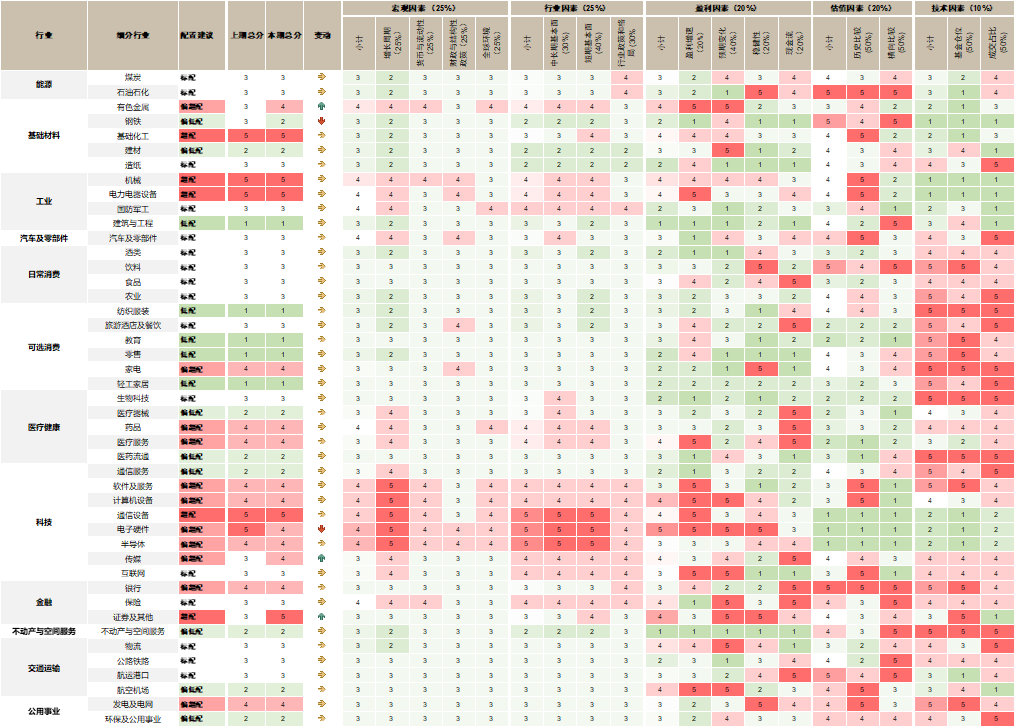
Note: Data as of July 31, 2026
Chart 2: Fundamentals of A-share segments
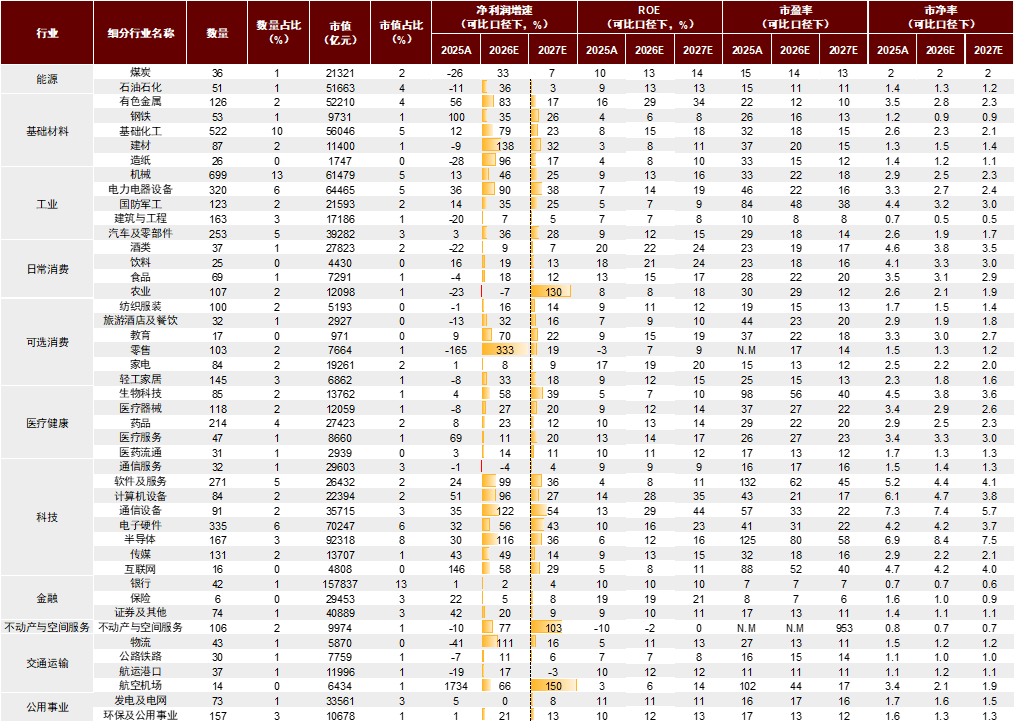
Note: Data as of July 31, 2026, using Wind's consistent expectations
Chart 3: Price performance of major energy and basic materials