


The Zhitong Finance App notes that the historic joint intervention of Japan and the US is shifting the market focus to whether the yen can rise above 1 dollar to 155 yen. Strategists believe that this mark is a key test to test whether the yen's rebound can continue.
The significance of this hurdle far exceeds general technical indicators. Japan's intervention in April and May of this year briefly pushed the dollar to around 155 against the yen, but then the exchange rate climbed again, reinforcing the market's view that the official action was simply buying time. Today, investors are evaluating whether a firm break through this hurdle means a structural shift.
As the Japanese and US governments join forces to support the yen — a strength that has been rare in decades — the risk of market bets has also increased. This was the first time since 1998 that the foreign exchange authorities of the two countries intervened to jointly buy yen, raising the yen by 5% from a nearly 40-year low of nearly 1 US dollar to 164 yen, and both governments have sent signals that they are ready to carry out further joint intervention if necessary.
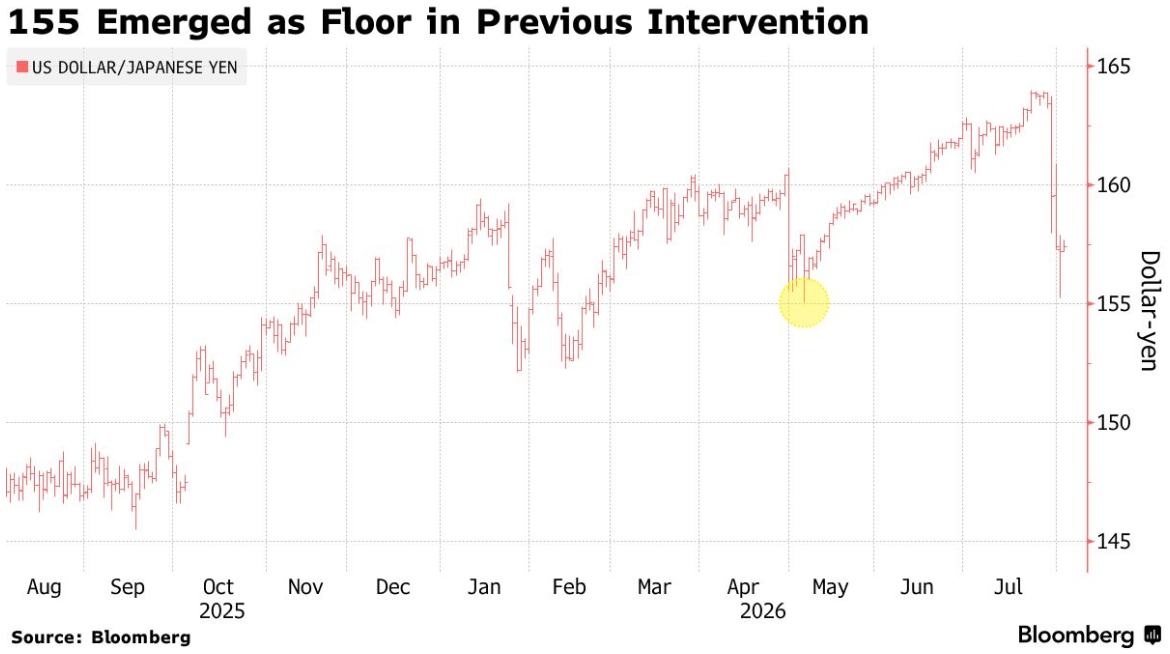 Shusuke Yamada, chief Japanese foreign exchange and interest rate strategist at Bank of America Securities, said in an interview: “This time the government is determined to actually break through the critical level of 155. If they fail to break through this hurdle, I think the market will assume that the government has exhausted its policy tools.”
Yamada pointed out that staying below 155 may trigger a shift in market dynamics. As demand from existing buyers is digested, demand for the dollar is likely to subside; and once the dollar breaks through the recent trading range against the yen, Japanese exporters and other investors will increase their efforts to sell the dollar. He wrote in a report: “Under these circumstances, the market dynamics of the dollar against yen may shift from 'buying on dips' to 'selling on high. '”
The market position structure may amplify this shift. Net yen positions held by asset managers and leveraged funds have risen to their highest level since 2024, according to the US Commodity Futures Trading Commission (CFTC).
Currently, USD/JPY has fallen below its 200-day moving average of about 158 for the first time since October last year.
Wells Fargo strategist Chidoo Narayanan said, “Breaking through 155 will increase the risk of an accelerated bearish squeeze. Even the partial closure of these positions is enough to generate huge demand for yen. As leveraged accounts reduce risk exposure and position imbalances are smoothed out, this opens room for a deeper correction in USD/JPY, which may fall towards 152.”
Despite this, many people on Wall Street are still skeptical about whether the yen can maintain its upward trend. They believe that if the Federal Reserve raises interest rates in the next few months, the dollar's yield advantage will only further strengthen.
Citigroup strategists, including Daniel Topan, anticipate that the yen's recent strength will prove short-lived, and believe investors may resume using it as a financing currency if official intervention stops. They expect USD/JPY to be mostly limited to the 156-161 range.
Market capital flows have shown signs that the yen's initial impetus is fading. Jerry Minnier, head of Citigroup's global linear G10 foreign exchange trading and head of foreign exchange for Europe, the Middle East, and Africa, noticed an increase in capital to buy USD/JPY in recent trading days, adding that leveraged accounts that previously bet on official intervention are now making good profits and closing tactical bets at current levels.
Jane Welfare, head of foreign exchange strategy at Rabobank, believes that the next phase of the yen's recovery depends on convincing investors that Japan's broader policy mix is changing.
She said, “As of now, concerns about further intervention and the weakening of the US dollar may be enough to stop the sharp rise of the dollar against the yen. But for the yen to recover its losses significantly, the market may need to be more confident that the Bank of Japan (BOJ) can speed up the pace of interest rate hikes and see more guarantees of fiscal prudence.”