


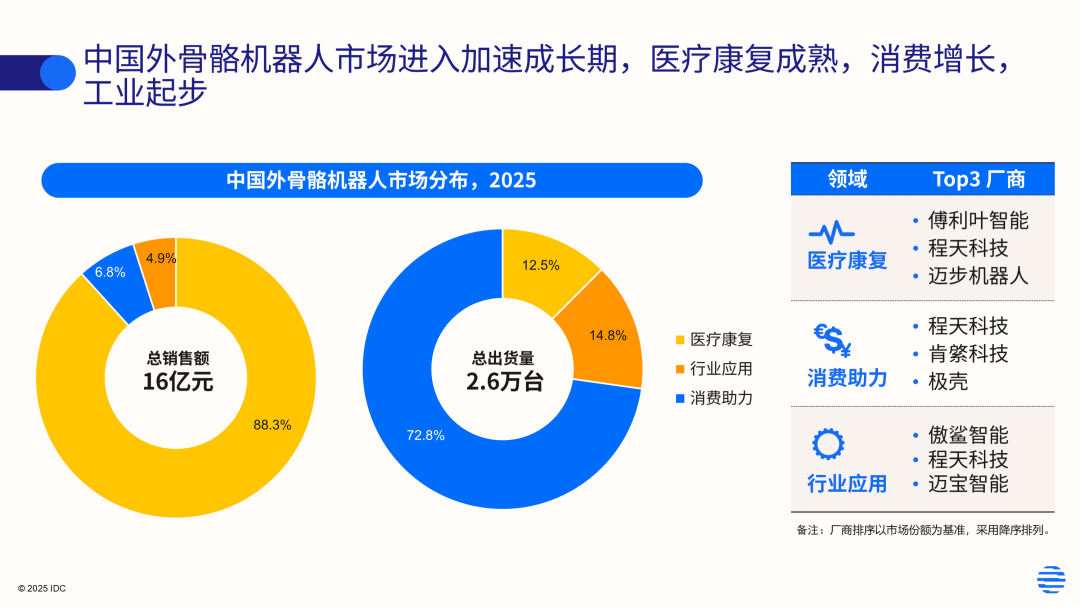
The Zhitong Finance App learned that the International Data Corporation (IDC) first released the “China Exoskeleton Robot Market Share, 2025” research report. For the first time, the three major segments of medical rehabilitation, consumer assistance, and industry application were incorporated into a unified market statistics framework to systematically sort out the competitive pattern and development of the Chinese exoskeleton robot market. According to IDC data, China's exoskeleton robot market will exceed 1.6 billion yuan in 2025, with shipments of about 26,000 units. Among them, the medical rehabilitation market still accounts for the main market value, while the consumer assistance market contributes more than 70% of shipments, and industry applications continue to expand new growth space. The three major market segments are jointly promoting the accelerated evolution of China's exoskeleton robot industry from a single medical application to multi-scenario human capacity enhancement equipment.
There are significant differences in the commercialization process of the three track segments. With mature clinical verification systems and payment channels, medical rehabilitation exoskeletons currently occupy the largest market size; consumption helps exoskeletons benefit from population aging and falling costs, and shipments are rising rapidly; industry-applied exoskeletons are moving from pilot to replication, driven by safe production and intelligent transformation.
Medical rehabilitation is developing steadily, consumption helps rapid deployment, and industry applications are being explored on a large scale
In 2025, the Chinese exoskeleton robot market has formed a pattern of collaborative development of the three major markets of medical rehabilitation, consumer assistance, and industry applications, and has entered a stage of accelerated commercialization. Among them, medical rehabilitation exoskeletons are still the largest segment of the current market, and the business model is relatively mature; consumption-assisted exoskeletons benefit from population aging, the silver hair economy and falling product costs, and have become the fastest growing market direction; industry applications (covering various industry scenarios such as logistics and warehousing, automobile manufacturing, power and energy, building construction, emergency rescue, etc.) exoskeletons are gradually entering the large-scale application exploration stage along with rising production safety requirements and intelligent transformation in the manufacturing industry.
Driven by policy and domestic substitution, the medical rehabilitation exoskeleton market remains leading
In 2025, China's medical rehabilitation exoskeleton robot market is about 1.42 billion yuan, and the shipment scale is about 3,200 units. Currently, hospital rehabilitation departments, rehabilitation specialist hospitals, and rehabilitation centers are still the main application scenarios. Driven by the aging population, growing demand for rehabilitation care, the construction of primary rehabilitation systems, and domestic substitution, medical rehabilitation exoskeletons have become the market segment with the highest degree of commercialization maturity. In the future, competition will shift from single device sales to competition for rehabilitation solution capabilities, and clinical verification, closed loop data and service systems will become the key to differentiated development of manufacturers.
Manufacturers such as Fourier Intelligence, Cheng Tian Technology, and Maibu Robotics occupy leading shares in the Chinese medical rehabilitation exoskeleton market.
Driven by the silver hair economy and outdoor demand, consumption helps exoskeletons unlock growth potential
In 2025, the Chinese consumer assistance exoskeleton robot market is close to 110 million yuan, and the shipment scale is about 19,000 units. With the aging population, the economic development of silver hair, and declining product costs, the expansion into scenarios such as daily travel assistance, outdoor sports, and cultural tourism experiences is accelerating, becoming an important driving force for market growth. In 2025, the leasing model represented by scenic spots, pension institutions and professional service providers developed rapidly. Through centralized procurement and operation services, the user experience threshold was effectively lowered, and it became an important channel for rapid expansion in the consumer market. In the future, as product prices drop further and the self-purchase market gradually matures, the consumer-grade exoskeleton is expected to evolve from experiential consumption to daily use, and ease of wear, comfort, battery life, scene adaptability, and offline experience will become the key for manufacturer competition.
Manufacturers such as Chengtian Technology, Kenyu Technology, and Polar Shell occupy a leading share in the Chinese consumer help exoskeleton market.
Demand for production safety is increasing, and industrial application exoskeleton scenarios are being implemented at an accelerated pace
In 2025, the market scale of exoskeleton robots used in the Chinese industry is close to 80 million yuan, and the shipment scale is about 3,800 units. Currently, industrial application exoskeletons are mainly used in scenarios such as logistics and warehousing, automobile manufacturing, electricity and energy, and emergency fire fighting to improve work efficiency by reducing workload and occupational damage. As enterprises pay more attention to production safety and personnel efficiency, industry application exoskeletons are gradually entering the stage of large-scale introduction. The application of exoskeletons and humanoid robots in the industry will form a differentiated development path. Exoskeleton robots focus on “enhanced human-robot collaboration”, which can improve human operation capabilities without changing existing production processes, and have unique value in intelligent systems in various industries. Manufacturers such as Aosha Intelligence, Cheng Tian Technology, and Maibao Smart occupy a leading share in the application exoskeleton market in the Chinese industry.
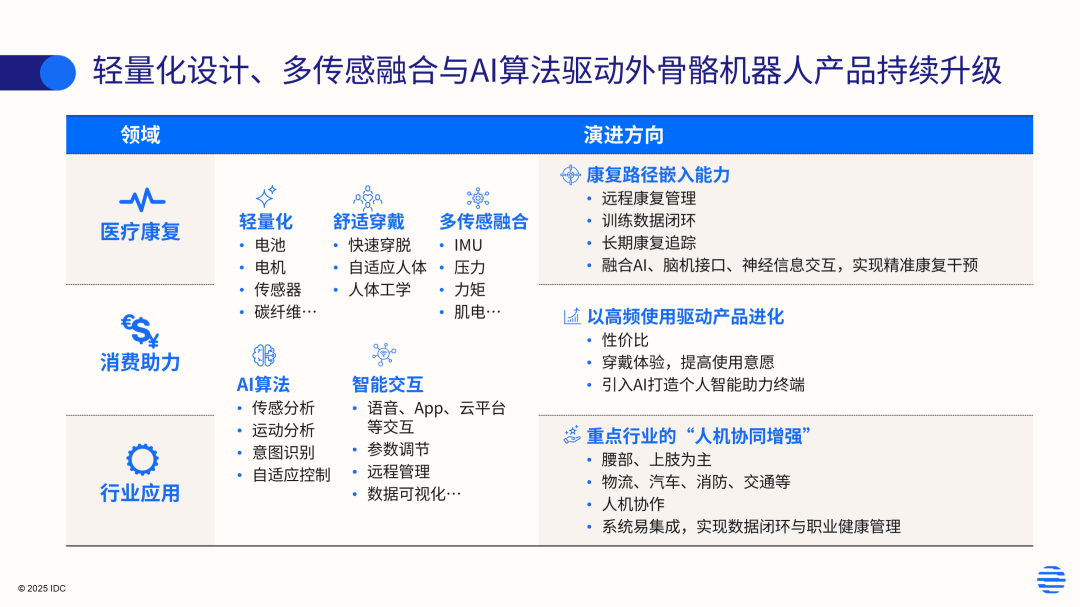
Lightweight design, multi-sensor fusion and AI algorithms drive continuous upgrading of exoskeleton robot products
For future market development, IDC suggests that exoskeleton robot manufacturers focus on the following directions:
Strengthen AI capacity building and promote the evolution of products from mechanical assistance to intelligent assistance.
As hardware technology gradually matures, future competition will shift to perception and algorithm capabilities. Manufacturers should enhance multi-source sensing integration such as IMU, EMG, pressure and torque sensors, and continuously optimize motion intent recognition, individualized control, and environmental adaptability.
Continue to promote lightweight innovation and accelerate the development of products into wearable devices.
Weight, comfort, and battery life will be important factors affecting market popularity. Companies need to continuously optimize materials, structures, batteries and drive systems to enhance the long-term wearing experience.
Strengthen the global layout and expand the space for overseas growth.
Markets such as North America, Europe, and Japan have a strong demand base in the fields of population aging, rehabilitation, and consumer assistance. Chinese enterprises should lay out certification, channels, services and intellectual property systems in advance to enhance international competitiveness.
Promote the transformation of medical rehabilitation from equipment sales to rehabilitation ecology.
Enterprises need to strengthen clinical data accumulation, rehabilitation effect verification, and closed-loop data construction to integrate products into hospital, community and home rehabilitation systems.
Reconstruct consumer-grade products around high-frequency scenarios.
Manufacturers should focus on improving wearability, comfort, and scene adaptability, and promote the transformation of users from early use to long-term use through offline experiences.
Focus on high-value jobs to promote the implementation of industry application markets.
Enterprises should prioritize the layout of labor-intensive scenarios such as logistics and warehousing, automobile manufacturing, etc., and verify commercial value by improving work efficiency and reducing occupational damage.
Li Junlan, research manager at IDC China, said that overall, 2025 is a key inflection point in China's exoskeleton robot market crossing from a “single medical device” to a “multi-scenario wearable device.” Medical rehabilitation has contributed to the current main revenue, but the consumer market has verified the emergence of public demand with shipments of nearly 20,000 units, and industry applications indicate more room for industrial imagination in the medium to long term. In the next three years, exoskeleton robots will gradually move away from being positioned as “assistive devices” and evolve into a new type of interactive terminal connecting people, machines, and data. In this process, whether barriers can be built simultaneously in the three dimensions of clinical verification, consumer experience, and industrial efficiency will determine who can take the lead in the next stage of global competition.
If before 2025, an exoskeleton was a medical device that helped a few people “stand up”; then after 2025, it is becoming an everyday device to help more people “go further.”