


Indian markets have put auto and financial services stocks back in the spotlight, while select technology stocks face fresh pressure after the latest moves in the Sensex and Nifty50. With Astra Microwave landing a large Rs 22.05b radar order and Thermax reporting an 85% YoY profit decline, investors are seeing very different reactions to the same news cycle. This article breaks down 3 stocks exposed to these developments, with 2 that appear better aligned with current momentum and 1 where recent news points to potential risks that may warrant extra caution.
Mahindra & Mahindra (NSEI:M&M)
Overview: Mahindra & Mahindra is a Mumbai based conglomerate that sells SUVs, commercial vehicles, two wheelers and construction equipment, alongside tractors and farm machinery, while also holding investments across auto, farm, industrial and consumer services businesses in India and overseas.
Operations: Mahindra & Mahindra generates most of its revenue from Automotive at about ₹1,262.3b and Farm Equipment at about ₹441.8b, with additional contributions from Financial Services at about ₹216.7b and Industrial Businesses and Consumer Services at about ₹250.5b, partly offset by internal eliminations.
Market Cap: ₹3,831.7b
Mahindra & Mahindra sits at the center of the current strength in Indian auto stocks, with recent gains in the index and solid Q1 2026 results drawing fresh attention to its mix of SUVs, tractors and growing finance and services arms. Revenue and earnings for FY2026 were sizeable, and analysts still see room for earnings to build further, even as forecasts point to a slower revenue path and a premium P/E relative to regional auto peers. At the same time, the business leans on higher risk funding, dividend cover looks tight and competition in electric vehicles and rural markets is intense. For investors, the key question is whether the breadth of its auto to farm platform outweighs those funding and growth concerns.
Mahindra & Mahindra’s broad auto to farm story looks powerful, yet its higher risk funding and tight dividend cover raise questions that many investors may be sidelining. Step into the 3 key rewards and 2 important warning signs (1 is major!)

Infosys (NSEI:INFY)
Overview: Infosys is a Bengaluru based IT services company that helps large organisations worldwide run and upgrade their technology through consulting, outsourcing, cloud and AI driven digital services across industries from banks and retailers to manufacturers and healthcare providers.
Operations: Infosys generates most of its revenue from Financial Services at about US$5.7b and Manufacturing at about US$3.3b, followed by Energy, Utilities, Resources & Services at about US$2.7b, Retail at about US$2.6b and Communication at about US$2.5b, with North America contributing about US$11.4b and Europe about US$6.6b.
Market Cap: ₹4,778.6b
Infosys is on many investors’ radars because it blends high quality metrics like a P/E below the Indian IT average, a strong ROE above 30% and steady 16.4% margins with a more troubling picture of slow revenue growth, intense AI driven pricing pressure and clear selling pressure in Indian IT stocks after being listed among the top losers in recent index moves. Analysts currently indicate only modest upside to their price targets, and recent target cuts suggest that optimism is fragile. A CEO transition planned for 2027 adds another layer of execution risk just as large AI and automation projects start to reshape its business model. Investors who focus only on the big AI headlines may overlook the range of risks that remain.
Infosys’ slow revenue growth, AI driven pricing pressure and upcoming CEO change suggest that the real story may lie beneath the headline margins and P/E. Read the analysis report for Infosys

Bajaj Finance (NSEI:BAJFINANCE)
Overview: Bajaj Finance is a Pune based non banking finance company that offers a wide range of loans and credit products for consumers, small businesses and rural borrowers, along with deposit products and distribution of insurance, all under the wider Bajaj Finserv group.
Operations: Bajaj Finance generates all of its ₹466,800.8m in revenue from financing activities in India.
Market Cap: ₹7,169.2b
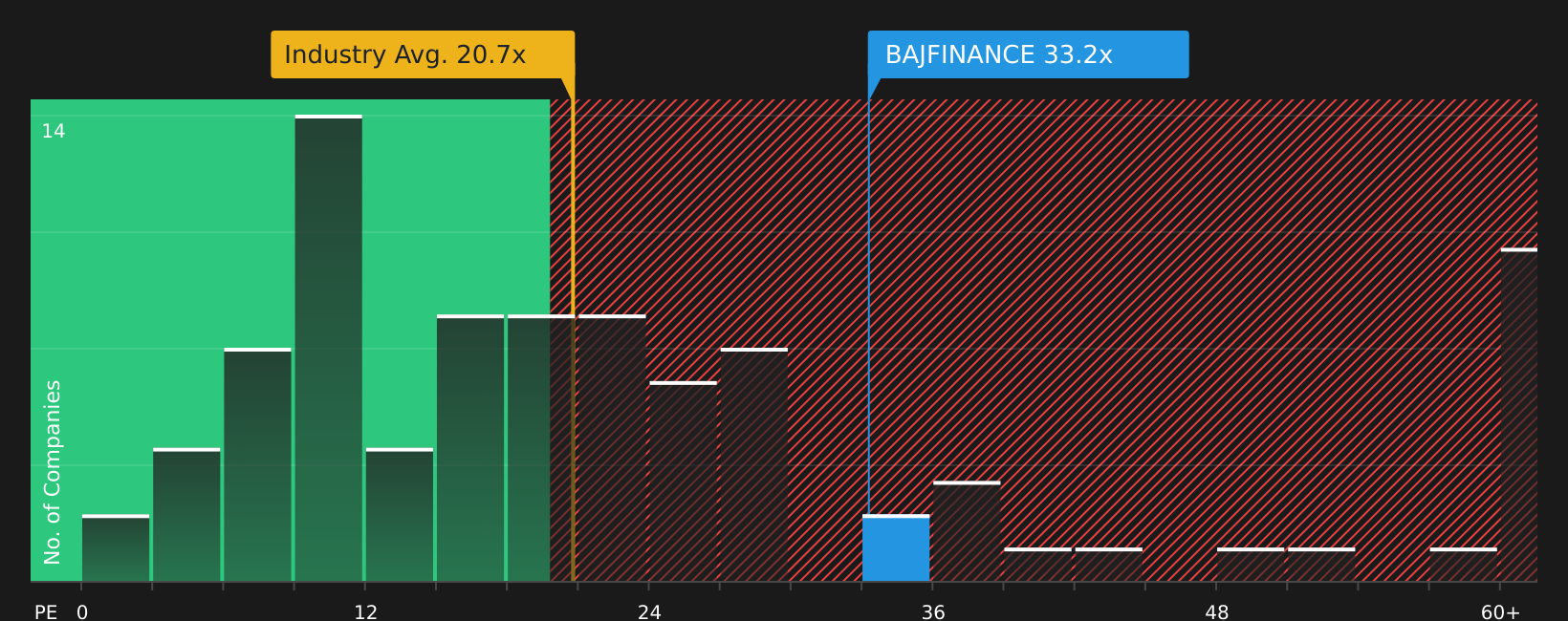
Bajaj Finance sits squarely in the current strength of Indian financial services stocks, as recent gains in the indices line up with its broad loan book, earnings profile and push into digital lending. Revenue of ₹231,664.2m and net income of ₹59,857.5m in Q1 FY2026-27 show the scale of its franchise. Long term customer growth, product diversification and digital investments are intended to support efficiency and asset quality, even as some unsecured MSME and 2 wheeler exposures remain sensitive. On the other hand, the shares trade on a rich P/E, the company relies on higher cost external funding and its dividend is not well covered by free cash flow. For investors, the key consideration is whether the quality of the franchise justifies the valuation given those funding and credit risks.
Bajaj Finance’s fast growing digital franchise and rich P/E suggest investors might be missing how funding costs and credit pockets really fit together. Walk through the 2 key rewards and 2 important warning signs (1 is major!)
Take Control of Your Investment Journey
If Bajaj Finance or any of these companies have caught your attention, register for FREE with Simply Wall St and add your companies to a Watchlist to monitor the share price against the fair value and track any new developments as they happen. Once you've made your move, manage your holdings with our Portfolio Command Center that filters out the noise to deliver only the most critical, actionable updates. Throughout your journey, our Community allows you to filter the best ideas from thousands of investor perspectives. By uncovering hidden catalysts and risks early, you'll accelerate your decision-making and stay one step ahead of the market.
Seeking Alternatives Before Momentum Flies?
Fresh stock ideas can move from quiet to crowded quickly. Screen for potential breakouts and shifting momentum before the crowd catches on and the edge drops. Act promptly to review opportunities that fit your criteria.
- Spot companies with strong balance sheets and fundamentals early by scanning the curated list of solid balance sheet and fundamentals (414 results) while they are still under the radar for now.
- Target potential compounding candidates by running through the hand picked 301 resilient stocks with low risk scores before others notice any steadier momentum building.
- Review structural themes with targeted exposure by using the focused 36 power grid technology and infrastructure stocks while valuations and sentiment may still leave room to move, based on your own analysis.
This article by Simply Wall St is general in nature. We provide commentary based on historical data and analyst forecasts only using an unbiased methodology and our articles are not intended to be financial advice. It does not constitute a recommendation to buy or sell any stock, and does not take account of your objectives, or your financial situation. We aim to bring you long-term focused analysis driven by fundamental data. Note that our analysis may not factor in the latest price-sensitive company announcements or qualitative material. Simply Wall St has no position in any stocks mentioned.
Have feedback on this article? Concerned about the content? Get in touch with us directly. Alternatively, email editorial-team@simplywallst.com