


The Zhitong Finance App learned that after strong financial reports boosted investors' confidence in the future of artificial intelligence (AI), US technology stocks showed a dramatic reversal, driving the market value of the NASDAQ 100 Index to increase by 3.5 trillion US dollars in just four trading days. The data shows that in the past four trading days, the tech stock benchmark index rose 9.3%, the biggest increase since April 2025 — when the market was recovering from market shocks caused by US President Trump's so-called “Liberation Day” tariffs.
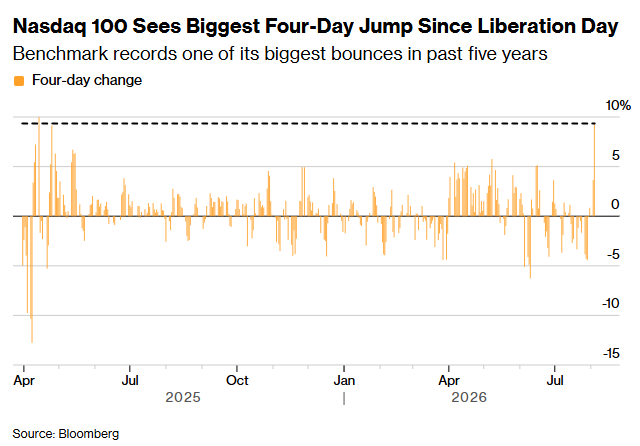
The Nasdaq 100 Index recorded one of the biggest four-day gains since “Liberation Day” in 2025
The second-quarter earnings quarter performance of US stocks far exceeded expectations, making investors once again believe that huge AI investments will not only continue, but have also begun to bring returns to some industry giants. According to the data, the backlog of cloud business orders from hyperscale cloud service providers surged more than 150% year on year, totaling about 1.7 trillion US dollars, and the growth rate far exceeded the 80% increase in capital expenditure during the same period. J.P. Morgan pointed out that this significant gap indicates that the potential return on revenue from AI infrastructure investment is exceeding market expectations, and that the pressure on tech giants to absorb valuation may be nearing its end.
Furthermore, during this earnings season, technology stocks still had a 90% chance of exceeding expectations under high expectations, while analysts continued to raise profit forecasts. However, at the same time as profit expectations were raised, technology stock valuations experienced significant compression — after the July market adjustment, the forward price-earnings ratio of the S&P 500 information technology sector fell to about 20 times, close to the lowest level in the past year. It is at the 1st percentile of the historical valuation range, lower than the average of about 23 times over the past ten years.
In response, J.P. Morgan pointed out that the forward price-earnings ratio of large market capitalization technology stocks (excluding semiconductors) is currently more than 2 standard deviations below the historical average since 2018. If the valuation is fixed to 1 standard deviation level below the historical average, there is room for growth of about 30%; if it returns to near the long-term average, the potential upward space may reach about 56%.
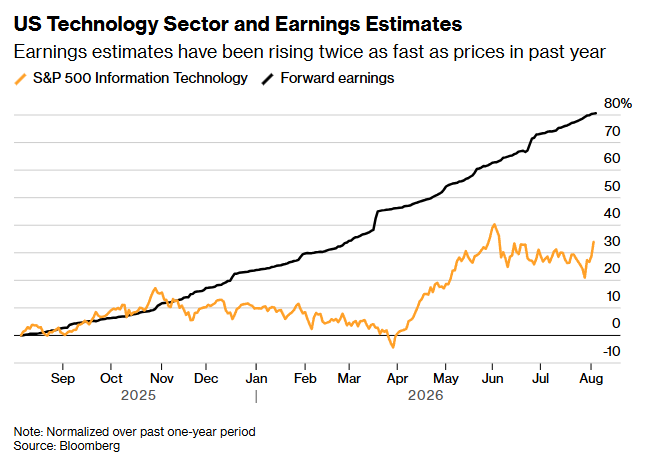
Over the past year, earnings expectations have risen twice as fast as stock prices
This rebound was also a quick counterattack by the Nasdaq 100 Index. More importantly, the tech sector has rebounded broadly, and semiconductor companies, software companies, and hyperscale cloud computing companies that have invested capital on a large scale have all risen. Among the companies with outstanding performance, over the past four trading days, SanDisk (SNDK.US) rose 41%, Palantir (PLTR.US) rose 32%, Microsoft (MSFT.US) rose 26%, and Google (GOOGL.US) and Nvidia (NVDA.US) both rose 11%.
David Rainville, head of the Sycomore Sustainable Tech Fund, said, “I think it's a good thing that the transaction method for shorting capital expenditure companies — that is, hyperscale cloud computing companies — to do more capital expenditure beneficiaries at the same time is over. The market is no longer a simple binary transaction.”
At the same time, large-scale deleveraging that occurred during the technology stock adjustment period last month caused quick trading funds such as hedge funds to close large numbers of short positions. Currently, these funds have reflowed back and are beginning to buy into the technology sector. According to data from Goldman Sachs Group's Prime Brokerage division, last week, the speed at which hedge funds increased their holdings in the information technology sector reached the fastest level since December 2022. The Goldman Sachs team said that the “Big Seven” have received capital purchases as a whole, but the current overall position level is still low, which means there is still room to further increase positions in the future.
However, the latest earnings season also highlighted a clear trend of differentiation among tech giants. Investors are rewarding companies that can show real AI revenue growth, while punishing companies where the return on AI investment is more uncertain.
Roland Caloyan, strategist at Société Générale, said, “The new changes in AI transactions are that semiconductor companies and hyperscale cloud computing companies have experienced significant differentiation. This means that stock portfolio managers who are unable to invest in indices and can only actively select individual stocks are now facing greater stock selection challenges.”
The scale of this gap is very clear. From the close of July 29 to the close of trading on August 4, Nebius (NBIS.US) shares rose 52%, while Apple (AAPL.US) shares fell 8.5%. There is a huge 61 percentage point gap between the best performing and worst performing stocks within a broad range of AI-related technology stocks.
For Deutsche Bank strategist Parag Tart and others, the trend of capital outflows from mega-capitalization technology stocks bottomed out last week. Since then, there has been a moderate recovery in market positions in this category of stocks, which means there is still room for further growth in the future.
Deutsche Bank strategists believe that within the technology sector, hyperscale cloud computing companies have the best risk-benefit ratio. Currently, the performance of these companies relative to the S&P 500 index has just broken out of the weakest level in the three-year range. The strategist said, “We believe that the trend of capital flowing back into the technology sector still has room for further development. According to historical rules, technology stocks can usually exceed performance by about 20 percentage points.” They pointed out, “This will be the fifth time the technology sector rotates in the past three years, and the market's focus has been repeatedly shifting between rapid growth opportunities and bubble risk, and the pace of this shift is accelerating.”
J.P. Morgan believes that if the market's core narrative on AI shifts from “whether capital expenditure is excessive” to “return on investment is being realized,” the driving force for the next phase of the rise in technology stocks may come more from rotation within the sector rather than simply relying on chip stocks to continue to rise.
From a technical perspective, the US Big Seven Tech Index (MAGS) has rebounded nearly 10% from its recent low, back on the 200-day EMA, and is close to the long-term upward trend line since April last year. J.P. Morgan believes that the current 200-day EMA has leveled off, which means that the market is going through a long period of consolidation. However, historical experience shows that the longer the sideways trade, the stronger the breakthrough after choosing a direction.