


Zhitong Finance App learned that after the US stock market on Wednesday, mobile advertising giant AppLovin (APP.US) handed over a report card showing a sharp increase in profits, but faced a cold judgment from investors. The company's stock price plummeted more than 25% in after-hours trading because its second-quarter revenue was slightly below market expectations and the guidance given for the next quarter was not encouraging enough — even though its net profit for the quarter surged 55% year over year, the adjusted EBITDA margin remained around a rare 84%.
According to financial reports, for the second fiscal quarter ending June 30, AppLovin achieved revenue of US$1.92 billion, an increase of 53% over the previous year, but it was still lower than analysts' previous estimate of US$1.94 billion. Adjusted earnings per share were $3.76, slightly exceeding market consensus of $3.75. Net profit reached US$1.27 billion, up 55% from US$820 million in the same period last year; adjusted EBITDA was US$1.61 billion, up 58% year on year, continuing to show strong profitability.
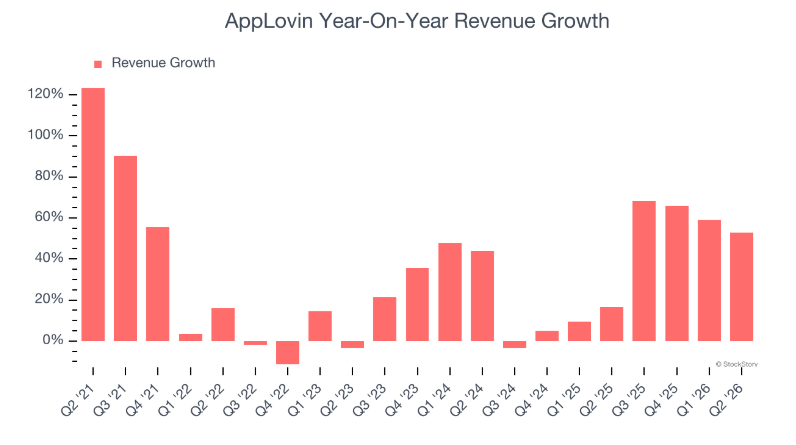
However, what alarmed the market was that this report card not only did not beat Wall Street expectations, but even fell short of AppLovin's own internal guidelines. In the results call that followed, management reduced the core reason for falling short of expectations to one word: timing.
The pace of model upgrades has stalled, and management explains the “timing” issue in detail
Co-founder and CEO Adam Foroughi confessed during the conference call that the company's game-based advertising business is highly dependent on improving the performance of its AI model. Every substantial iteration of the model allows advertisers to dare to invest more while maintaining the target return on ad spend. However, in the past second quarter, this jump in model performance did not come as expected.
“The problem with this quarter came down to timing,” Foroughi explained. “The pace at which we received substantial model improvements was slower than normal, and the next major improvement in model performance happened to be implemented just after the quarter ended.” He stressed that no decline in advertisers' demand or adverse changes in the competitive environment were observed during the season. Publisher revenue of MAX, its aggregation platform, achieved double-digit month-on-month growth, and AppLovin's share in the publisher bidding waterfall remained stable.
This statement is intended to send a signal to the market: the growth engine itself has not stopped; it's just that the pace of technological upgrades has accidentally mismatched the financial reporting deadline.
For the current quarter, AppLovin gave performance guidelines reflecting the contributions of the new model. The company expects third-quarter revenue to be between US$2,055 billion and US$2,085 million, with a year-on-year increase of about 46% to 48%. The median value of US$2.07 billion is slightly lower than analysts' general expectations of US$2.08 billion. The adjusted EBITDA is expected to be between US$1.71 billion and US$1.74 billion, and the adjusted EBITDA margin is approximately 83%.
Chief Financial Officer Matt Stumpf stated that the third-quarter guidance already included increased training and computing infrastructure costs due to the deployment of new models, but did not include further model releases that may be launched in the future but have not yet been realized. He reiterated that the company uses absolute EBITDA and free cash flow as core management indicators, and will continue to invest as long as computing power investment can bring incremental revenue.
Stumpf said that in the long run, the adjusted EBITDA profit margin is expected to remain at around 80%, but it may fluctuate in the short term due to infrastructure investment.
Consumer advertising has set a record, and the second growth curve is yet to take shape
In addition to games, AppLovin is actively advancing into broader consumer advertising fields such as e-commerce. Foroughi revealed that consumer ad spending reached a new high in the second quarter, which was 28% higher than in the fourth quarter of 2025, which is usually the peak season. Despite this, this sector is not large enough to fully hedge against fluctuations in the gaming business, but management expects its contribution to gradually increase.
During this period, the company opened a self-service advertising platform called “AppLovin Ads Manager” to the public. Foroughi said the initial target was for mid-sized advertisers with a budget and willing to bear the cost of learning the new platform, rather than immediately competing for the biggest brands or a large number of small merchants. At present, the system can generate interactive landing cards more efficiently, but it still needs to overcome technical difficulties in automatically creating high-quality long video advertisements. Once an alternative solution is solved or introduced, it will greatly lower the creative threshold for small and medium-sized advertisers.
Looking at the long term, Foroughi believes that the combination of continuous optimization of game advertising models and consumer business expansion is expected to support the company's performance to achieve compound annual growth of about 30%.
In terms of cash flow, free cash flow for the second quarter was $863 million. Stumpf explained that the lower than normal cash conversion rate is mainly due to the time difference between international cash taxes and interest payments. It is not a change in profitability. It is expected to improve in the third quarter, and the annual free cash flow conversion rate is expected to return to around 75% of the adjusted EBITDA.
The company's balance sheet remains stable. At the end of the quarter, it held 3.05 billion US dollars in cash and total debt of 3.7 billion US dollars. The net leverage ratio was only about 0.1 times, far below the long-term target of maintaining about 1 times leverage. In terms of repurchases, AppLovin spent about 551 million US dollars to repurchase and cancel about 1.14 million shares in the second quarter. The pace was significantly slower than the nearly $1 billion repurchase in the first quarter. Stumpf clarified that this only reflects a temporary decline in free cash flow during the quarter, and the company's attitude towards repurchases has not changed. By the end of the quarter, approximately $1.8 billion in repurchase authorization credits were still available.
Furthermore, Stumpf revealed that the US Securities and Exchange Commission (SEC) had closed the previous voluntary inquiry and did not suggest any action, and the company did not consider the matter significant.
Why the Market Isn't Buying: High Expectations Meet AI Anxiety
Before the financial report was released, AppLovin's stock price had fallen by about 40% from a high of over $740 during the year, and the forward price-earnings ratio fell from extreme excitement to about 25 times, which is closer to the normal valuation of the advertising technology sector. Because of this, a clean “excess of expectations” could trigger a retaliatory rebound. However, in the end, what was achieved was a double weak gap in revenue and guidance, providing the bears with new ammunition.
Deeper unease is still linked to AI disruption. Although AppLovin has always emphasized that its Axon system uses AI for accurate mobile ad matching and has successfully expanded beyond gaming, some investors are still wary of any traditional software and advertising platforms that may be impacted by the AI wave. The market analysts' camp is also deeply divided: some optimists are still maintaining a target price well above $700, believing that the recent sell-off has been excessive; however, those who are cautious believe that the easiest acceleration period may have passed after the platform matures.
In the end, AppLovin's experience once again confirmed the strict logic of the current market: in a trading environment that pursues “perfection” at any cost, a company whose annual revenue growth rate still exceeds 50% is treated as a loser simply because the pace of progress is slightly slower than most optimistic expectations. As the paradox revealed in its earnings report — the quarter was strong by almost any conventional standard, but in this climate, the word “strong” is far from enough.