


The Zhitong Finance App learned that Western Digital (WDC.US), which is one of the top three storage products in the US, announced quarterly results and future prospects after the close of the US stock market on Wednesday (that is, Thursday morning Beijing time), which together highlights the global technology companies' near-“ endless” explosive demand for near-line high-capacity HDDs, and that the storage giant's quarterly performance and outlook guidelines have all exceeded Wall Street analysts' expectations. Following the release of extremely strong performance data from two major memory chip manufacturers, Samsung and SK Hynix, as well as Seagate, which is also the hegemon of HDD storage, Western Digital's overall strong performance exceeding expectations can be described as a comprehensive strengthening of the so-called “storage supercycle” narrative of prosperity and growth led by storage product giants.
Results for the fourth quarter of fiscal year 2026 as of July 3 show that Western Digital's quarterly revenue was US$3,747 billion, up 44% year on year and 12% month on month. The cash flow and deleveraging process is also very optimistic. The company's management's performance outlook for the next quarter was also strong, but before the financial report was released, Western Digital's stock price rose by about 201% during the year. The market had already pre-priced and traded HDD shortage expectations, and although the outlook given by Western Digital exceeded analysts' benchmarks, it did not release more aggressive forward supply, order locking, and profit prospects like Seagate, so it was biased in comparison.
This “cliff of expectations” is also part of the logic of Western Digital's stock price plummeting more than 10% after the market results were announced. The “cliff of expectations” means that although performance and guidance exceed the consensus of the market, they have not crossed the higher threshold required for extremely crowded positions, falling slightly short of expectations (even if they are still growing), which will cause a collapse in confidence and a cliff-style decline in asset prices.
The company's performance conference call also strengthened the logic of order visibility and pricing rights. Western Digital's management expects the EB-level demand growth rate to remain above 25% in the next few years, and customer discussions have been extended to 2029-2031; the “order schedule to 2031” here needs to be more rigorously expressed as extending the visibility of long-term agreement negotiations (that is, LTA) and demand planning until 2031. The existing LTA mainly locks in capacity and pricing frameworks. Not all contracts are irrevocable.
Western Digital is committed to delivering more EB, reducing the cost per TB, and expanding the operating logic of gross margin by expanding the number of hard drives in varying proportions through 40TB ePMR, subsequent HAMR, and higher surface density. Western Digital's latest official roadmap points to ePMR 60TB and HAMR reaching 100TB in 2029, while high-bandwidth hard drives and dual actuator (dual pivot technology) architectures seek to further expand the scope of application of HDDs from the pure capacity layer to high-throughput AI workloads.
Management emphasized that HDD demand is no longer just a one-time equipment cycle that follows the construction of data centers, but is driven by continuous data production after AI computing power infrastructure is put into use; even if GPU/TPU or cloud computing companies gradually slow down the growth rate of self-developed AI ASIC deployments, the deployed “AI factories” will continue to generate data that needs to be saved, accessed, and reused.
Western Digital's 54% gross margin and strong cash flow confirm the AI storage bull market, but the post-market collapse unraveled the “cliff of expectations”
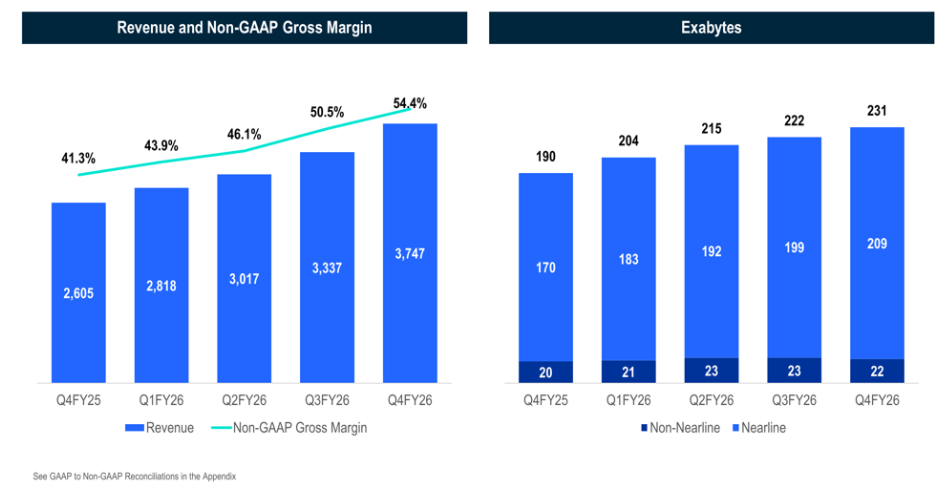
Western Digital's results for the fourth quarter of fiscal year 2026 announced on August 5 are essentially a high-quality financial report that simultaneously strengthens revenue, profit margins, cash flow, and balance sheets. The company's quarterly revenue was US$3.477 billion, up 44% year on year and 12% month on month; non-GAAP gross profit margin of 54.4%, up 1310 basis points year on year and 390 basis points month on month; non-GAAP operating profit of US$1,655 million, up 126% year on year, and operating margin rose to 44.2%; non-GAAP net profit of US$1,382 million, up 130% year on year; adjusted EPS under non-GAAP guidelines was US$3.56, up 109% year on year and 31% month on month.
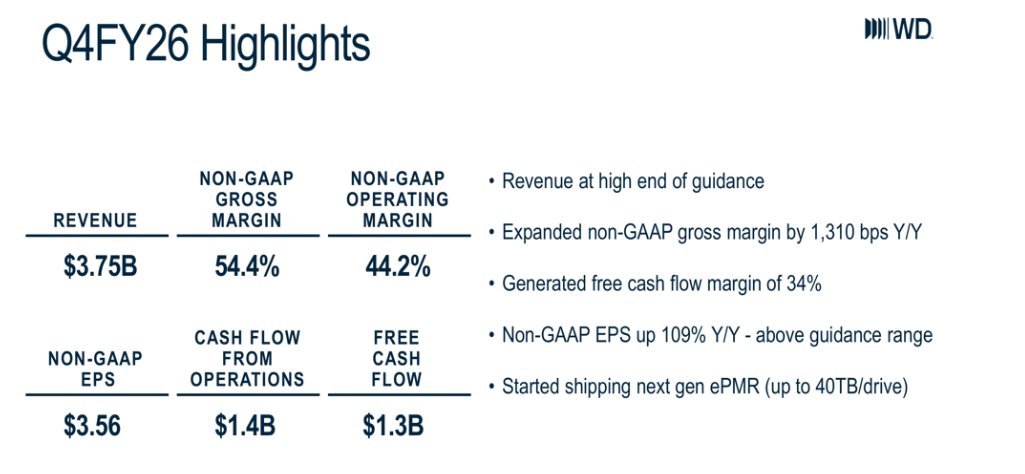
Western Digital's quarterly revenue and adjusted EPS exceeded Wall Street analysts' average expectations of US$3.7 billion and US$331, respectively. Compared with the company's previous median revenue of US$3.65 billion, gross margin of 51.5%, and US$3.25 EPS guidelines, the actual results were 2.7%, 290 basis points, and 9.5% higher, respectively. EPS under GAAP guidelines is as high as $8.21, but it includes approximately $2.05 billion in revaluation of Sandisk's remaining equity, so the main profitability should be based on non-GAAP EPS of $3.56.
Since the flash memory business was spun off into Sandisk (or “SanDisk”) in February 2025, Western Digital's financial caliber no longer includes NAND flash or eSSD. The “enterprise data center SSD (eSSD) super business line” covered by Western Digital for a long time has been fully migrated to the NAND storage giant SanDisk (that is, the original WDC Flash business) — SanDisk, which was spun off from Western Digital, has entered public trading with the US stock market in February 2025; and Western Digital, as a listed entity, can be described as an unprecedented wave of AI in history Below “the purest HDD stock target”.
Cash flow and the deleveraging process are also a major fundamental benefit. Western Digital's quarterly operating cash flow was US$1,389 million, up 86% year on year; after deducting capital expenses of US$108 million, free cash flow was about US$1,281 million, up about 90% year on year and 31% month on month. FY2026's full-year revenue was US$12.919 billion, up 36% year on year; non-GAAP EPS reached US$1,022, up 104% year over year, and annual free cash flow was approximately US$3,511 million, up about 174 percent from the previous fiscal year of approximately US$1,284 million.
At the same time, the company reduced its total debt from about US$4.711 billion to US$1,052 million in one year, and its cash at the end of the period was US$1,579 million. It has turned into a net cash position of approximately US$527 million, and has repurchased US$672 million of shares in the current quarter. In other words, the storage boom cycle under this unprecedented AI frenzy is not only reflected in accounting profits, but has also been transformed into real free cash flow and capital return capabilities.
In terms of market-focused performance forecasts, Western Digital expects revenue for the first quarter of the 2027 fiscal year to be US$4 billion to US$4.2 billion, up 9.4% from the current quarter and up about 45.5% from US$2.818 billion in the same period last year; higher than analysts' expectations of US$4.06 billion in non-GAAP gross margin of 55.5%, an increase of 110 basis points month-on-month and 1,160 basis points year-on-year; EPS median value of US$4.00, up 12.4% month-on-month, up about 125% from US$1.78 in the same period last year, higher than analysts' expectations $3.77. This data outlook means that revenue, profit margins, and EPS are still in the same acceleration range, which is by no means a sign that HDD and storage cycles are peaking. However, market expectations are no longer satisfied with “slightly higher than consensus”. Although Western Digital's performance guidelines exceed analysts' benchmarks, they have not released more aggressive forward supply, order locking, and profit prospects like Seagate, so they are biased in comparison.
As far as Western Digital's stock price is concerned, the newly announced results and outlook are not an immediate positive catalyst for stock prices. In particular, the future quarterly outlook has failed to greatly exceed the agreed market expectations. Prior to the announcement of the financial report, Western Digital's stock price rose by an astonishing 201% during the year. The market had already traded HDD shortages, price increases, profit margin expansion, and AI data center orders locked in advance; the stock price first fell 5.4% during the regular trading period on August 5, and then fell about 10% — 11% to around 465.96 US dollars after the earnings report.
Goldman Sachs trading desk statistics show that after the extreme deleveraging sell-off in July, US stocks just recorded the biggest net purchase since November 2020 last week. Technology hardware became the focus of rebuilding positions, and WDC (Western Digital) and STX (Seagate) were clearly listed as AI trading recovery directions; at the same time, S&P 500 (SPX) bullish options traded more than 4 million in a single day, and the market entered positive FOMO feedback of “buy the more you go up”. Since most of the new purchases come from short payback, option leverage, and higher capital, rather than low-cost long-term allocation, financial reports must provide guidance that far exceeds consensus in order to continue to squeeze the bears; once they are just “excellent but not yet to the next level,” overvalued, high volatility, and crowded positions will quickly transform into profit settlement and options deleveraging. The post-market crash was closer to expectations and liquidation of positions rather than a fundamental collapse.
AI data torrents awaken “sleeping hard drives”, and HDD oligarchs reap the “AI infrastructure dividends”!
The reason why the two major HDD oligarchs Western Digital and Seagate have greatly benefited from the almost “endless” storage demand brought about by the unprecedented global AI computing power torrent is the explosive expansion demand of large-scale AI data centers such as “Stargate” for Western Digital and Seagate data center class nearline HDDs (that is, near-line high-capacity HDDs) and Seagate high-performance eSDs.
The AI training/inference process not only consumes computing power, but also produces data that needs to be stored for a long time at an exponential rate. AI training/inference has brought the “data generation-cleaning-version-playback-archiving” chain to an exponential level. What data centers need is storage that balances cost and scale at the Exabyte level. At this level, nearline (nearline) HDDs are still one of the optimal solutions for “cost per terabyte/capacity per watt”, so when expanding AI infrastructure, cloud vendors and enterprises will invest large budgets into high-capacity near-line hard drives to handle data lake/object storage/cooling and heating stratification and long-term retention requirements.
The global AI infrastructure construction process is inseparable from the high-capacity near-line HDD storage tier. GPUs and HBM are responsible for matrix computation. DRAM and high-performance SSDs are responsible for thermal data, cache, and high-frequency random access, but training corpus, raw video and sensor data, model checkpoints, vector and embedded snapshots, inference logs, synthetic data, model output, backup copies, and compliance archives will continue to settle into PB and even EB-level “warm data and cold data”. This data requires a few seconds or even sub-seconds of access, tape is too slow, and the cost per TB and energy consumption of using all NAND is unbearable. Therefore, HDDs that have been ignored by the market for a long time are being transformed from low-speed traditional storage to the optimal solution for the capacity, energy consumption, and total cost of ownership of the AI data layer.
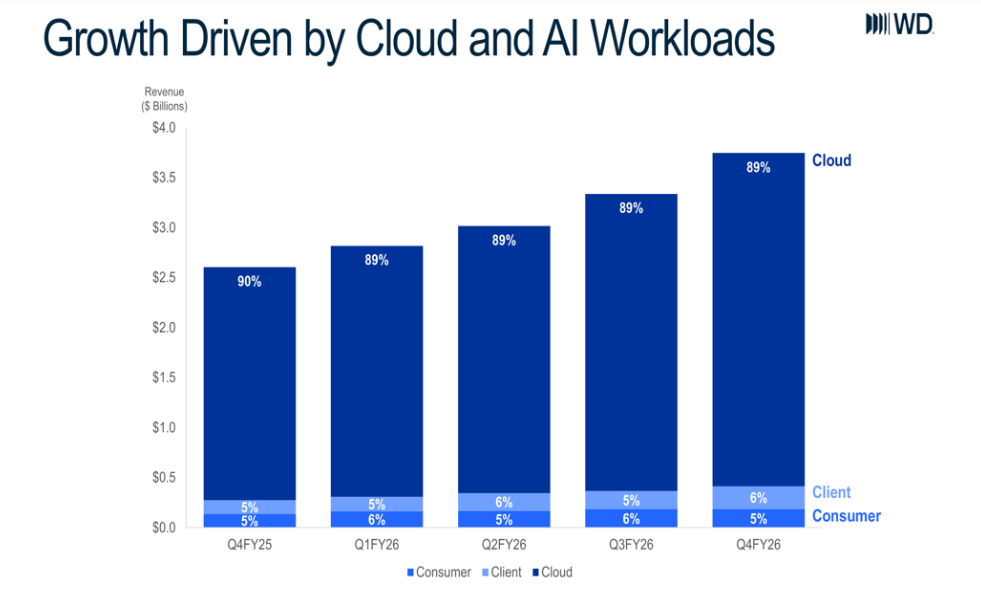
Western Digital said that NAND flash memory has had a cost premium of about 6-10 times that of HDDs for a long time; in the last quarter that disclosed complete operating data, the company's cloud revenue was about 3 billion US dollars, accounting for 89% of total revenue, up 48% year on year, and total shipment volume was 222EB, up 34% year on year. Among them, the latest generation ePMR hard drives shipped more than 4.1 million blocks and a capacity of 118 EB, which directly reflects that hyperscale cloud vendors are turning AI data lake demand into near-line HDD procurement.
The most important increase in the performance call was not the $4.1 billion revenue guide for the next quarter. Instead, management redefined the AI-driven storage requirement function, that is, computing resources can be repeatedly scheduled between different training and inference tasks, but model input, output, checkpoints, inference logs, agent workflow context, and synthetic data will continue to accumulate and grow compounded. Even if GPU/TPU or cloud computing companies develop their own AI ASIC deployment growth in a phased manner, the “AI factory” that has already been deployed will continue to generate data that needs to be saved, accessed, and reused. Autonomous driving, robotics, and industrial automation further amplify this mechanism, because insufficient actual data will force companies to generate large amounts of synthetic video and simulation data, making “physical AI” a new round of capacity black holes after training and inference.
The conference call also strengthened the logic of order visibility and pricing power. Western Digital's management expects the EB-level demand growth rate to remain above 25% in the next few years, and customer discussions have been extended to 2029-2031. Western Digital's management said that in the context of supply restraint, WDC does not need to increase the production capacity of hard drives on a large scale, but instead increases single disk capacity, reduces the cost per TB, and increases the total cost of ownership value for customers through 40TB UltraMR, 2027 HAMR, and higher surface density; the official roadmap already points to ePMR 60TB and HAMR to reach 100TB in 2029, while high-bandwidth hard drives and dual actuator (Dual Pivot) architectures seek to expand the scope of application of HDDs from the pure capacity layer Further expand to high-throughput AI workloads.
Western Digital's 40TB UltraMR ePMR hard drive has been certified by two hyperscale customers and is scheduled to be mass-produced in the second half of 2026; the ePMR route will be extended to 60TB, and HAMR plans to climb the slope in 2027 and reach 100TB in 2029. High Bandwidth Drive and Dual Pivot architectures each increase throughput through parallel read/write with multiple magnetic heads and dual independent actuators. Combined, sequential I/O can be increased by about 4 times; power-optimized HDDs aim to reduce power consumption by 20%, enabling data centers to expand storage capacity without increasing the scale of rack, electricity, and SSD procurement.
The HDD cycle is shifting from a traditional inventory cycle to a structured capacity cycle driven by data compounding
Western Digital's latest financial report and future outlook have undoubtedly significantly strengthened Western Digital's medium- to long-term fundamentals rather than a short-term transaction catalyst — it proves that this round of profit expansion is not only due to a brief shortage of stock, but also from the combined effects of AI data volume growth, high-capacity product upgrades, long-term customer collaboration, and industry supply discipline. However, whether the stock price can be repaired immediately still depends on how fast gross margin catches up with Seagate, the upward pace of 40TB products, and whether LTA can be converted into actual EB shipments and continued price increases.
The post-market decline reflects high valuations and extreme expectations of liquidation; what the call will reveal is that the HDD cycle is shifting from a traditional inventory cycle to a structured capacity cycle driven by data compounding led by AI data centers. Next, we will focus on whether gross margin can continue to stabilize at around 55%, the growth rate of EB shipments in the cloud, 40TB product certification and mass production, HAMR progress, and capital expenses of hyperscale customers. It is impossible to infer that the AI storage cycle has been reversed based only on post-market declines.
On the eve of the announcement of the results, Ben Reitzes, head of science and technology research at Melius Research, gave a rating of “buy” for Western Digital's $1,050 target price. Western Digital's regular trading closed at $519.17 on August 5, with $1,050 representing potential room for growth of about 102.2%; based on a static estimate of the current market value of about US$178.9 billion and the current basic share capital, when the stock price reaches US$1,050, the company's market value will reach about US$362 billion.
Reitzes' core judgment is that HDDs are not traditional cycle hardware that has been eliminated by flash memory, but rather capacity-layer assets whose medium- to long-term strategic value of AI data infrastructure is seriously underestimated. Reitzes said that generative AI, especially video models, will simultaneously expand the scale of training materials, inference output, logs, checkpoints, and content archiving; “physical AI” such as autonomous driving, robotics, and industrial automation will also generate real-world video, sensor data, and synthetic training data around the clock, changing storage requirements from one-time data center construction to continuous compound growth. As a result, Reitzes from Melius sees the previous stock price falling by more than 20% from its high level as an opportunity for AI infrastructure bulls to re-step in.
The deeper profit logic is that Western Digital does not need to expand the number of hard drives in the same ratio, but can use 40TB ePMR, HAMR, and higher surface density products to deliver more EB capacity with similar unit output. The growth rate of industry demand continues to be higher than the growth rate of supply. Combined with multi-year customer agreements, it is beneficial to the price increase per TB; at the same time, capacity upgrades reduce the manufacturing cost per TB, thus forming a triple operating lever of “EB shipment growth+price increase+unit cost reduction”. Management expects EB demand to grow by more than 25% in the next few years, and the call will show that the customer's long-term plans are being extended to 2029-2031.