


The Zhitong Finance App learned that Google's parent company Alphabet (GOOGL.US) is returning to the bond market after drastically raising the 2026 capital expenditure guidelines to a maximum of 205 billion US dollars and recording the first negative free cash flow in a single quarter since listing. According to people familiar with the matter, the company plans to raise up to $25 billion through the latest US dollar investment-grade bond offering. This will be another large-scale debt financing for the tech giant in less than a year, and a direct test of investors' true appetite for AI-related bonds after the July sell-off.
Issuance details: Ten bonds span 2 to 40 years
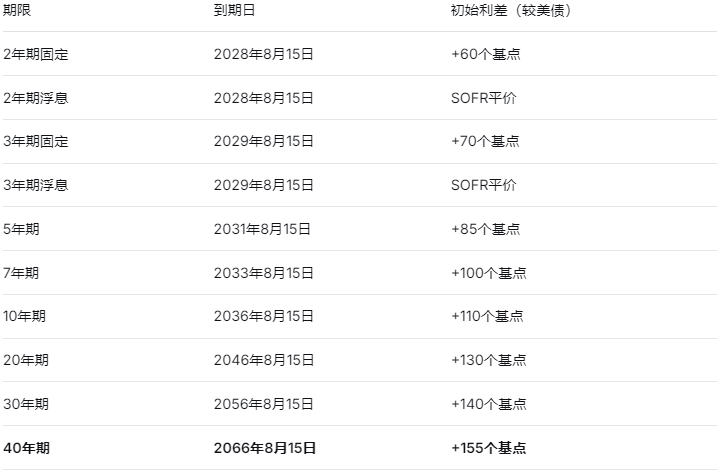
According to people familiar with the matter, Alphabet now plans to issue up to 10 maturing bonds, with maturity dates ranging from 2 years to 40 years. The initial price guide for the longest term 40-year bond was about 1.55 percentage points higher than the yield on US Treasury bonds.
The initial spread for each grade of bond increases with maturity: about 60 basis points for a 2-year term, about 70 basis points for a 3-year term, 85 basis points for a 5-year term, about 100 basis points for a 7-year term, 110 basis points for a 10-year term, about 130 basis points for a 20-year term, and about 140 basis points for a 30-year term. The issuance structure includes fixed interest rate and variable rate notes, and aims to cover a wide range of investors from short-term fund managers to long-term pension funds.
Bank of America, Citibank, Goldman Sachs, J.P. Morgan Chase, Morgan Stanley, and Wells Fargo will co-act as joint bookkeepers for this offering. The bond is an advanced unsecured debt and is expected to receive a top rating of aA2/aa+.
Background of debt issuance: capital expenditure of 205 billion dollars and negative cash flow for the first time in history
This bond issue is only about two weeks since Alphabet raised its 2026 capital expenditure forecast. On July 22, Alphabet drastically raised its annual capital expenditure guidelines from 180 billion to 190 billion US dollars to 195 billion US dollars to 205 billion US dollars, more than double the size of the 2025 expenditure. Management emphasized at the time that the risk of “underinvestment” during the current AI transformation period is far greater than the risk of “excessive investment,” and demand for computing power still far exceeds supply.
The direct consequence of the huge capital expenditure was that although operating cash flow of approximately US$39.1 billion was achieved in the second quarter, Alphabet recorded a negative free cash flow of US$5.855 billion in the second quarter of 2026, the first time since the company went public in 2004 that the quarterly free cash flow was negative. Capital expenditure for the quarter reached 44.9 billion US dollars, double the previous year. In the first quarter, the company's free cash flow was still positive at $10.1 billion.
Despite this, Alphabet is still a “cash-rich” tech giant — financing by issuing bonds rather than consuming cash reserves, which can fund aggressive expansion plans while retaining huge cash buffers and optimizing capital costs.
Market reaction: long-term US bonds are rising, and demand for AI bonds has become the biggest suspense
After the announcement of the bond issuance, US bond yields rose by 3 to 4 basis points across the board, and the long-term pressure was particularly evident. The 10-year US Treasury yield rose to about 4.65%, and the 2s10s and 5s30s term spreads both widened.
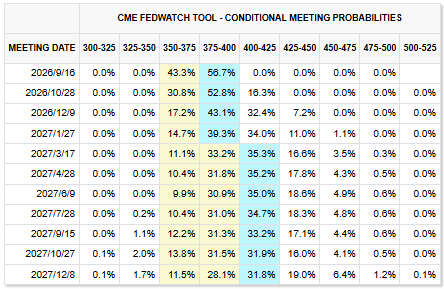
This reaction reveals deep anxiety in the market: the huge supply of AI infrastructure is resonating with expectations of the Federal Reserve's potential interest rate hike. The interest rate market is currently still taking into account the September interest rate hike forecast of about 15 basis points, and the cumulative interest rate hike is expected to reach about 33 basis points by the end of the year. According to the CME Federal Reserve's observation tool, the market expects the probability that the Fed will raise interest rates in September to reach 56.7%, and raise interest rates at least once this year.
The reason why this bond issuance is viewed as a “stress test” is that demand for AI-related bonds has clearly cooled down in July. Last week, BlackRock's affiliate issued a $12.5 billion bond for Meta Platforms' data center project in Texas. Initial demand was lackluster; Amazon's bond issuance also experienced a lack of enthusiasm for subscription; many companies, including SpaceX, issued new AI-related bonds, and interest spreads in the secondary market widened. According to Morgan Stanley strategists, interest spreads on Meta and Oracle bonds widened by about 22 and 29 basis points, respectively, in July.
Industry landscape: Tech giants' AI debt torrent has reached the critical point of “indigestion”
Alphabet's $25 billion bond issuance is just the latest wave in the AI infrastructure financing torrent. According to statistics, since 2026, the six “AI hyperscale computing companies”, Alphabet, Amazon, Meta, Oracle, Nvidia, and SpaceX, have issued a total of about $244 billion in bonds in the global bond market, more than double the $108 billion last year, and more than 14 times the $17 billion in 2024.
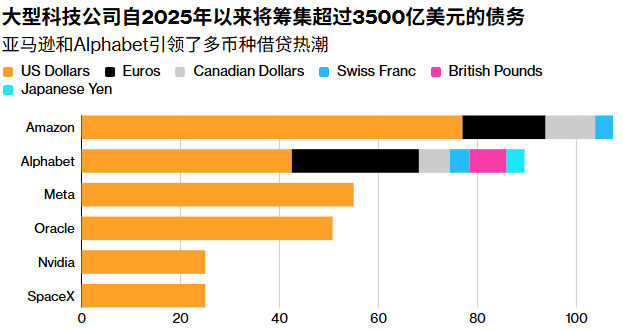
Alphabet itself is one of the frontrunners. In February of this year, the company issued about 20 billion US dollars in bonds, and actually raised nearly 32 billion US dollars. In the first half of 2026 alone, the company has issued more than $50 billion in bonds, covering the Swiss franc, the British pound, the euro, the Canadian dollar and the Japanese yen. Two months ago, Alphabet also completed a stock increase of nearly 85 billion US dollars. In addition, the company simultaneously submitted applications to issue up to $40 billion in Class A and Class C shares.
A Morgan Stanley strategist pointed out that the valuation advantage of European investment-grade credit compared to the US has begun to weaken by hyperscale companies to finance AI. Signs of market “indigestion” and investor fatigue are showing.
In this context, Alphabet's $25 billion bond issuance is seen as a key test to test the market's willingness to accept AI-funded bonds. Annual capital expenditure of $205 billion, negative free cash flow for the first time in history, and the cooling of demand for AI bonds in July — the results of this bond issue under the combined triple pressure will provide a key market signal for the sustainability of the entire AI infrastructure financing cycle.