


The Zhitong Finance App learned that as the US Department of Labor is about to release the July non-farm payrolls report on Friday, the market is once again focusing on this labor market, which has shown extraordinary resilience amid policy tightening and geographical turmoil. Economists generally expect that employment growth in July is expected to continue the weak pace of recent months. Under the apparently stable unemployment rate, the sharp contraction in the labor participation rate and the unequal heat and heat between industries are outlining a complicated picture of “low recruitment and low dismissal.” Meanwhile, the accelerated rise in labor productivity and the emergence of structural wage differentiation in the second quarter added new variables to the Federal Reserve's dual mission of balancing inflation and employment.
According to a survey of economists, the number of new non-farm payrolls is expected to be 83,000 in July. Although it is a slight recovery compared to the 57,000 increase in June, it is still less than half of the average monthly increase in the decade before the pandemic (nearly 200,000 people). Job creation capacity has declined significantly compared to the normalized expansion from 2022 to 2024, not to mention the signs of acceleration that appeared once this spring — the number of new non-agricultural jobs reached 214,000 in March, but was then rapidly destroyed by the outbreak of the Middle East war and the resulting impact on oil prices and costs.
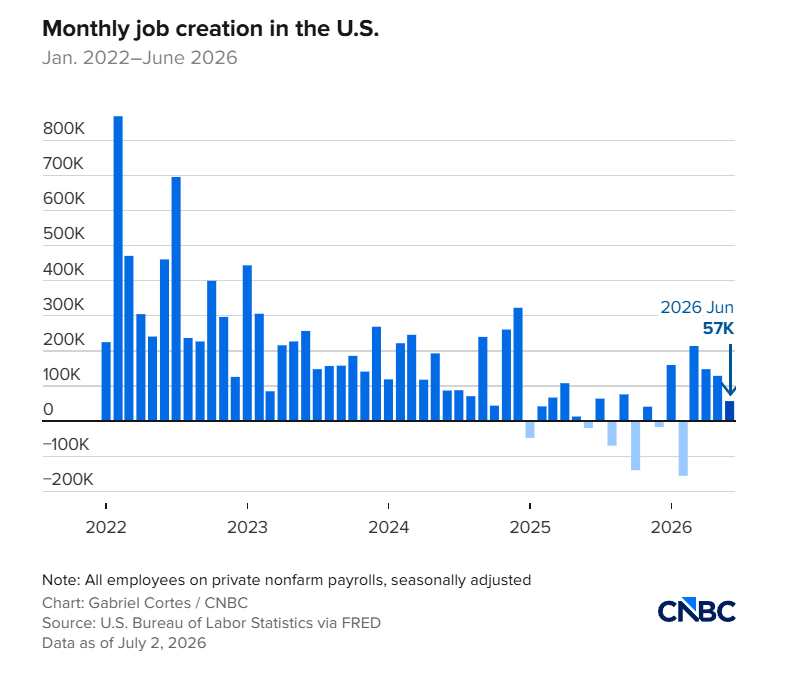
Forward-looking indicators have generally pointed to weakness. According to data released by the ADP Research Institute on Wednesday, private sector employment only increased by 44,000 jobs in July, the lowest monthly increase since January this year, and a further deceleration from 95,000 in June. Based on the huge 401 (k) payer data it has, Pioneer Group estimates that the increase in non-farm payers in July may be only 18,000. This estimate, which is far below the consensus, causes it to worry that “summer weakness may spread to fall.”
The balance of “low recruitment and low judgment” under a very low layoff rate
In stark contrast to laid-back recruitment, the other side of the labor market — the dismissal side — is unusually calm. According to data from the Ministry of Labor, the number of initial jobless claims for the week ending August 1 was 199,000 after seasonal adjustments, a slight increase of only 1,000 from the previous week, and is at the low end of the year in the range of 189,000 to 230,000. Unseasonally adjusted data, which better reflects real trends, fell to 175,000, one of the lowest levels in 60 years. According to a report by global re-employment agency Challenger, Gray & Christmas, the number of layoffs announced by US employers in July fell sharply by 27% month-on-month to 33,429, a year-on-year drop of 46%, the lowest since July 2024. The layoffs were mainly concentrated in the technology industry, and there were no widespread employment losses related to the widespread deployment of artificial intelligence (AI).
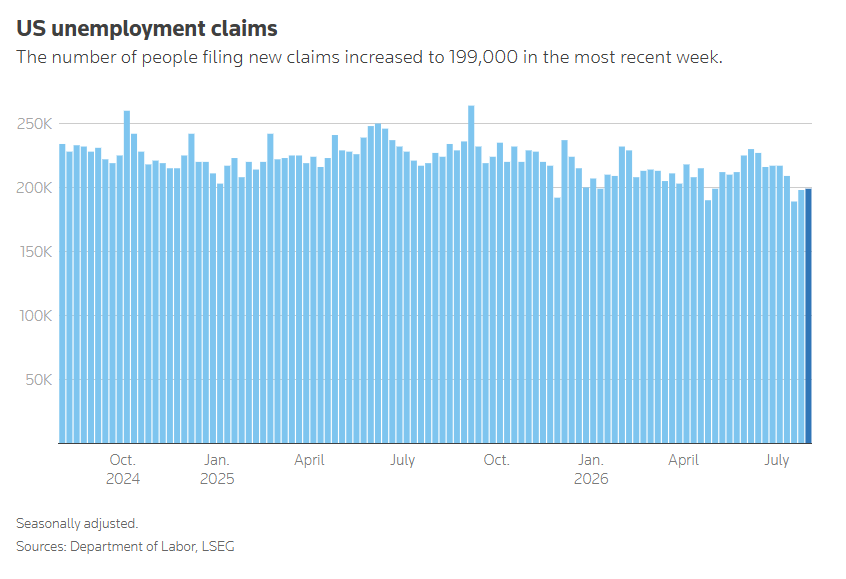
This “enterprise is unwilling to recruit people and is unwilling to lay off people” situation was accurately summed up by Federal Reserve Governor Lisa Cook as a “balanced state of low recruitment and low layoffs.” “Despite the low employment rate, the unemployment rate remains stable because layoffs are also low,” she said. The formation of this balance is rooted in the geopolitical and cost environment faced by enterprises: the war between the US and Israel has entered its sixth month, rising oil prices and rising inflation have boosted overall operating costs, and companies have chosen to adopt a conservative strategy of freezing recruitment and shelving vacant jobs in terms of controllable labor expenses. Furthermore, the Trump administration's continued immigration restrictions have drastically reduced the available labor pool, making it difficult for companies to find suitable candidates even if they intend to expand recruitment, further solidifying the companies' attitude of “retaining existing employees and not releasing people easily.”
However, this low recruitment situation has had a particularly severe impact on specific groups. Cook admits that this balance “hits particularly hard on some groups, including new entrants, and may reasonably dampen workers' emotions.” Young workers and newcomers trying to establish career paths are the most direct victims of the lack of employment opportunities.
The relaxation overshadowed by participation rates: the real temperature under the unemployment rate
The current 4.2% unemployment rate (June data, expected to remain unchanged in July) appears to be stable, but there is an unsettling indicator hidden behind it — a sharp drop in the labor participation rate. The labor participation rate unexpectedly collapsed to 61.5% in June, the lowest level since the economy was still affected by the COVID-19 pandemic in March 2021; if not during the pandemic period, it dates back to June 1976. What is particularly worrisome is that the “adult participation rate”, which covers the ages of 25 to 54, also declined sharply, to a new low since December 2023, and the biggest monthly decline since records were recorded other than when the outbreak was announced in April 2020.
The contraction in the participation rate means that the apparent stabilization of the unemployment rate is due in large part to the large number of workers leaving the labor market rather than the solid employment situation itself. In fact, since 2026, the total number of employed people in the US has been reduced by a cumulative total of 833,000 people. Economists will pay close attention to whether the participation rate rebounds in the July data — short-term fluctuations caused only by seasonal factors or statistical disturbances are fine; but if this trend solidifies, it indicates that the labor market's deep weakness far exceeds the overall unemployment rate.
Pioneer Group predicts, “The rise in non-participation rates reflects a slump in recruitment, which is particularly challenging for young workers... We expect most of the decline in participation rates to reverse in the next few months, but as these workers re-enter the workforce faster than they find jobs, it will put upward pressure on the unemployment rate.” In other words, even if there were no cliff-style declines in employment opportunities, just fixing the participation rate would be enough to push up the unemployment rate.
Citibank economist Veronica Clark clearly wrote in the report: “Although labor market data is still described as' stable ', we expect the situation to change in the next few months, and the unemployment rate will rise above 4.5%.” At that time, the market's focus will once again return to expectations of interest rate cuts.
Healthcare takes the lead, and the construction and service industries are on the rise
Under the total figures, the structural differentiation between industries is extremely remarkable. Since 2026, healthcare services such as hospitals and clinics have contributed more than half of the nation's new jobs, becoming the only solid pillar of the labor market at a time when it is shaky. This trend continued in July with little suspense. According to ADP data, the education and health services industry added 36,000 jobs in the same month, continuing to lead all major industries. An ongoing shortage of healthcare workers has forced employers to compete for qualified talent with high pay.
Another very different example comes from the construction industry. Although the industry saw only a slight increase of 1,000 jobs in ADP statistics in July, the salary increase for job-hitters soared to a record high. ADP chief economist Nella Richardson attributed this phenomenon to a sharp contradiction between the strong demand for AI-related data center construction and a severe shortage of skilled workers. She said, “Remuneration reflects a labor market that is not only unrelaxed, but may even be tightening slightly. What you're seeing is a local supply constraint.”
The overall pay dynamics also showed a divergence worth watching out for. Although the average hourly wage in the Department of Labor's report is expected to increase 0.3% month-on-month and 3.5% year-on-year in July — a growth rate similar to pre-pandemic and roughly in line with the Federal Reserve's 2% inflation target — ADP data showed that the annual salary growth rate for employees who changed jobs in July accelerated to 7%, the fastest since August 2025; the annual wage growth rate for employees who remained on the job also stabilized at 4.4%. The “partial tightening” of the labor market is particularly evident among low-income groups. According to the Bank of America Research Institute, the post-tax wage growth rate of low-income households climbed to 5.2% year-on-year in July. For the first time since the end of 2024, it was the first time since the end of 2024 against ultra-high income households, showing an “upward convergence” rather than a “downward flattening” trend. David Tinsley, the firm's senior economist, believes that this means “there are some signs of tightening in the labor market as a whole.”
Productivity jumps and the cost puzzle: will price pressure be solved as a result?
Just the day before the employment report was released, the Ministry of Labor released another set of key data: the productivity rate of non-farm workers grew at an annualized rate of 1.4% in the second quarter, which not only greatly exceeded market expectations of 0.6%, but also significantly higher than the revised value of 0.8% in the first quarter. From the fourth quarter of 2019 to the second quarter of 2026, the average annual growth rate of productivity reached 2.1%. The labor share index, which reflects workers' compensation as a share of output, fell to a record low of 52.9%, suggesting that capital and technology are reaping greater benefits.
The unexpected increase in productivity is due in part to the application of AI by enterprises, which allows more output to be extracted from existing employees even when labor growth is weak. Pantheon Macroeconomics economist Oliver Allen commented: “Weak labor growth may be driving companies to push out a little more of their current workforce.” Increased productivity effectively curbs unit labor costs. The annualized increase in unit labor costs in the second quarter was only 1.3%, a year-on-year increase of only 1.4%, far lower than expected. The increase in hourly pay was 2.7% per annum, which remained moderate.
If we only look at labor costs, the chain of wage transmission to inflation seems to have been digested by labor productivity. Richardson said that although the recent wage growth rate is worth watching, “I don't think this is enough to slide into a wage-driven inflation cycle.”
Yet another set of data unravels a more complicated side of the story. In the second quarter, unit non-labor payments — that is, non-labor factor costs such as corporate profits and indirect taxes — surged 14% per annum, the fastest growth rate in four years, and a 9% year-on-year increase. According to this, Stephen Stanley, chief US economist at Santander's US capital market, stated: “In the current environment, relatively moderate unit labor costs alone are not sufficient conditions to achieve a 2% inflation rate.” In other words, if corporate profits and non-labor costs such as energy and tax burdens continue to expand, even if wages do not rise, the overall price pressure will be difficult to dissipate. Christopher Rupke, chief economist at FWDBONDS, pinned his ultimate hope on AI: “Whether a true miracle of productivity can reduce some of the high price costs borne by consumers and businesses and control overall inflation depends on whether emerging advances in AI can actually enable workers to produce goods more cheaply and provide services at a lower cost.”
Is a rate hike close at hand or is it still possible to cut interest rates?
Amidst such mixed signals, the focus of the Federal Reserve's decision is still firmly locked on the side of inflation. Chairman Kevin Walsh defined the labor market as “stable” last week, and several officials made it clear that unless inflation clearly improves, austerity is still the direction. At last month's interest rate meeting, the Federal Open Market Committee kept the benchmark interest rate unchanged at 3.50% to 3.75%, but three members of the committee already preferred to raise interest rates by 25 basis points. Director Cook also publicly stated that if inflation still does not cooperate, she will support interest rate hikes.
However, the potential fragility of the labor market and the contraction in total employment that has already occurred are causing some observers to bet that policies will have to be reversed within the year. Citibank's forecast clearly deviates from market consensus. It is expected to restart interest rate cuts three times between now and January 2027. The first rate cut may be in the fourth quarter of this year. The central reason is that as the upward pressure on the unemployment rate due to the recovery in participation rates becomes apparent, the “stable” labor market will lose its protective color within a few months, and the Federal Reserve will then be forced to shift from focusing on inflation to caring for employment again. Pioneer Group is also concerned that if the summer slump continues into the fall, the probability of a policy shift will increase significantly.