


After the market on July 31, Ted Pharmaceuticals (03880) issued its financial statement for the 26H1 fiscal year. The company expects its current revenue to be approximately RMB 2,298-239.2 million, a year-on-year decrease of about 5.7-9.4%; net profit of about RMB 4940-57.1 million, a year-on-year decrease of about 44.0-51.6%; and a corresponding decrease of about 43.1-50.6% year-on-year in adjusted net profit.
The Zhitong Finance App observed that after hitting a phase high of HK$25 and the BOLL online trajectory on July 15, Ted Pharmaceuticals began a technical correction the next day. Until the close of trading on July 31, the company's stock price fluctuated near the middle of the BOLL line. However, after the announcement of the sharp decline in net profit was revealed, the willingness to sell on the market increased markedly. On August 3 and 4, Ted Pharma's stock price pulled a negative line for 2 consecutive trading days, with a cumulative decline of 11.20%, basically recovering the increase in early June.
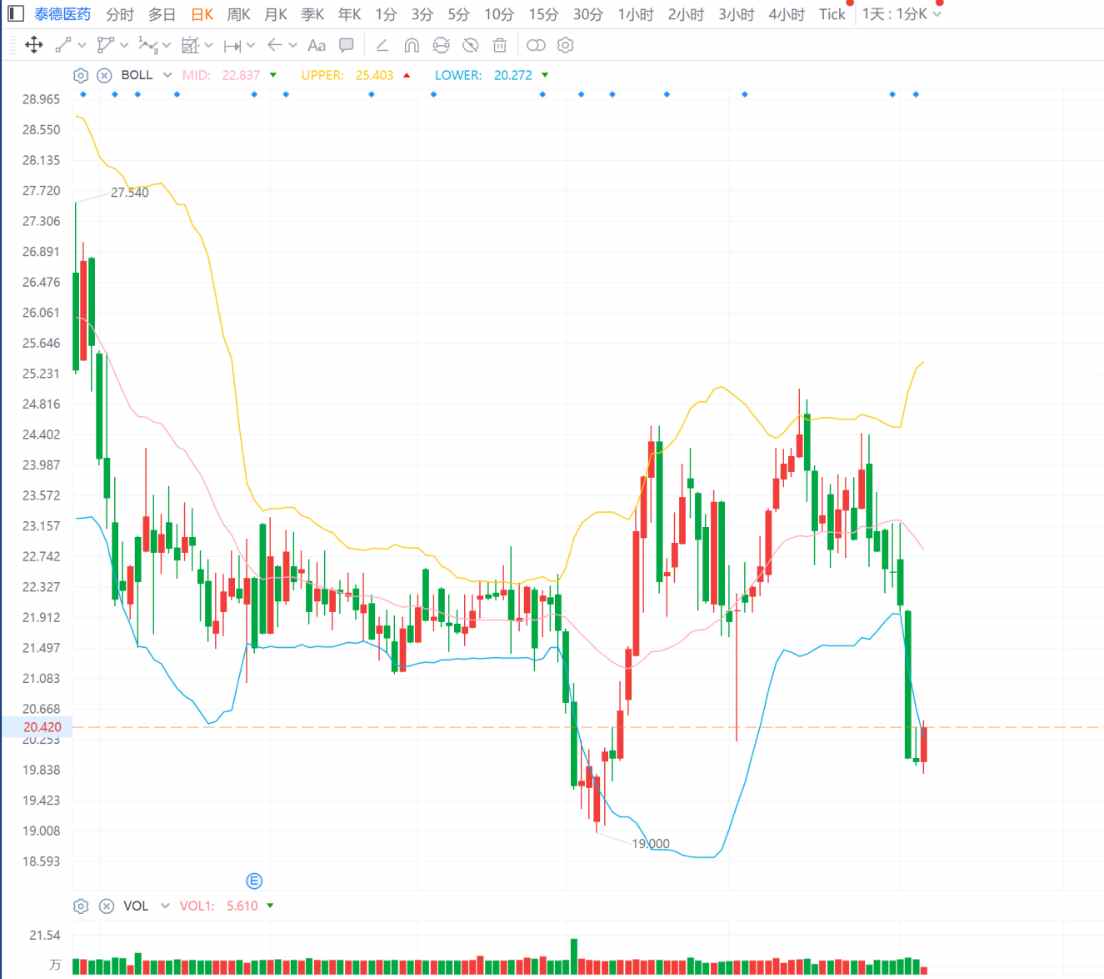
The IRG announcement and the fall in flat volume
Judging from Ted Pharmaceuticals's recent market, although the overall performance seems to have fluctuated dramatically, even showing six consecutive negative and large negative lines, below the K line, its intraday volume performance is still stable.
According to the data, from July 29 to August 3, that is, in the 4 trading days before and after the disclosure of Ted Pharma's profit warning announcement, the company's stock trading volume on the same day was 104,400 shares, 101,600 shares, 101,100 shares, and 108,500 shares, respectively. Even if Ted Pharmaceuticals's stock price pulled a negative line on August 4, its trading volume for the day was only 121,300 shares. The flat price drop indicates to a certain extent that the main capital in the market did not flee in a panic due to the company's profit alert.
Judging from the Yingjing announcement itself, Ted Pharmaceuticals mainly attributed the changes in its performance to the impact of the following comprehensive factors:
The decline in the company's revenue is due to the timing difference in revenue recognition: delivery of some customer orders and revenue recognition are expected to be delayed until the second half of 2026, leading to a phased decline in mid-term revenue.
However, the main reason for the decline in the company's profit is, firstly, that some of its cash and cash equivalents and trade receivables are denominated in US dollars, which has had a negative impact on profits due to the appreciation of the RMB during the reporting period; secondly, the company also lost an amount of non-recurring income; then, the company's business-side sales revenue declined year-on-year, leading to a year-on-year decline in gross profit.
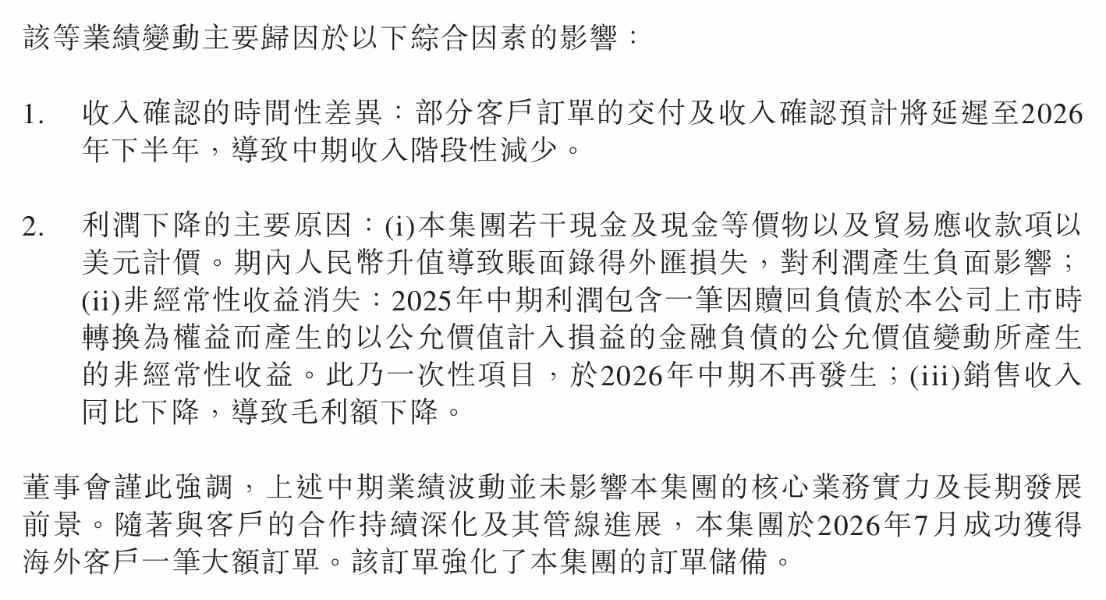
Finally, Ted Pharmaceuticals also emphasized in the announcement that the above fluctuations in interim results did not affect its core business strength and long-term development prospects. As cooperation with customers continues to deepen and its pipeline progresses, the company successfully obtained a large order from an overseas customer in July 2026, further strengthening the company's order reserves.
However, judging from the market, during the recent decline in Ted Pharma's stock price, although its stock price has continued to drop, the trading volume has always maintained a similar volume, and there has been no cliff-style exodus, indicating that the main capital did not ship on a large scale; it only passively followed the market to absorb the floats.
Judging from the chip structure, compared to Ted Pharma's on-market chip structure on August 5 and June 5, investors can easily see that although the company's stock price showed a wave of M-shaped trends within these 2 months, the main capital in the market has remained low at HK$21-22, all lower than the average cost of chips. The difference is that chips above the cost line have changed greatly. In the process of continuing to operate at low prices, most fundraisers in Ted Pharmaceuticals who cost more than HK$27 chose to “cut meat” to push the overall chips towards the cost balance.
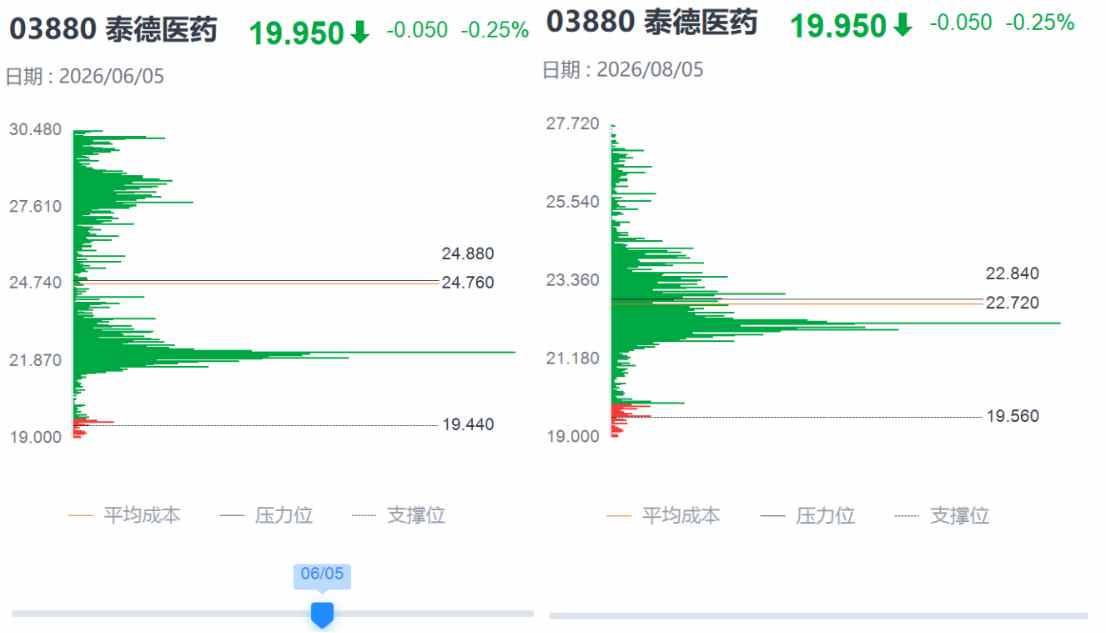
Looking at it now, even after several trading days, Ted Pharma's stock price continued to hit a phased low level as of August 5, indicating that the air power has not yet been released. At present, Ted Pharmaceuticals has yet to gradually rise from its low point of several consecutive trading days to completely end the downward trend, and there has been no significant shift in the key quantitative energy balance. Generally speaking, in the absence of exploratory entry of incremental capital, investors still need to wait for market capital attention to increase and market trading sentiment to change from cold to warm.
Can the Hong Kong stock CXO market be used to achieve a rebound in valuation?
Recently, Hong Kong pharmaceutical concept stocks have collectively risen, and the CXO and innovative drug sectors have exploded, driving a strong rebound in the Hang Seng Healthcare Index. On August 4 and 5, the index closed up 2.02% and 1.18%, respectively.
In fact, the recovery of Hong Kong Stock Pharmaceuticals began in late June of this year, mainly due to the fact that the CXO leaders in the sector exceeded expectations, which led to an outbreak of sentiment in the entire sector, driving innovative drugs and medical devices to rise at the same time.
Taking the August 4 market as an example, the Hong Kong stock CXO sector saw a wave of individual stocks rising collectively. Among them, Yao Ming Kangde's stock price surged 11.17%, while Kanglong Chemical and Tiger Pharmaceuticals both rose more than 5%. Positive feedback from the secondary market has benefited from the strong performance of Hong Kong stock CXO industry leaders: for example, Pharma Ming Kangde's 26Q2 revenue and profit reached a record high. The company not only raised its annual guidelines, but also declared an interim dividend of 1,506 billion yuan, verifying the recovery in global demand for pharmaceutical research and development; the performance of Kanglong Chemical, another leading company, showed that its new orders had increased by more than 30% in the current period, intuitively showing the high prosperity of the industry.
It is easy to see from the mid-report results disclosed by leading Hong Kong stock CXO sectors that the Hong Kong stock CXO sector already has a basis for repairing medium- to long-term allocation values, but the overall rise is difficult to sustain. Diversification within the sector may lead the market out of a more volatile structural market. The continuity of CXO orders will also be an important basis for investors to differentiate the fundamentals of individual stock companies.
Looking at the peptide segmentation circuit, Cognitive Market Research data shows that the global peptide API market size is about 9.60 billion US dollars in 2025, and it is expected to expand at a compound annual growth rate of 23.50% from 2025 to 2033. As the popularity of innovative peptide drug development rises, related outsourcing demand is expected to continue to expand.
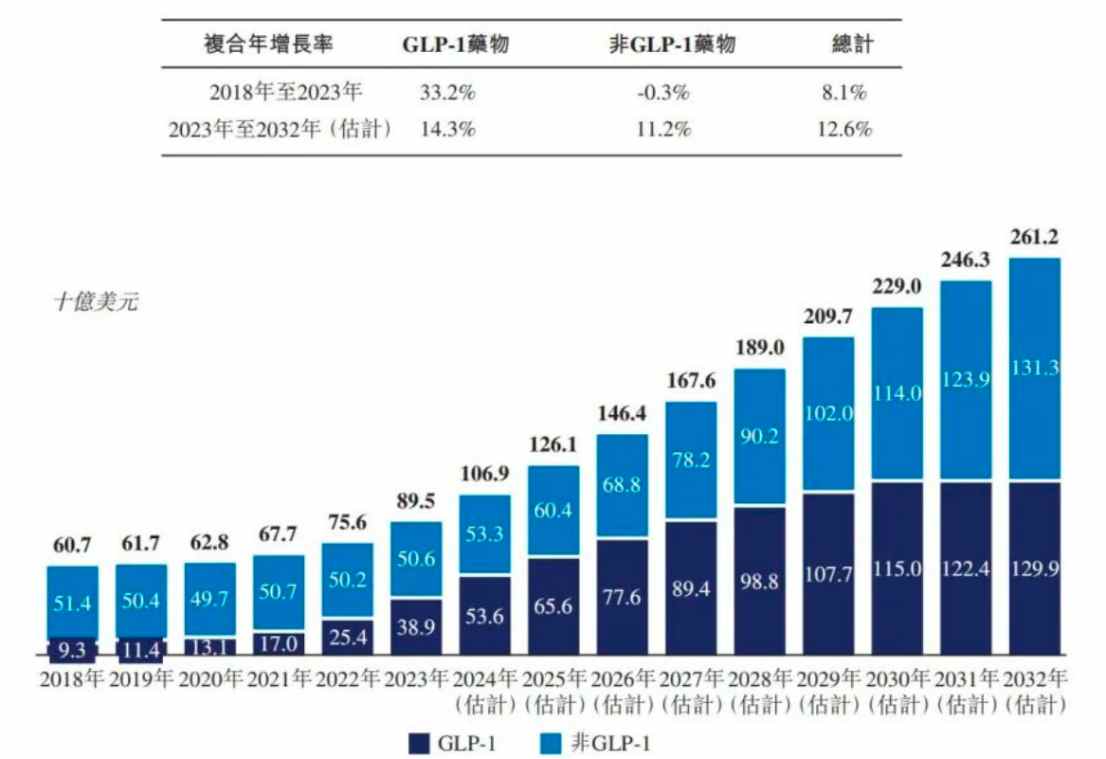
According to Frost & Sullivan estimates, the global GLP-1 drug market grew from US$9.3 billion in 2018 to US$38.9 billion in 2023, with a compound annual growth rate of 33.2%, and is expected to further grow to US$129.9 billion in 2032. China's GLP-1 market also grew from US$100 million in 2018 to US$1.3 billion in 2023, with a compound annual growth rate of 65.3%, and is expected to further grow to US$23.2 billion by 2032, with a CAGR of 37.3%.
In addition to the medium- to long-term market sentiment, in the first half of 2026, of the 52 peptide clinical projects it served, 19 were related to weight loss projects. The company revealed in the Q1 financial report that its target production capacity for solid phase peptide synthesis will increase dramatically from 45,000 liters to 69,000 liters by the end of the year, expanding production by 53%, and this pace of production expansion is even highly consistent with the growth rate of orders in hand.
As far as Ted Pharmaceuticals is concerned, as the world's third-largest peptide CRDMO, Ted Pharmaceuticals not only achieved US FDA registration for terpotide APIs, but its simeglutide APIs were also included in the FDA green list; on July 31, the company also completed the US FDA pre-marketing inspection (PLI) for HEPCLUDEX® APIs. A series of business-side developments also confirm what the company emphasized in Yingjing that “fluctuations in performance have not affected its core business strength and long-term development prospects.”
From a valuation perspective, after continuous stock price declines, Ted Pharma's latest PE valuation is only 12.43 times, far lower than the industry average of 23.34 times, and about 17% lower than its PE valuation in the past three months. The current valuation is already below the company's reasonable valuation range. And this may also indicate that this peptide CXO target has a short-term chance of overfalling and rebounding.