


Archimedes once said, “Give me a lever and a place to stand, and I can move the world”.
Thousands of years later, investors continue to talk about the power of leverage.
However, when investors discuss leverage, they usually refer to the amount of debt they use. But there is an even more powerful type of leverage that many investors ignore – operating leverage.
Debt, or financial leverage, uses other people's money to invest more than what you would be able to do without it, magnifying returns (or, if things go the other way, losses).
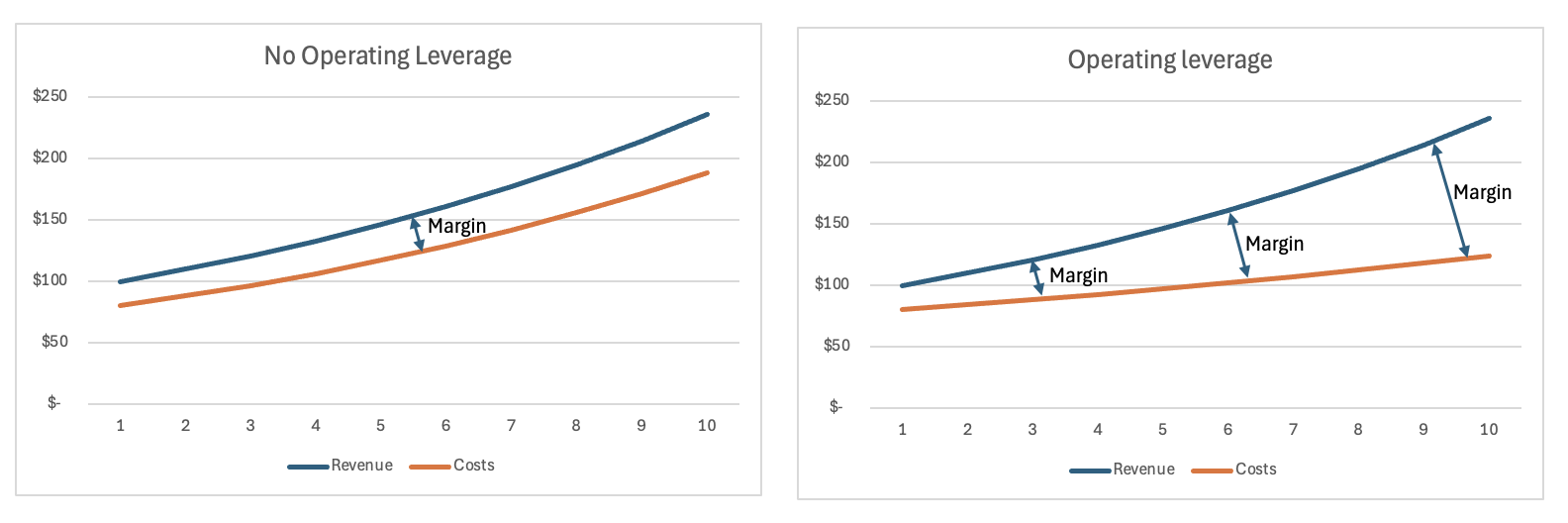
But operating leverage is different. It happens when a company’s cost structure is largely fixed, which are costs that don’t change much as activity changes, meaning that costs don’t grow as fast as revenue, leading to increased profit margins over time. Of course, like in the case of financial leverage, if revenue goes backwards, profitability will fall at a faster rate than revenue.
Why this ASX stock is building profit, not buildings
A great example of operating leverage in action is ASX stock and Australian alternative investment manager Qualitas (ASX:QAL).
Although Qualitas’ business is largely focused on the Australian real estate market, it does not own properties directly. Instead, it manages a series of investment funds which invest in assets across different real estate asset classes such as real estate private equity, developments, and private credit, amongst others.
This means it has more in common with a fund manager, a textbook example of a business model with lots of operating leverage, than your average real estate investment trust (REIT).
Because of how Qualitas generates revenue, there is little incremental cost incurred as it grows. This means that while Qualitas continues to generate strong revenue growth, its earnings growth may persistently outpace it.
While it can launch new investment products or take in new investment capital in its funds, it doesn’t need to pay for additional inventory, land, or even necessarily increase the number of people it needs to employ to function as it grows.
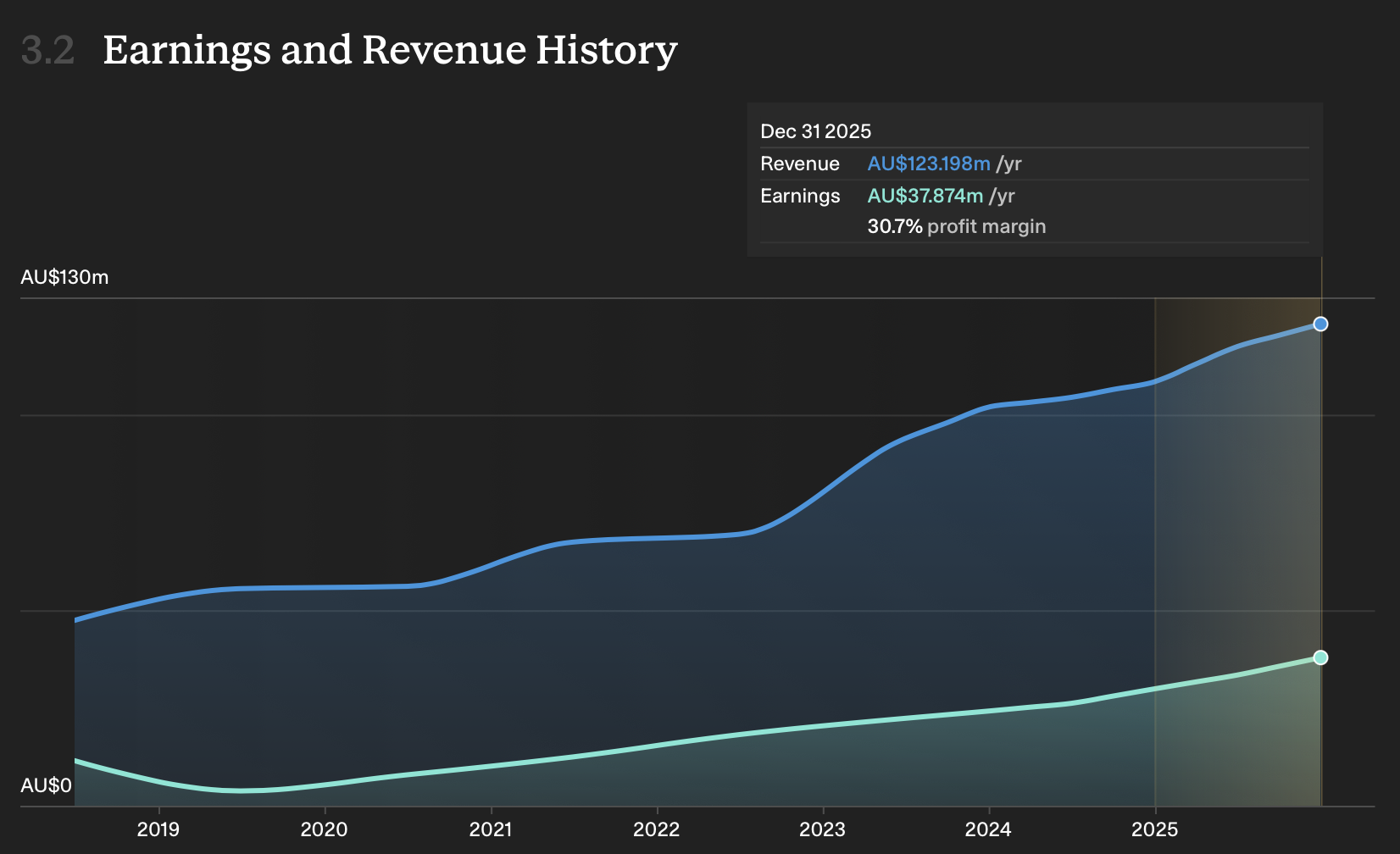
This can be observed in Qualitas’ historical financial performance.
In 2018, Qualitas generated $11.5 million in net earnings on approximately $47.4 million of revenue (or a 24.1% net margin). By the end of the 2025 calendar year, on a trailing twelve-month basis, Qualitas was generating $37.9 million in net earnings on $123.2 million of revenue (or a 30.8% net margin). This means that in around seven years, revenue had increased by 160%, and earnings had increased 229%.
How Qualitas does it
The key to Qualitas’ success, in part, comes from its business model.
As we discussed earlier, it does not own and operate property directly. Instead, it creates and manages investment funds that revolve around different mandates aimed at the real estate industry, some owning property, others investing in asset classes like real estate private credit and other financing.
Most traditional real estate companies borrow money to purchase blocks of land and construct buildings and/or rent them out. Whereas Qualitas uses the capital of its investors to invest in assets that will generate management fees and performance fees, amongst other revenue sources. The total of this invested capital is called funds under management or FUM.
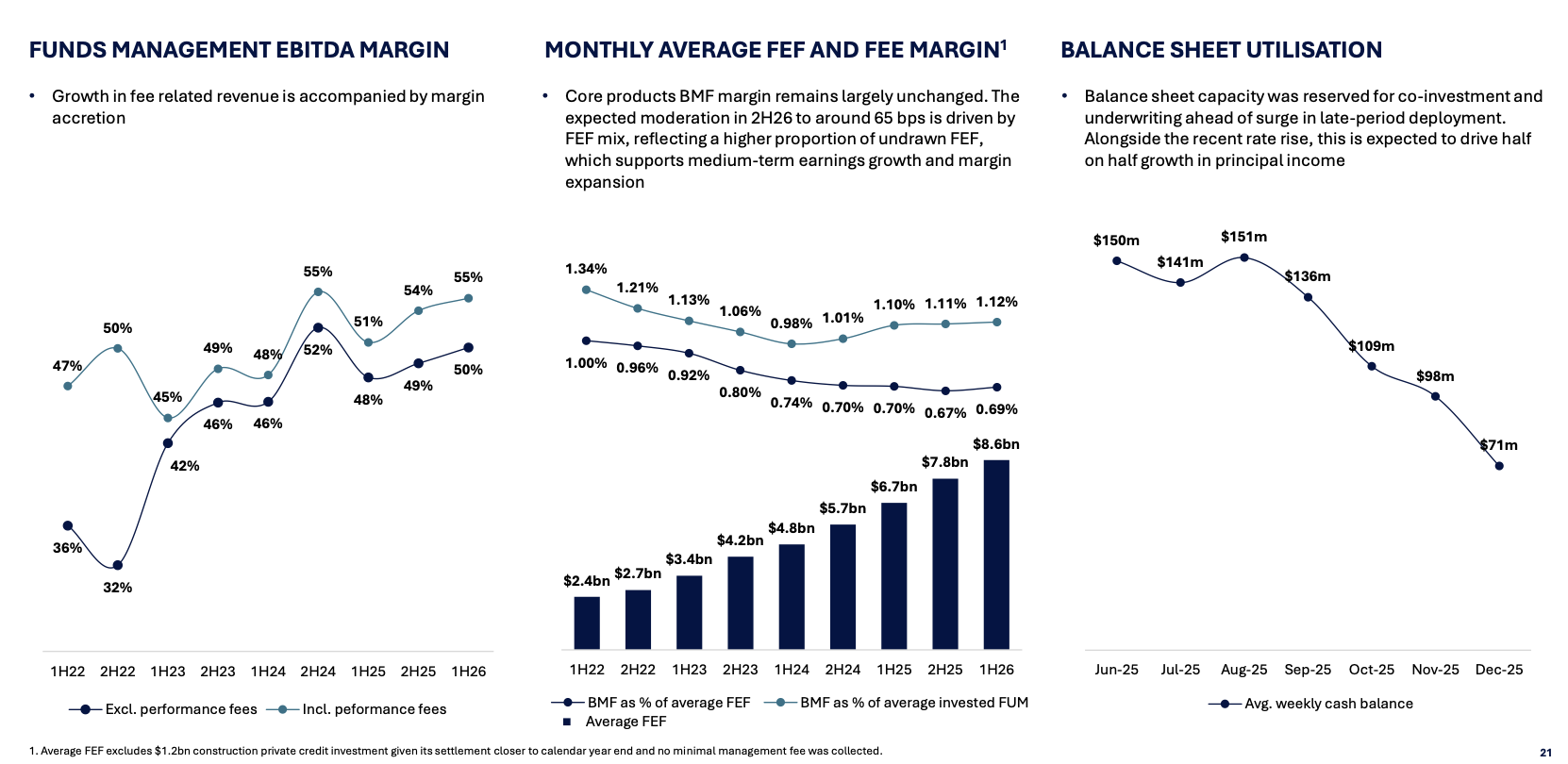
However, for Qualitas, growing funds under management does not necessarily come with a requirement for more inventory, material or even employees. It can, and continues to be focused on, growing revenue without requiring a significant increase in expenses.
As shown in the image above, this shows how as funds under management (which they call the average FEF or fee-earning funds under management) grows, the EBITDA or operating profit margin (before depreciation and amortisation) has increased.
Why operating leverage matters
Earnings typically help drive share prices, so if a company can grow earnings sustainably, at a strong rate, it is often viewed as a potential investment opportunity.
However, how a company grows earnings is also important.
Where some companies need to take on increased costs or risky debt to fund this growth, those that can show operating leverage through their business models are able to accelerate earnings growth simply because their already strong revenue growth is coming at little extra cost, and therefore can disproportionately flow into the company coffers.
While most investors think of software companies and equity fund managers as the stereotypical examples of companies with strong operating leverage, Qualitas is an example of an ASX stock which is exposed to the real estate industry, and is also able to reap the rewards of operating leverage.
As a result, the business can showcase years of earnings growing faster than revenue.
And management expects this to continue into the future.
It is not only management that sees room to run. It can be worth seeing how other investors weigh the same dynamics. The most followed narrative for Qualitas from the Simply Wall St Community sets out the growth drivers and risks behind its $4.24 fair value estimate, which implies around 29% upside.
Disclaimer
This article is paid promotional content, commissioned and paid for by Qualitas ("the Issuer"). The Issuer has paid Simply Wall St a one-time cash fee of $22,500 AUD for marketing services to be provided over a term of Six Weeks commencing 21 Jul 2026. Simply Wall St has maintained full editorial independence over this article, and the Issuer has had no influence over the opinions, analysis, or recommendations expressed. Simply Wall St was provided with the following information by the Issuer in connection with the preparation of this article: a webinar video featuring Qualitas (ASX:QAL) and Andrew Schwartz, dated 10 July 2026. Simply Wall St has no other or prior agreement with the Issuer.
Simply Wall Street Pty Ltd (ACN 600 056 611) is a Corporate Authorised Representative (Authorised Representative Number: 467183) of Sanlam Private Wealth Pty Ltd (AFSL No. 337927). Any advice contained in this article is general advice only and has been prepared without considering your objectives, financial situation or needs. You should not rely on any advice and/or information contained in this article, and before making any investment decision we recommend that you consider whether it is appropriate for your situation and seek appropriate financial, taxation and legal advice. Please read our Financial Services Guide before deciding whether to obtain financial services from us. This article is for informational purposes only and does not constitute an offer to sell or a solicitation of an offer to buy any securities, nor does it constitute legal or tax advice. Please do your own research before investing, including reading the Issuer's ASX announcements, press releases, and risk disclosures, and any applicable prospectus or offering memorandum. The information in this article was obtained from the Issuer and from publicly available sources; Simply Wall St cannot guarantee its accuracy and assumes no obligation to update it, and prospective investors should conduct their own due diligence.
Have feedback on this article? Concerned about the content? Get in touch with us directly. Alternatively, email editorial-team@simplywallst.com
Simply Wall St analyst Andrew Legget and Simply Wall St have no position in any of the companies mentioned. This article is general in nature. We provide commentary based on historical data and analyst forecasts only using an unbiased methodology and our articles are not intended to be financial advice. It does not constitute a recommendation to buy or sell any stock and does not take account of your objectives, or your financial situation. We aim to bring you long-term focused analysis driven by fundamental data. Note that our analysis may not factor in the latest price-sensitive company announcements or qualitative material.