


The Zhitong Finance App learned that Cui Dongshu, Secretary General of the Passenger Transport Association, published an article stating that from January to July 2026, automobile exports were 6.4 million units, a sharp increase of 54% over the same period last year. Among them, 1.092,000 units were exported in July, with a year-on-year growth rate of 57% and a slight increase of 2% month-on-month, with outstanding explosive growth. From January to July 2026, total automobile exports reached US$110.8 billion, a sharp increase of 55% over the previous year, and the growth rate returned to a high level. Vehicle exports in July were US$19 billion, up 60% year on year and 4% month-on-month, breaking the rule that July 2023-2025 was slightly lower than May.
Total parts exports from January to July 2026 were US$60.7 billion, up 8% year on year, and the growth rate rebounded slightly from the first half of 2025. Auto parts exports in July were 9.38 billion US dollars in a single month, up 14% year on year and 4% month on month. After high growth in June, the trend was stable in July.
Auto parts exports grew steadily at the same time this year, focusing on serving mature markets in Europe and the US. Relying on a perfect supply chain system, they provided stable support for global car companies, forming a cross-complementary pattern where “parts are deeply cultivated in Europe and America, and vehicles spread globally”. The synergy effect of the industrial chain is prominent, and jointly supports the continuous improvement of the global competitiveness of the Chinese automobile industry.
1. China's automobile exports have exploded
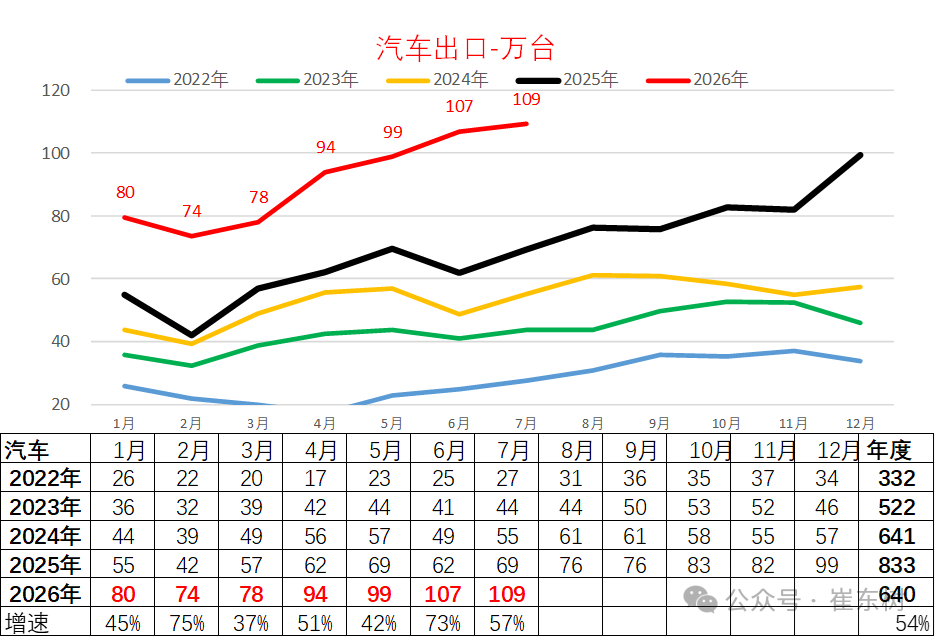
Automobile exports continued to rise from January to July 2026. The monthly value rose from 800,000 units in January to 1.09 million units in July. There was only a slight correction in February, and the overall growth momentum was strong.
Compared with the same period in previous years, the overall export volume in each month of 2026 surpassed the same period of 2022 to 2025. The monthly growth rate exceeded 54%. The year-on-year growth rate in July reached 57%. The cumulative export rate in January-July was 6.4 million units, a year-on-year increase of 54%.
Demand from overseas markets continues to be released, and the competitiveness of domestic cars going overseas has steadily increased. The scale and growth rate of automobile exports since April have all reached new highs in the same period of the year.
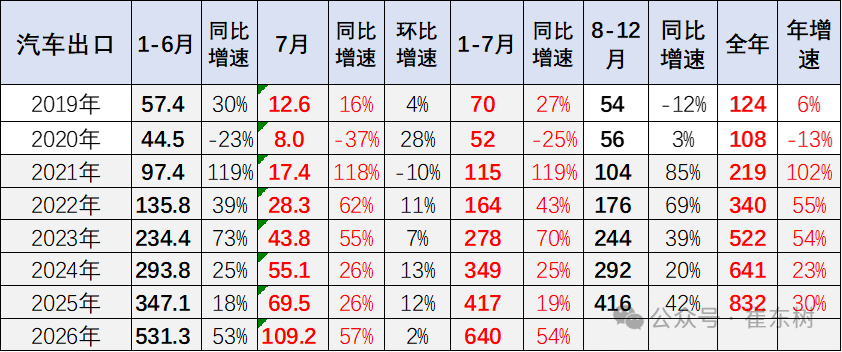
In 2026, China's automobile exports will experience explosive growth. From January to July 2026, automobile exports were 6.4 million units, a year-on-year increase of 54%, far exceeding the same period in previous years. Among them, 1.092,000 units were exported in July, with a year-on-year growth rate of 57% and a slight increase of 2% month-on-month. The explosive growth was outstanding.
Reviewing the trend of 2019-2025:2021 ushered in an explosion of overseas travel, and the subsequent growth rate slowed year by year; positive month-on-month growth was achieved in July 2026, and the complementarity of domestic and overseas demand increased significantly.
2. China's automobile exports continue to rise
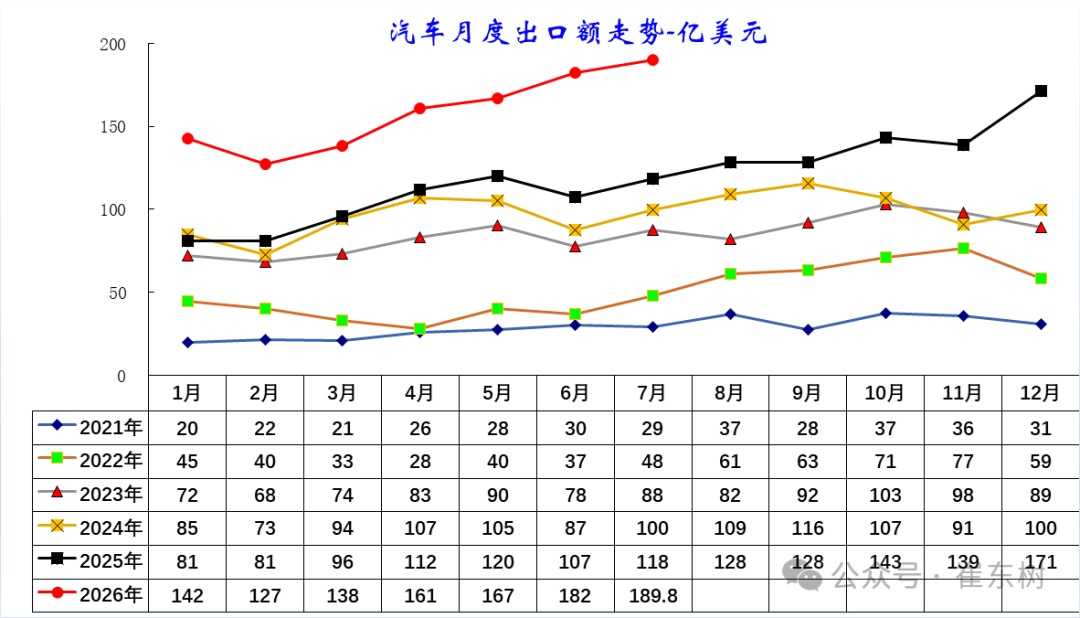
Automobile exports continued to rise strongly from January to July 2026. The monthly amount rose from US$14.2 billion in January to US$19 billion in July. In February alone, there was a slight month-on-month decline, and the monthly values were significantly ahead of the same period from 2022 to 2025.
Compared to previous years, the export value base in 2022 was the lowest, and fluctuations were moderate throughout the year; there was a steady increase in 2023-2025, but the monthly peak was lower than the level of the first half of 2026.
The growth rate of export value was significantly higher than the growth rate of export volume, reflecting the continued rise in the average price of bicycle exports, the increase in the share of new energy and high-end models, and the shift from large-scale expansion of automobile exports to an increase in value.
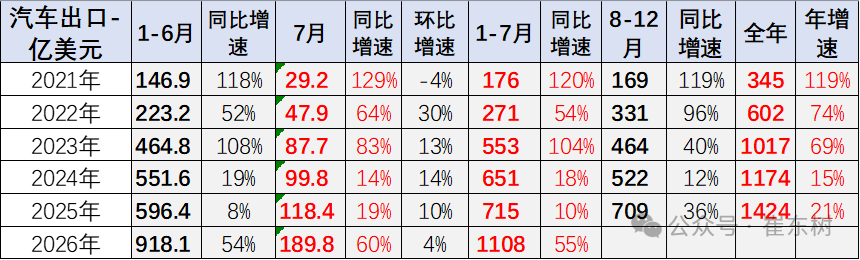
From January to July 2026, total automobile exports reached US$110.8 billion, a sharp increase of 55% over the previous year, and the growth rate returned to a high level. Vehicle exports in July were US$19 billion, up 60% year on year and 4% month-on-month, breaking the rule that July 2023-2025 was slightly lower than May.
3. Auto parts export trends
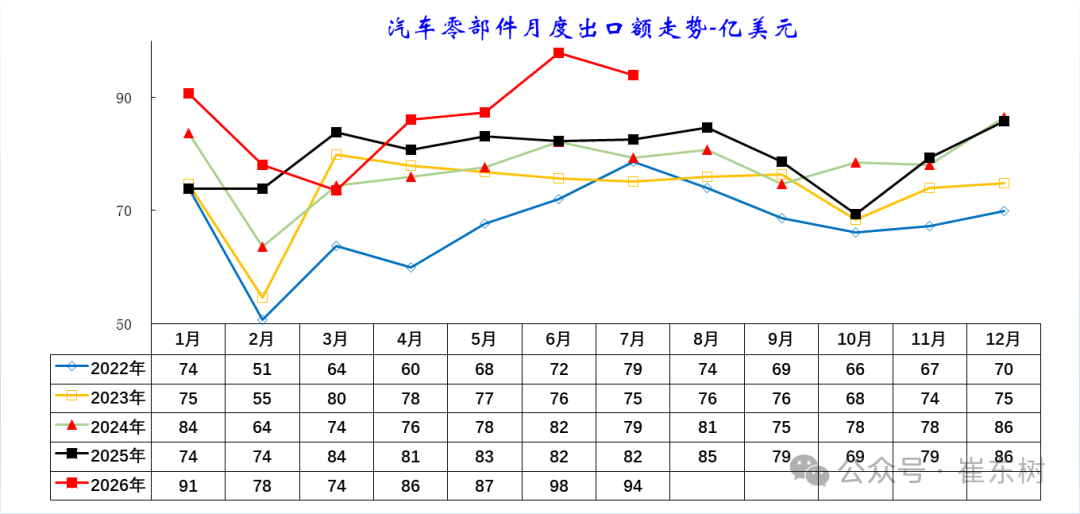
The trend in parts exports was strong in 2026, rising to US$9.1 billion in January and US$9.8 billion in June. There was only a slight correction in March. The monthly values for January-July were higher overall than in the same period of 2022 - 2025.
The rule in previous years was that exports were low for the whole year in February, to 7.8 billion US dollars in February 2026, which is significantly higher than the bottom of the same period in previous years. The monthly scale for the period from 2022 to 2025 remained in the $50-8 billion range all year round, breaking through the upper limit of the range from June to July 2026.
Vehicle exports are driving an increase in external demand for supporting parts, and overseas demand for new energy components is increasing, supporting the continued rise in parts exports.
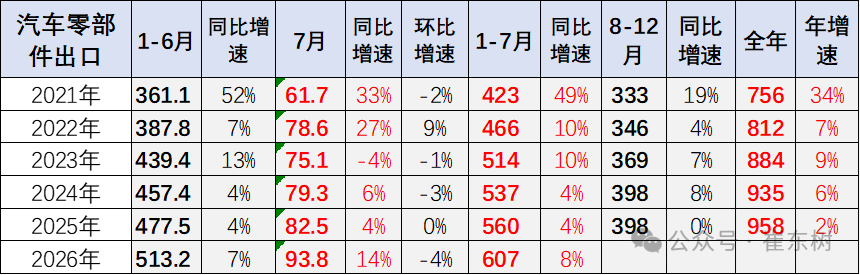
Total parts exports from January to July 2026 were US$60.7 billion, up 8% year on year. The growth rate rebounded slightly from the same period in 2025. Auto parts exports in July were 9.38 billion US dollars in a single month, up 14% year on year and 4% month on month. After high growth in June, the trend was stable in July.
The growth rate of parts exports continued to be low from 2022 to 2025. There was a slight year-on-year increase in June-July 2025, and the boom was weak. In 2026, along with the large volume of vehicle exports, external demand for supporting parts picked up at the same time. Production and marketing support orders were released centrally in June-July, and the monthly export scale reached a new high in the same period in recent years.
As an important support for vehicle exports, the steady growth in parts exports has built a solid supply chain foundation for the global layout of China's automobile industry, and also provided a continuous supporting guarantee for subsequent vehicle exports.