


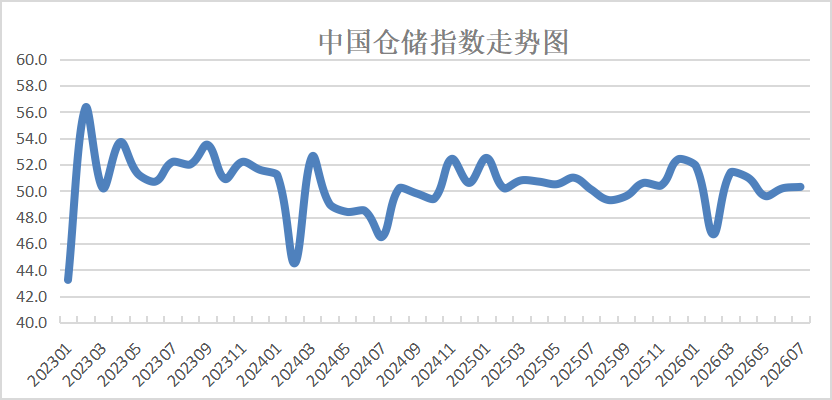
The Zhitong Finance App learned that on August 7, the China Warehouse Index, which was jointly surveyed by the China Federation of Logistics and Purchasing and China Storage Development Co., Ltd., was 50.3% in July 2026, up 0.1 percentage points from the previous month, and has been in the expansion range for two consecutive months. Demand for the warehousing business has continued to grow moderately, commodity turnover efficiency has improved markedly, value-added service capabilities have been enhanced, and business upgrades have accelerated markedly. Overall, the warehousing industry continues to expand despite seasonal climate and extreme weather disturbances, and the operation of the industry is quite resilient. Specifically, this month's index has the following characteristics:
New orders continue to expand, and demand resilience is good. In July, the new orders index was 51.4%, down 2.6 percentage points from the previous month. It is still operating in the expansion range, and demand for the warehousing business grew moderately. The facility utilization index was 50.5%, down 3.5 percentage points from the previous month. It remained on the boom and bust line, and the utilization rate of storage facilities remained at a good level. Macroeconomic performance slowed down in July due to seasonal climate and extreme weather factors such as high temperatures, rain, and typhoons, but the new storage order index remained in the expansion range, reflecting the strong ability of the warehousing sector to cushion short-term fluctuations. By type, the index of new coal orders rose markedly. The peak of electricity consumption in summer led to strong demand for electricity and coal, and the related warehousing business grew steadily; the index of new food orders increased significantly, and demand for summer consumption, travel and catering led to a better increase in demand for food storage. Major products such as steel and non-ferrous metals were affected by the slowdown in demand in the manufacturing industry and the entry of some industries into the off-season, and new orders for warehousing declined somewhat.
Inventory levels continued to decline, and turnover efficiency improved markedly. In July, the inventory index at the end of the period was 47.5%, operating in a contraction range for two consecutive months, indicating that the overall inventory level of the industry continued to decline, and the trend of de-inventory continued. The average inventory turnover index was 52.5%, up 3 percentage points from the previous month, which is an important supporting factor for the recovery of the storage index this month. Judging from the survey, the increase in inventory turnover efficiency is mainly due to the increase in warehousing and exit activities driven by the release of stocking demand for some types of non-ferrous metals, coal, chemical products, food, etc.
The volume of extended business increased markedly, and the upgrading of warehousing business accelerated markedly. In July, the extended business volume index was 53.8%, a sharp increase of 7.8 percentage points from the previous month to a higher boom level. The business upgrade of warehousing enterprises has been significantly accelerated, value-added service capabilities have been enhanced, and the transformation from simple warehousing to integrated supply chain services has accelerated. By category, the extended business volume index for consumer goods such as food, agricultural and sideline products is high, reflecting strong demand for value-added services in the consumer goods warehousing sector.
The number of employees continues to grow, and the company's expectations are stable and improving. In July, the enterprise employee index was 50.9%, up 0.4 percentage points from the previous month. The employment demand of warehousing enterprises was stable, and the industry's ability to absorb employment continued to improve. The expected business activity index was 52.3%, a slight decrease of 0.2 percentage points from the previous month, but it remained at a high level in the expansion range, and warehousing companies maintained optimistic expectations about market trends. Looking at the later stages, as the effects of extreme weather gradually subside and policies such as the “six networks” and “two new” continue to be implemented, demand for warehousing business is expected to be further released, and the industry has a stable and positive foundation.