


Key Points
Taiwan Semiconductor's success would not be possible without ASML's vital EUV machines.
Equipment from Applied Materials handles critical processes in semiconductor development.
Many investors argue that Taiwan Semiconductor Manufacturing (TSMC) is the most crucial chip company. Given that it manufactures the chips designed by Nvidia, Broadcom, and other chip giants, the industry would collapse without it.
Unfortunately, TSMC built most of its fabs in Taiwan, a geopolitical hotspot. While an invasion of Taiwan is unlikely, investors have to account for the possibility of such an event, one that could cost the company most of its production capacity.
Missed Nvidia in 2009? This Rare Signal Is Flashing Again. In 2009, a "Double Down" signal flashed for a little-known chipmaker called Nvidia. For the first time in years, that same "Total Conviction" signal is flashing for a company 1/100th the size of Nvidia. Continue »
Knowing that, investors may want to look to the equipment makers, and these two semiconductor stocks could drive returns.
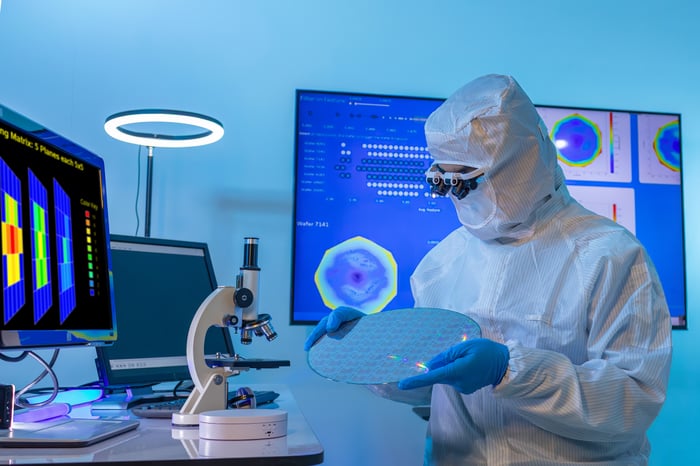
Image source: Getty Images.
ASML
ASML Holding (NASDAQ: ASML) is the only company that makes the extreme ultraviolet lithography (EUV) machines that help produce TSMC's most advanced chips. So the industry needs ASML to advance, and with it based in the Netherlands, it doesn't face the same geopolitical dangers as TSMC.
The projected compound annual growth rate (CAGR) of the AI sector is 29% through 2030, according to Grand View Research. This implies that ASML's equipment is becoming more valuable than ever. Since 29% of the company's revenue in the first half of 2026 came from maintaining those machines, the company should continue to earn some recurring revenue.
It shouldn't surprise investors that ASML's revenue rose by 17% annually over the same period. That led to a net income of nearly 5.7 billion euros ($6.5 billion) in that period, a 22% yearly increase. Amid that improvement, the stock is up 145% over the last year.
Its trailing P/E ratio of 53 makes the stock appear expensive. Nonetheless, growing profits take its forward P/E down to 39, and as industry expansion continues, customers like TSMC and others should stoke higher demand for ASML's equipment.
Applied Materials
Materials engineering company Applied Materials (NASDAQ: AMAT) takes a different approach than ASML. Like ASML, it sells equipment to make semiconductors. However, instead of focusing only on lithography, Applied Materials' equipment performs other steps in the chip development process. That includes material deposition, etching, and polishing.
Applied Materials faces more competition than ASML, as companies like Lam Research and KLA produce equipment that performs many of these functions. Still, with high demand for AI chips, it should continue to prosper.
Indeed, the pace of growth has just begun to quicken. With an annual revenue increase of 7% in the first half of 2025, it may not match the industry's growth. Also, even though the $4.8 billion it earned in the first half of 2026 grew by 45%, most of that rise came from interest income.
Nonetheless, analysts project 18% revenue growth this year and 29% in 2027. That accelerating growth may have helped the stock rise by over 200% over the last year. Those improvements should also make the P/E ratio of 52 and the forward P/E of 45 more palatable as investors seek to capitalize on this bull market in Applied Materials stock.
Will Healy has no position in any of the stocks mentioned. The Motley Fool has positions in and recommends ASML, Applied Materials, Broadcom, KLA, Lam Research, Nvidia, and Taiwan Semiconductor Manufacturing. The Motley Fool has a disclosure policy.