


On June 26, 2025, Junshengtai Pharmaceutical-B (02511) issued an announcement announcing that it plans to place shares at a price of HK$2.21 per share at a discount of about 15%. The placement was completed on July 7 of the same year, for a total of 56.555 million shares, raising a net allocation of HK$131 million.
The Zhitong Finance App observed that during this round of placement of Junshengtai Pharmaceutical, from the announcement of the placement to the completion of the placement, the company's stock price not only did not fall below the allotment price, but instead increased by about 8.9%; after completing the placement, the company's stock price rose sharply by 29.35% within 4 trading days.
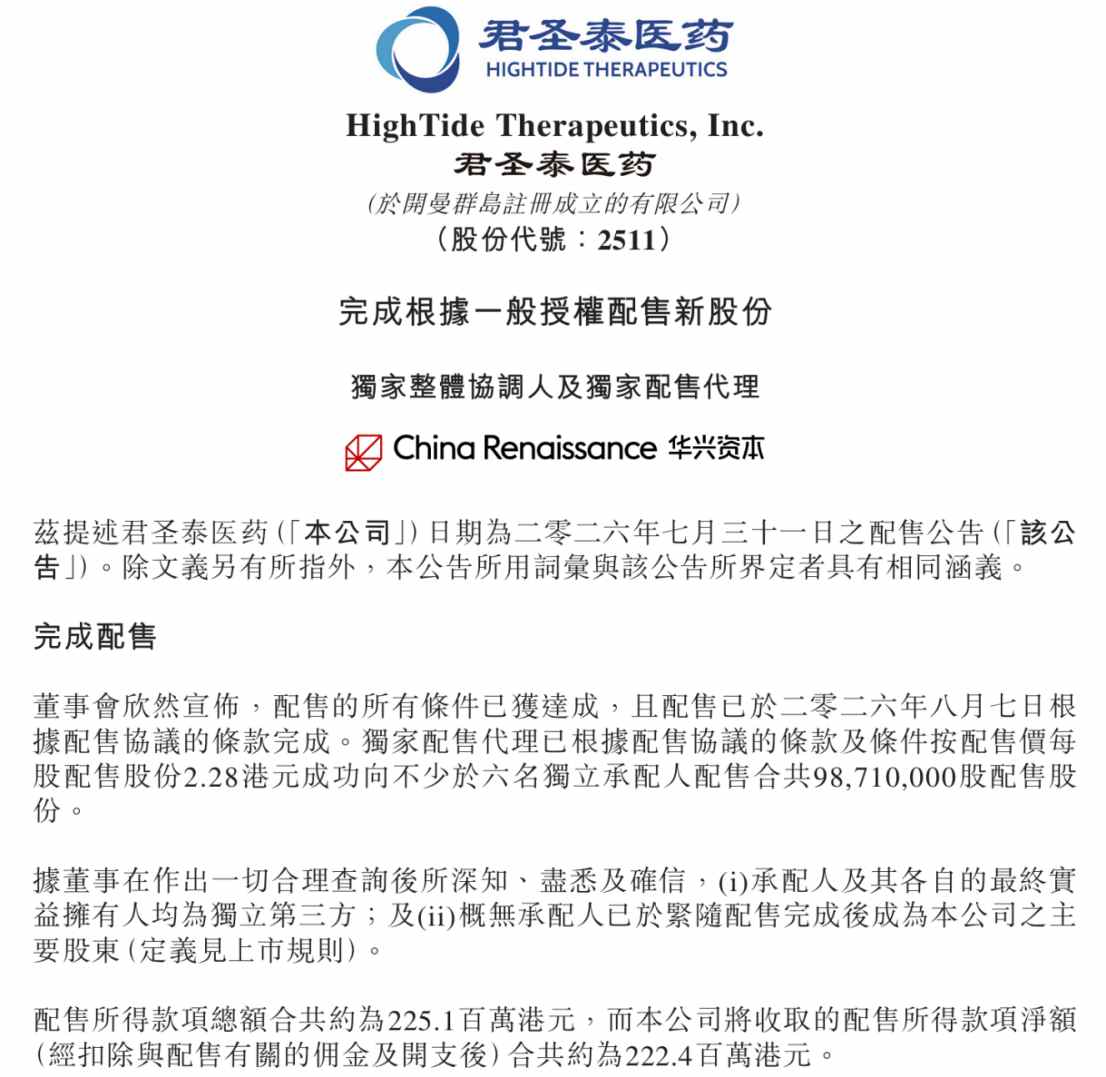
On August 7, 2026, Junshengtai Pharmaceutical announced that a new round of placement of 98.71 million shares has been completed, with a net raise of approximately HK$222 million. The company's stock price closed up 16.84% on the same day and climbed 30.77% over 5 trading days. Is this a new round of “arbitrage opportunities” for market investors after the company's distribution?
The stock price retracted by more than 40%, why did market sentiment fluctuate?
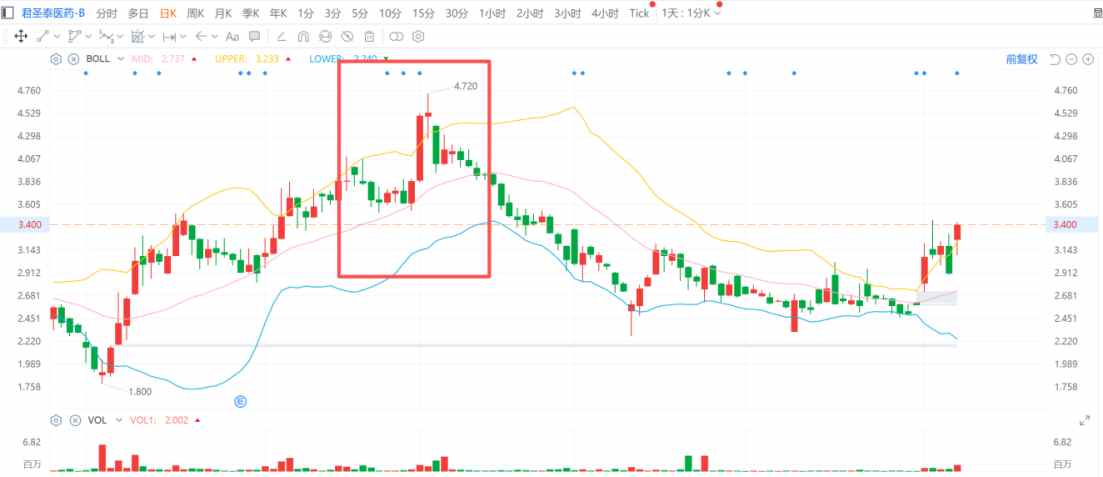
Since hitting a phased high of HK$4.72 in the intraday market on May 5 this year, Junshengtai Pharmaceutical's stock price began a round of continuous decline for nearly 2 months. It wasn't until July 30 that it was able to stop falling, and the range's stock price retraced by 44.81%.
Judging from Junshengtai's market perspective, it can be seen that after the stock price hit the BOLL line on April 21, Junshengtai's stock price did follow the downward trend of the sector and once approached the middle BOLL line under the four-consecutive negative trend, but then there was a sideways stoppage and a reversal of the market driven by three positive lines. The combination of sharp increases in volume and price brought the company's stock price strength to a phased high.
The core driver is the 2025 annual report disclosed by the company after the market on April 29. Although the financial report shows that its current revenue decreased sharply by 73.26% compared to the same period last year, due to a sharp drop of 54.76% year on year in R&D expenses, the company's net loss for the current period was 245 million yuan, a decrease of 35.84% year on year. As an unprofitable 18A company, the favorable trend in cash conditions became the main reason for its short-term stock price rebound at the time.
However, after breaking through the BOLL line at an accelerated pace on May 4 and May 5, Junshengtai Pharmaceutical's stock price showed a technical correction in volume decline over the next 2 trading days, and then there was a clear downward range of price declines.
During this time period, Junshengtai Pharmaceutical's poor stock price performance was probably affected by both sluggish market sentiment and market short-selling pressure.
From April to June this year, the Hang Seng Healthcare Index fell by 27.65% in the range. This was mainly driven by a sharp decline in the innovative drug sector in the market. According to the data, the Hong Kong Stock Innovative Drug Index fell by more than 26% from a high in September 2025 to a low in June 2026, while the Hong Kong stock 18A sector retreated nearly 40% during the same period.
Within this industry-wide correction range, the Hong Kong stock pharmaceutical sector showed a sharp gap between chip supply and capital structure. That is, on the one hand, the continuous expansion of circulation chips brought about by the rapid rise in financing enthusiasm in the 18A sector of Hong Kong stocks, yet on the other hand, with no incremental capital entering the market, the average daily turnover in the market gradually shrank.
In other words, the amount of chips in the pharmaceutical sector of Hong Kong stocks continues to increase, leaving market capital in a stock game, and as a result, valuations can only be digested downward. Therefore, even when it is beneficial to highly valued growth stocks, market investors are more likely to “fall back in the bag and be safe.”
As can be seen, on June 10, the Hang Seng Healthcare Index showed signs of stopping its decline and closed up 1.44%. On the same day, although the stock price of Junshengtai Pharmaceutical closed down 5.13%, it drew a long shadow on the same day. The stock price remained above the BOLL line. There were also signs of a sharp decline and rebound, which began a rebound in Silianyang.
However, unlike the subsequent sector, which continued to fluctuate and rise, Junshengtai's stock price was once again sluggish and falling until the end of July after this round of four consecutive victories. The reason for this is that the company experienced a “favorable empty window period” during this period. Continued volume trends also indicate a slump in in-market trading. It wasn't until this round of discounted placement that there were obvious volume and price fluctuations.
Why are discounted placements emerging from a new round of rebound?
As mentioned above, as an unprofitable 18A company, the cash problem is still one of the important factors affecting the performance of Junshengtai Pharmaceutical's secondary market.
Judging from the previously disclosed annual report data, as of the end of 2025, the company's cash account was 232 million yuan, a year-on-year decrease of 25.22%. This is the second year in a row that the company's cash account has declined. Based on operating expenses of 224 million yuan in the same year, without open source, the company may run out of cash on its accounts by the end of this year. This is one of the main reasons why Junshengtai chose to sell at a discounted price for the second year in a row.
However, the reason why the company showed an upward trend after both rounds of discount sales was due to its financing use and the market's expectations for the company's future.
According to the Zhitong Finance App, according to this placement announcement, Junshengtai used 75% of the proceeds from the placement for research and development of its core product HTD1801, and stated that the proceeds will be used by 2028; in the placement announcement last year, the company stated that it also accounts for 75% of the placement proceeds for research and development of its core product HTD1801.
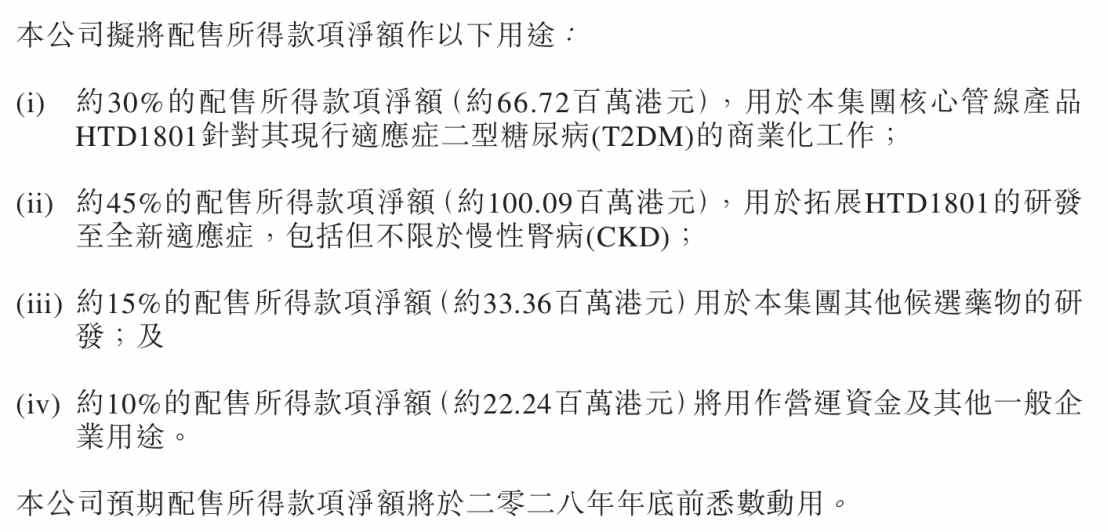
Financing has been carried out for 2 consecutive years for core product research and development, which is one of the reasons investors approved Junshengtai's discounted sale. The more important reason is that some investors are optimistic about its core product HTD1801.
The Zhitong Finance App learned that Jun Shengtai handed over a tough report card at the end of last year. On December 2 of last year, Junshengtai Pharmaceutical officially announced that HTD1801, the world's first self-developed oral anti-inflammatory and metabolic regulator, defeated AstraZeneca's star drug dagliflozin in several core indicators in the key phase III clinical trial HARMONY for type 2 diabetes.
Clinical results showed that after 24 weeks of treatment with HTD1801, the least square mean change of HbA1c was -1.12%, while the dapagliflozin group was -0.93%, and the least square mean difference between the two groups was -0.20%, which is statistically significant.
In addition to reaching the main end point, the HTD1801 also showed clear advantages in a number of secondary endpoints. Compared with dapagliflozin, HTD1801 is more effective in reducing low-density lipoprotein cholesterol and non-high-density lipoprotein cholesterol, and the proportion of patients requiring additional or enhanced statins is also lower. Furthermore, after treatment with HTD1801, a higher proportion of patients achieved the control target of glycated hemoglobin < 7.0%, while showing a greater reduction in lipoprotein (a).
In terms of safety, HTD1801 showed good tolerability. The incidence of serious adverse events was 3.8%, lower than 4.4% in the dapagliflozin group. The most common adverse events in the HTD1801 group were mild to moderate gastrointestinal adverse events, and no serious hypoglycemic events occurred during the study.
Unlike SGLT2 inhibitors, which simply promote glucose excretion, HTD1801 aims to address the unmet clinical needs of cardio-renal metabolic diseases at the root. However, many clinical results from around the world have continued to verify the drug's “one drug has multiple effects” characteristics.
However, from a medicinal chemistry perspective, the core mechanism of HTD1801 is an elaborate design that combines berberine and ursodeoxycholic acid through ionic bonds, although it does improve solubility and bioavailability. However, compared to high-threshold innovative technologies such as monoclonal antibodies, dual antibodies, ADC, or gene therapy, whether such improved new drugs can obtain the high premium of the original innovative drug in the long term also requires a question mark.
From a valuation perspective, driven by this placement, the company's PB valuation has continued to rise. Up to now, it has reached 6.71 times, far exceeding the industry average of 2.55 times, and over 92% compared to the company's one-year PB valuation. With the RSI indicator reaching a high of 84 and showing clear signs of being overbought, whether Junshengtai Pharmaceutical can maintain its current price is also one of the issues investors need to pay attention to.