


Dual Edge Research publishes two powerful newsletters that work great individually — and even better together. The Bull Strangle Newsletter focuses on stocks and options, combining stock ownership with premium-selling strategies to generate consistent income and market-beating returns. The Smart Spreads Newsletter specializes in seasonal commodity futures spreads, offering a diversified approach with low correlation to equities. Together, they deliver a complete investment perspective — one focused on income, the other on diversification — all under one simple subscription.
Introduction
In the previous articles, we've explored several of the major decisions involved in constructing a higher-probability commodity spread. We began by asking whether history favored buying or selling a particular market. Next, we examined when seasonal opportunities have historically performed best, followed by which front-month contract cycle has produced the strongest long-term results. This week, we'll examine another important question. What spread structure has historically worked best? Should a trader use a traditional two-leg calendar spread, or is there an advantage to adding a third contract? The answer may surprise you.
More Than Adding Another Contract
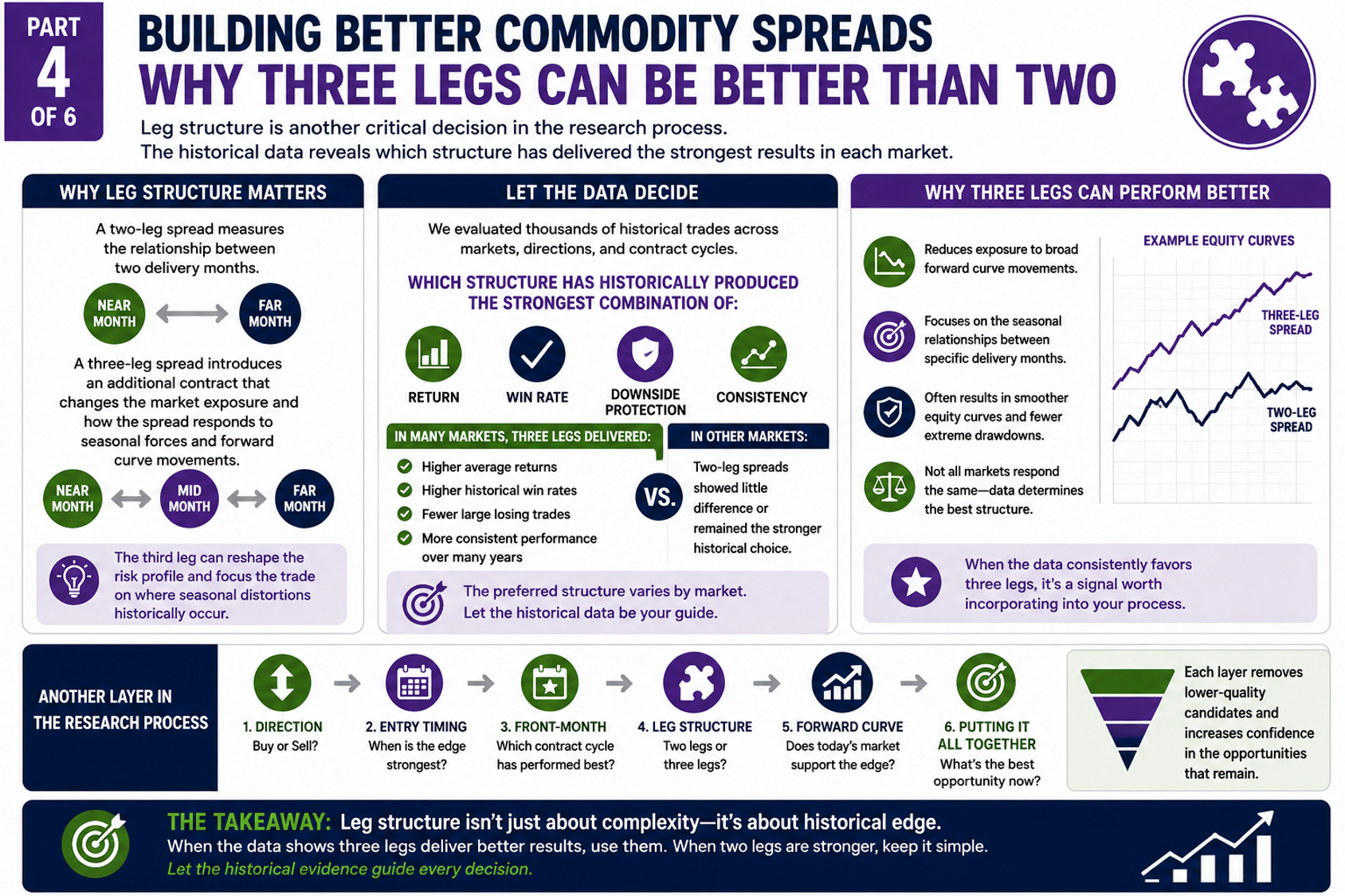
At first glance, a three-leg spread appears to be a more complicated version of a two-leg spread. In reality, it creates an entirely different market exposure. A two-leg spread measures the relationship between two delivery months. A three-leg spread introduces an additional contract that changes how the spread responds to seasonal forces, supply-and-demand imbalances, and movements along the forward curve. Rather than simply adding complexity, the third leg often changes the character of the trade itself. That makes leg structure another important decision in the research process—not simply a matter of personal preference.
Let the Data Decide
Rather than assuming one structure was superior, we evaluated both two-leg and three-leg spreads across thousands of historical trades. For every market, direction, and contract cycle, we asked the same question:
- Which structure has historically produced the strongest combination of return, consistency, and risk?
The answer wasn't universal. Some markets showed very little difference between two-leg and three-leg spreads. Others displayed a clear historical preference for one structure over the other. That finding reinforces one of the core principles behind Smart Spreads. Rather than relying on assumptions or conventional wisdom, we let the historical data determine which structure has the stronger statistical edge.
What the Research Revealed
In several markets, three-leg spreads consistently demonstrated meaningful improvements over their two-leg counterparts. Compared with traditional calendar spreads, they often produced:
- Higher average returns
- Higher historical win rates
- Fewer large losing trades
- More consistent year-to-year performance
Those improvements weren't the result of one exceptional year or a handful of isolated trades. They appeared repeatedly across many years of historical testing. That doesn't mean three-leg spreads are always superior. In some markets, two-leg spreads remained the stronger historical choice. The important point is that the preferred structure varies by market, making leg selection another valuable research filter.
Why Might Three Legs Perform Better?
Although every commodity behaves differently, there are several reasons why adding a third contract can improve a spread's historical characteristics. A third leg often reduces exposure to broad movements affecting the entire forward curve while placing greater emphasis on the seasonal relationships between specific delivery months. Instead of relying solely on the price difference between two contracts, the spread focuses more on the portion of the curve where recurring seasonal distortions have historically developed. In many markets, that has translated into smoother historical equity curves, higher consistency, and fewer extreme drawdowns.
Again, this isn't true in every commodity. But when the historical evidence consistently favors a three-leg structure, it's a signal worth incorporating into the research process.
Another Layer of the Process
By now, a pattern is beginning to emerge. Each stage of the Smart Spreads methodology answers a different question.
- Direction asks whether buying or selling has historically provided the stronger edge.
- Entry Timing identifies when that edge has historically been strongest.
- Front-Month Analysis determines which contract cycle has historically produced the best opportunities.
- Leg Structure identifies whether a two-leg or three-leg spread has historically delivered the strongest results.
Each layer removes additional lower-quality candidates. Each layer increases confidence in the remaining opportunities. Rather than relying on a single seasonal trend, each recommendation is supported by multiple independent historical records.
Looking Ahead
Historical research tells us which spread structure has worked best over time. But one important question remains. Does today's market environment support the historical opportunity? The answer often lies in the shape of the forward curve. In the next article, we'll explore how forward-curve analysis helps distinguish between seasonal opportunities that look attractive historically and those that are also supported by current market conditions. By combining historical tendencies with today's market structure, we can take another step toward identifying higher-probability commodity spread opportunities.
Part Articles in the Series
Part 3: Why the Front Month Matters
Part 2: Timing Is More Than a Calendar
Part 1: Why Direction Isn't Enough
Additional Details
The Bull Strangle Newsletter focuses on stocks and options, combining stock ownership with disciplined option-selling techniques designed to generate consistent income while managing risk.
The Smart Spreads Newsletter focuses on seasonal commodity spreads, a historically proven approach that seeks opportunities across agricultural, energy, metal, and financial futures markets.
Each strategy is designed to stand on its own, but together they provide a diversified approach that can perform across a wide range of market environments. For traders looking to deepen their education, The Bull Strangle Strategy and Trading Commodity Spreads are both available on Amazon.
Visit BullStrangle.com to subscribe for just $1 for the first month.
For a video overview of the Bull Strangle Newsletter
For a video overview of the Smart Spreads Newsletter
Darren Carlat
Dual Edge Research
(214) 636-3133
DualEdgeResearch@gmail.com
Disclaimer
This information is for informational purposes only and should not be considered as investment advice. Past performance is not indicative of future results, and all investments carry inherent risk. Consult with a financial advisor before making any investment decisions.