


AstraZeneca stock has pulled back sharply in recent weeks even though a 56.7% gain over the past five years still leaves long term holders comfortably ahead, and the latest valuation checks suggest the current share price may sit well below an intrinsic value estimate. With both the Discounted Cash Flow (DCF) intrinsic value and market multiples pointing to AstraZeneca screening as undervalued, investors now have to weigh that against recent news driven volatility.
- AstraZeneca has returned 56.7% over five years, which means the current debate is less about whether the company can create value at all and more about what a reasonable entry price looks like after that run.
- Management's stated ambition for higher long term revenue alongside oncology partnerships such as the SOPHiA GENETICS deal can support valuation upside, while legal investigations and trial setbacks such as the Wainua outcome may cap how much investors are willing to pay for that growth story.
- The stock scores highly on Simply Wall St's checks, with AstraZeneca screening as undervalued in 5 of 6 valuation areas, which means the broader set of measures currently leans cheap rather than expensive.
The issue now is whether AstraZeneca's current discount to intrinsic value and market multiples offers enough compensation for the news and pipeline risks that have driven the recent share price swings.
Find out why AstraZeneca's 10.8% return over the last year is lagging behind its peers.
Is AstraZeneca Still Cheap on Cash Flow?
The Discounted Cash Flow model estimates what AstraZeneca’s future cash generation could be worth today based on cash flow projections. For AstraZeneca, the latest twelve month Free Cash Flow stands at about US$7.6b, and the model assumes these cash flows continue growing rather than shrinking over the coming decade.
On that basis, the Discounted Cash Flow (DCF) output suggests an intrinsic value of around £223.63 per share. Compared with the current market price, this implies a discount of roughly 46.8%, so the stock screens as materially undervalued on this method. The recent late stage Wainua trial setback and related legal investigation help explain why the market price may sit below what the cash flows suggest.
Overall, the Discounted Cash Flow (DCF) workup indicates AstraZeneca stock currently looks undervalued relative to its projected cash flows.
Our Discounted Cash Flow (DCF) analysis suggests AstraZeneca is undervalued by 46.8%. Track this in your watchlist or portfolio, or discover 7 more high quality undervalued stocks.
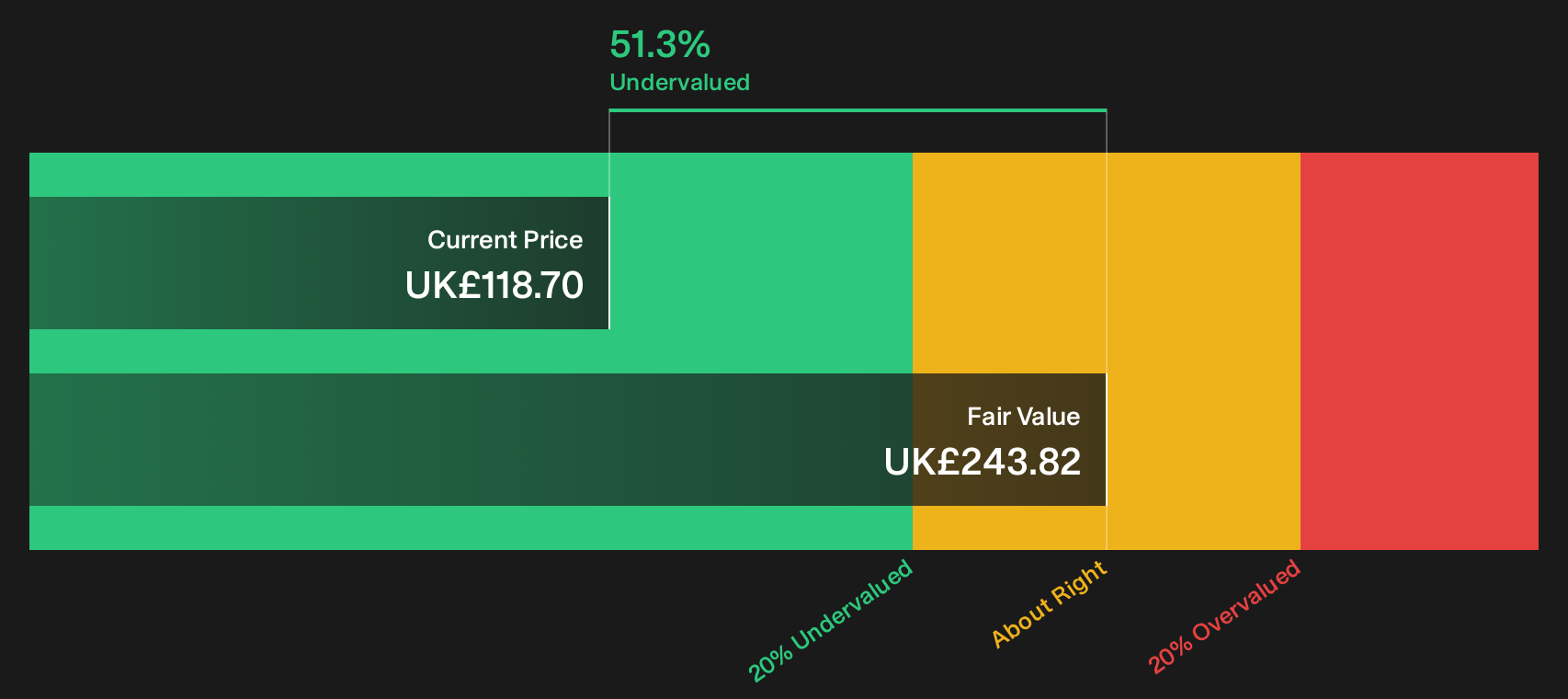
Is AstraZeneca a Bargain on Earnings?
The P/E multiple is a useful yardstick for AstraZeneca because earnings are a key focus for many investors in large, established pharmaceutical companies. AstraZeneca currently trades on about 23.8x earnings, which is slightly above the wider pharmaceuticals industry average of roughly 21.2x. Compared with a peer average of 42.3x, the stock sits on a materially lower earnings multiple than many large rivals.
Simply Wall St's model suggests a fair P/E for AstraZeneca of about 40.6x, based on factors such as its scale, sector, margins and risk profile. That is a sizable gap versus the current 23.8x. This points to the market pricing AstraZeneca at a discount to what this framework implies for the earnings it generates.
On this earnings multiple, AstraZeneca stock appears undervalued compared with both peers and its modelled fair P/E level.

See what the numbers say about this price — find out in our valuation breakdown.
The AstraZeneca Narrative: What Would Justify Today's Price?
Simply Wall St Narratives pick up where the AstraZeneca valuation puzzle leaves off by spelling out which assumptions about AstraZeneca's future growth, margins and earnings would need to hold for the stock to be worth materially more or less than it is today, and they sit on the company’s Community page. Rather than a single multiple or model output, each one sets out the underlying assumptions for its fair value so you can compare them with actual results over time.
The community sits on two very different scenarios for AstraZeneca, which gives you a clear bull versus bear spread to consider.
Bull case: 25% undervalued
"The company's robust and diversified late-stage pipeline, particularly in oncology, rare diseases, and cardiovascular/metabolic therapies, is set to deliver multiple blockbuster launches over the next several years. Management estimates these new medicines could generate $10+ billion in peak risk-adjusted revenue, directly supporting both long-term high-margin revenue growth and future earnings expansion..."
Read the full Bull Case to see why AstraZeneca could be undervalued
Bear case: roughly fairly valued
"The looming expiration of patents on key blockbuster drugs like Tagrisso, Farxiga, and Imfinzi exposes AstraZeneca to biosimilar and generic competition that is almost certain to erode high-margin revenue streams, leading to a sharp decline in earnings and a structurally lower return on invested capital in later years..."
Read the full Bear Case to see why AstraZeneca could be overvalued
Do you think there's more to the story for AstraZeneca? Head over to our Community to see what others are saying!
The Bottom Line
AstraZeneca screens as undervalued on both the Discounted Cash Flow (DCF) intrinsic value estimate and on earnings multiples, which points to a consistent signal rather than a single outlier. The broader valuation checks also lean supportive, so the market is clearly pricing in a meaningful margin of safety. What really decides the outcome from here is whether AstraZeneca can turn its late stage pipeline into durable cash flows while managing legal and trial risks. The key question for investors is whether that current discount reflects mispricing or is a fair cushion for those execution and regulatory uncertainties.
This article by Simply Wall St is general in nature. We provide commentary based on historical data and analyst forecasts only using an unbiased methodology and our articles are not intended to be financial advice. It does not constitute a recommendation to buy or sell any stock, and does not take account of your objectives, or your financial situation. We aim to bring you long-term focused analysis driven by fundamental data. Note that our analysis may not factor in the latest price-sensitive company announcements or qualitative material. Simply Wall St has no position in any stocks mentioned.
Have feedback on this article? Concerned about the content? Get in touch with us directly. Alternatively, email editorial-team@simplywallst.com