


The Zhitong Finance App learned that the Reserve Bank of Australia kept the cash interest rate unchanged at 4.35% on Tuesday, for the second time in a row, in line with market expectations. The Reserve Bank of Australia has failed to reach the midpoint of its 2-3% inflation target range for almost five years.
The Reserve Bank of Australia said in a statement after the meeting: “The Commission will remain committed to ensuring that high inflation does not become entrenched. As monetary policy is considered to be slightly tightened, the Commission will continue to take the necessary measures to keep inflation back at the target level, including further raising the cash interest rate target when upside risks arise.”
The Australian dollar fell 0.2% after the interest rate decision was announced. Australian three-year government bond yields, which are more sensitive to policy, erased earlier gains and fell 2 basis points as market expectations for the Reserve Bank of Australia to raise interest rates again this year weakened.
The Reserve Bank of Australia has already raised interest rates at the first three meetings of this year. It is currently evaluating whether to keep interest rates unchanged or whether monetary policy needs to be further tightened. The US-Iran conflict is still uncertain. The war triggered a global energy shock and boosted oil prices.
“Recent data has generally been beneficial to the Reserve Bank of Australia,” said Callum Pickering, an economist at recruitment website operator Indeed Inc. “Inflation has not risen as sharply as initially feared, and the job market has stabilized after some poor data earlier this year.”
Australia's four major banks all believe that the Reserve Bank of Australia has completed its austerity policy and will keep interest rates unchanged for a period of time before moving to an easing policy. Westpac's Lucy Ellis pointed out that higher borrowing costs and the end of tax incentives for real estate investors are putting pressure on the real estate market, which once again shows that the coordinated operation of fiscal and monetary policies can have strong effects.
The Reserve Bank of Australia said in a statement: “Domestic economic activity and the outlook for inflation remain highly uncertain. In Australia, historically weak productivity growth continues to constrain potential growth.”
The Reserve Bank of Australia also released a quarterly economic forecast update on Tuesday. The report shows that the overall inflation rate and core inflation rate are not expected to reach the midpoint of the 2.5% target range until the beginning of 2028. The Reserve Bank of Australia pointed out that although the unemployment rate is expected to rise slightly from three months ago, the labor market is still “slightly tight.”
The Reserve Bank of Australia is still facing an inflation problem
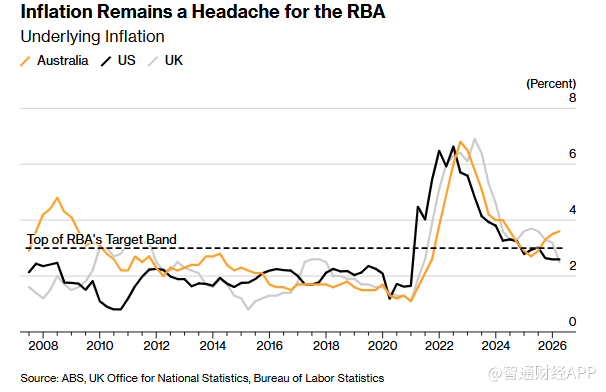
The RBA's suspension of interest rate hikes brought its policy stance closer to the Federal Reserve. At the end of last month, the Federal Reserve kept interest rates unchanged for the fifth consecutive meeting, even though three opponents voted to raise interest rates by 25 basis points. However, the weak US employment data released on Friday and the slowdown in price increases may help ease some of the Fed's inflation concerns.
Meanwhile, US President Donald Trump made a series of new demands against Iran after Iran reiterated its demand for compensation as part of negotiations to end the conflict. This made the hopes of the US and Iran quickly reaching an agreement and reopening the all-important Strait of Hormuz diminished, and boosted oil prices.
Brendan Lynn, KPMG Australia's chief economist, said: “The Reserve Bank of Australia is now in a dilemma. It is trying to restore inflation to target levels while avoiding unnecessary damage to the labor market, but at the end of the day, its primary responsibility is to keep prices stable. Overall, it's not surprising that interest rates will be raised again in the next few months.”