


Key Points
The latest FOMC meeting made history, with three policymakers dissenting in favor of a quarter-point rate hike.
Kevin Warsh shelved forward-looking guidance from FOMC meeting statements, and it's having quite an impact on the bond market.
Warsh also wants to deleverage the central bank's balance sheet, which would come with unintended consequences for the bond market and lending rates.
Wall Street and investors were privy to a bit of history two weeks ago. The Federal Open Market Committee's (FOMC) July 28-29 meeting marked the first time in 56 years that three FOMC members dissented so early in the tenure of a new Fed chair.
Although the Federal Reserve held interest rates steady at 3.5%-3.75%, three members favoring a quarter-point rate hike suggest how pressing an issue inflation is at the moment. This historic dissension also sent the Dow Jones Industrial Average (DJINDICES: ^DJI), S&P 500 (SNPINDEX: ^GSPC), and Nasdaq Composite (NASDAQINDEX: ^IXIC) on quite the ride.
Missed Nvidia in 2009? This Rare Signal Is Flashing Again. In 2009, a "Double Down" signal flashed for a little-known chipmaker called Nvidia. For the first time in years, that same "Total Conviction" signal is flashing for a company 1/100th the size of Nvidia. Continue »
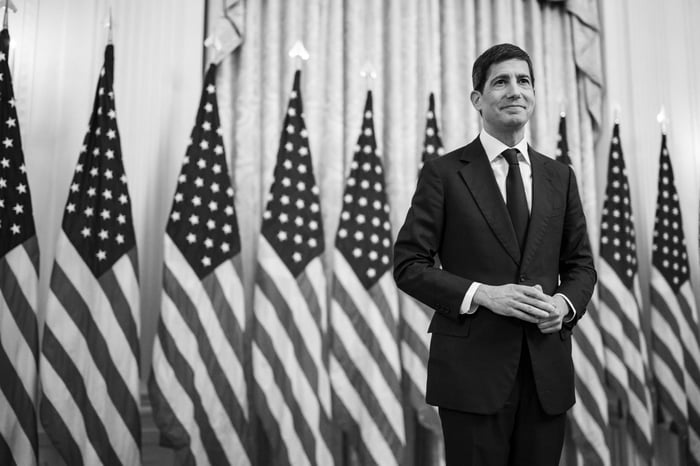
The Fed chair and his colleagues have a few sneaky ways they can influence interest rates. Image source: Official White House Photo by Daniel Torok.
While there's a very real possibility that Fed Chair Kevin Warsh and his FOMC colleagues will undertake a rate-hiking cycle to stabilize prices, the Fed chair and policymakers have two nontraditional methods they can employ to raise interest rates without adjusting the federal funds target rate.
Removing forward guidance can influence the bond market
To begin with, Warsh's removal of forward-looking guidance from FOMC meeting statements appears to be having a clear impact on interest rates.
For more than two decades, it's been customary for the central bank to include forward-looking guidance (i.e., an easing, neutral, or tightening bias) in FOMC meeting statements. While this guidance provided transparency in the equity and bond markets, it also constrained policymakers' responses, according to Warsh.
BREAKING: Fed Chair Kevin Warsh announces that the Fed has "dropped" forward guidance.
-- The Kobeissi Letter (@KobeissiLetter) June 17, 2026
"Forward guidance is not the business we should be in," he says.
Beginning with his first FOMC meeting as Fed chair in June, Kevin Warsh axed forward-looking guidance. Removing this transparency from Wall Street's plate is likely to make the bond market more cautious when inflation is well above or below the central bank's long-term target of 2%.
With inflation running hot at the moment (a three-year high of 4.2% in May and 3.5% in June), bond traders have been pushing up yields at the long end of the Treasury yield curve. The 30-year Treasury yield reached a 19-year high, while the 10-year yield isn't too far from accomplishing the same feat.
Higher yields at the long end of the curve can increase borrowing costs and provide the same/similar effect of a traditional FOMC rate hike.

Image source: Getty Images.
Deleveraging the central bank's balance sheet can boost interest rates
Another way that Kevin Warsh and his colleagues can influence interest rates without formally adjusting the federal funds target rate is through deleveraging the Fed's balance sheet.
During Warsh's testimony before the Senate Banking Committee on April 21, he criticized the central bank's bloated balance sheet, which grew tenfold between August 2008 and March 2022 to nearly $9 trillion. As of Aug. 5, the central bank held $6.75 trillion in assets (primarily long-term Treasury bonds and mortgage-backed securities).
The new Fed chair would prefer the central bank to be a passive market participant, which would entail meaningfully paring down this asset portfolio.
Kevin Warsh Nomination: one reason why market players are interpreting it as a hawkish pick- I agree-is because of his views on the need for a radical balance sheet reduction.
-- Joseph Brusuelas (@joebrusuelas) January 30, 2026
The $31 trillion-dollar American economy demands liquidity & financing needs that are larger than what... pic.twitter.com/zYunGAItV8
Keeping in mind that bond prices and yields are inversely related, selling trillions of dollars in U.S. Treasury bonds could quickly move the needle. Selling pressure would be expected to weigh on bond prices, push up long-term yields, and make lending costlier.
Whereas Warsh has been able to effect change in the bond market by removing forward-looking guidance, he'll need the support of his colleagues to shrink the Fed's balance sheet. But if he's successful in garnering support for this deleveraging, the FOMC can meaningfully boost bond yields without a traditional rate hike.
Sean Williams has no position in any of the stocks mentioned. The Motley Fool has no position in any of the stocks mentioned. The Motley Fool has a disclosure policy.