


The Zhitong Finance App learned that the yen exchange rate continued to weaken slightly in foreign exchange trading on Tuesday and is approaching a very critical level for the rise of the dollar against the yen (meaning the depreciation trajectory of the yen). This may trigger market speculation that the Japanese Ministry of Finance authorities will once again intervene to support the yen. The yen exchange rate is still approaching 160 after the joint intervention of the US and Japanese governments. The core logic is undoubtedly that foreign exchange intervention can change short-term capital flows, but it cannot change the weak fiscal outlook, relative yield gap, and monetary policy response function that determine the exchange rate center.
On Tuesday, market fluctuations were moderate due to the closure of the Tokyo market due to a holiday, but foreign exchange market traders were preparing for the depreciation trajectory of the yen to 160 yen per dollar. The key level of 160 has held back the yen's further weakening in the past. During the London market trading session, the yen fell 0.1% to 159.39 yen per dollar.
On Monday, as the dollar strengthened against most Group of Ten (G10) currencies, the yen fell 1%, the worst single-day performance since mid-February. Currently, the yen has taken back nearly half of the increase since July 31; on the same day, Japan and the US implemented the first joint coordinated intervention since 1998 to significantly support the yen.
Masayuki Nakajima, a senior strategist from Japanese banking giant Mizuho Bank, wrote in a report: “If the USD/JPY exchange rate clearly breaks through the psychologically significant 160 mark, market concerns about intervention may further heat up.”
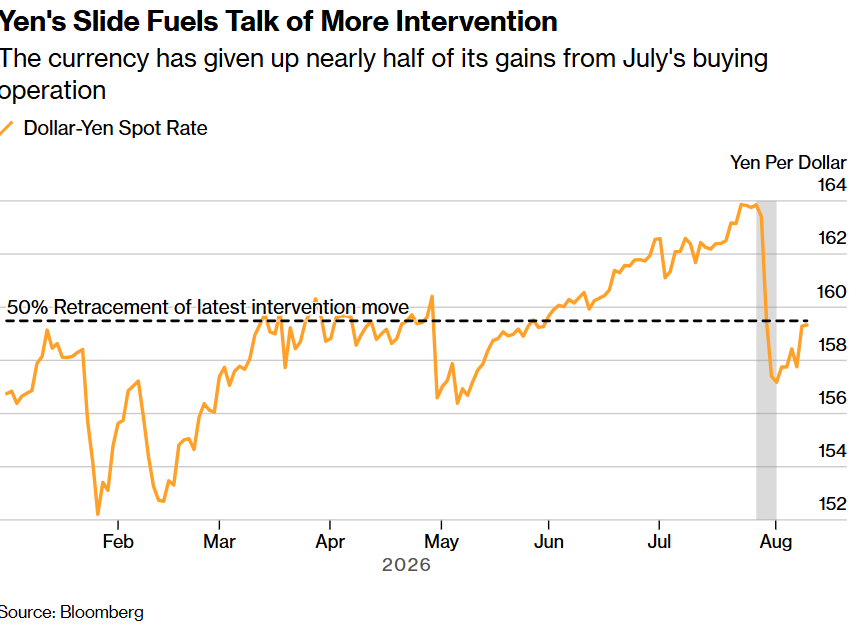
As shown in the chart above, the fall in yen has sparked discussions on further government intervention — the yen has already taken back nearly half of the increase brought about by the joint intervention of the US and Japan to buy yen in July.
The US government's promise to “do whatever it takes” to support the yen, led by US Treasury Secretary Bessent, essentially conceals a very limited amount of intervention.
This joint intervention helped the yen exchange rate to rebound from an extremely low level of about 1 US dollar to 164 yen in late July, which is close to a 40-year low, and once rose to a high of 155 yen per US dollar earlier this month.
Analysis by financial institutions based on Bank of Japan accounts shows that the relevant government authorities under the coordination of the US Treasury may have used about 34 billion US dollars to intervene in the foreign exchange market on July 31 to support the yen. The day before that, the Japanese government authorities under the coordination of the United States may have invested 53 billion US dollars; if officially confirmed, this is likely to be the largest single-day foreign exchange intervention in human society's recorded history.
However, as market participants refocused their attention on fundamental-type drivers, the yen gradually weakened again. Even though officials in Tokyo and Washington warned that they are ready to take another joint action if necessary, huge interest spreads between the US and Japan, market concerns about Japan's fiscal and monetary policy prospects, and geopolitical uncertainty continue to put pressure on the yen.
For the Japanese government, what is more difficult is that the government is not facing a simple monetary policy issue, but rather a triangular “interest rate - finance - exchange rate” constraint. This makes the yen even have a kind of backlash where intervention is more frequent and policy credibility is more important. Japan needs to raise interest rates to actually reduce the spread between the US and Japan, but higher Japanese interest rates will also drive up the financing costs of the ultra-high government debt system and the Japanese treasury bond maturity premium; if the government remains cautious about the Bank of Japan's rapid contraction as a result, the market will doubt the extent to which it can actually raise policy interest rates.
At the same time, if Japan relies on foreign exchange reserves to continue to buy yen, it may also involve the reallocation of global bond assets and have a spillover effect on America's long-term yield, which is already under pressure — this is an important background for America's rare participation in the coordination.
An intervention of nearly 100 billion dollars cannot stop 160 million dollars! The real “bear engine” of the yen is not speculation, but the spread between the US and Japan
Japan and the US rarely bought yen together around July 31. At one point, it lowered the dollar against the yen from about 163.99 to around 155.20, but as of August 11, it had returned above 159, recovering about half of the increase. The real problem is that the Bank of Japan's July meeting still maintained the policy interest rate at 1.0% at 8:1, and only Takada Hajime advocated a direct rise to 1.25%; in contrast, the US monetary policy interest rate and the yield on US bonds with a long-term term of 10 years or more are still significantly higher, and short-term interest spreads between the US and Japan are still sufficient to maintain the yield advantage of US dollar assets and the economic foundation of Japanese yen financing arbitrage transactions (that is, carry yen trade).
Bank of Japan Governor Ueda Kazuo sent a hawkish signal that “interest rate hikes may be accelerated,” and indeed made the market see the September rate hike as an increasingly realistic scenario, but the expected rate hike does not mean that the interest spreads that have already been realized have narrowed — as long as Japan's real interest rates rise more slowly than financial market traders agree, the basic yield structure of shorting the yen has not disappeared at all.
The US non-agricultural thunderstorm has actually proven that what can actually make the yen continue to appreciate is not “how much yen the government has bought,” but whether the interest rate spread between the US and Japan will continue to shrink. After an unexpected drop of 23,000 in US non-farm payrolls in July, far below market expectations, the US short-term yield plummeted. The dollar fell 1.1% to 156.68 against the yen on the same day. This is also a typical fundamental repricing: the market lowered expectations of the Federal Reserve → the US yield fell → the advantage of the US dollar spread narrowed → the yen rose. However, since then, the Middle East's geopolitical risk once again boosted the sharp rise in oil prices and greatly boosted the risk of US inflation and US bond yields. The US dollar quickly regained interest rate spread support, and the yen immediately fell again to 160.
The joint intervention of Japan and the US is more like raising shorting costs, reducing leverage, and creating a “two-way risk” when the exchange rate fluctuates unilaterally in a disorderly manner, rather than permanently changing the equilibrium price of the dollar against the yen. Therefore, although short positions have shrunk sharply after the joint intervention, if the Bank of Japan fails to tighten monetary policy to keep up with the market's real interest rate expectations, it is entirely possible that these positions will be re-established.