The Zhitong Finance App learned that from “revolving financing” controversy to teaming up with the six Wall Street giants to open up an external funding pool of 500 billion US dollars, NVDA.US (NVDA.US) completed a key narrative reversal in just a few weeks. A number of Wall Street analysts pointed out that this massive financing agreement accurately hit the biggest pain point of AI infrastructure construction — capital, not demand.
According to reports, Nvidia announced this Monday that it has signed memorandums of understanding with six financial giants: Apollo Global Management, Blackstone, Brookfield Asset Management, Goldman Sachs, and KKR, to establish an independent computing power financing platform with the goal of mobilizing more than 500 billion US dollars of third-party capital over the long term for AI infrastructure construction.
Here are the main points from Wall Street analysts:
Bank of America analyst Vivek Arya made it clear in the investor report: “Funding has always been a bottleneck, not a demand — every hyperscale customer is complaining about limited supply. The $500 billion capital pool (equivalent to 2.5 times the size of Google's network) allows non-investment buyers — including AI labs, new cloud service providers, and sovereign entities — to obtain GPUs, computing power, and data center resources at attractive interest rates, which effectively reduces procurement risks and supports our expectations that the 2026 AI system can reach the size of the market of $1.7 trillion.”
“We are still awaiting more details, but the initial verdict is positive — the risk burden falls on the syndicate rather than Nvidia's balance sheet,” Arya added. “This seems to mark a shift away from the supplier financing model (that is, OpenAI's original $100 billion financing and about $250 billion guarantee), which has sparked controversy over 'revolving financing'. We estimate that Nvidia's exposure to such disputes was only about 15% of the approximately $470 billion free cash flow for the 2026-2027 fiscal year.”
After the disclosure of the financing news, Bank of America reaffirmed Nvidia's “buy” rating and target price of $350, and is still listed as the preferred stock.
Seeking Alpha analyst Julia Ostian revealed the strategic significance of this agreement from another dimension — it is opening up a new channel of low-cost funding.
Ostian points out that fanatical AI infrastructure construction is causing some companies to run out of cash. Companies that have invested heavily in AI infrastructure are gradually running out of cash. And getting a loan for a chip is extremely expensive because the chip is viewed as bad collateral — its life cycle is short and unpredictable. As a result, fewer and fewer companies are buying Nvidia GPUs, which is a huge problem for Nvidia. Hwang In-hoon's new initiative is aimed at solving this problem.”
Ostian further analyzed: “When loan-backed AI data centers are standardized, banks will be able to package these loans into financial instruments such as asset-backed securities (ABS), loan-backed bonds (CLO), and debt-backed bonds (CDO). This means that institutional investors such as pension funds and insurance companies can buy these products. As a result, Nvidia not only did not allow technology companies to face a shortage of capital, but instead opened up a new, sizeable low-cost financing channel. The aim is for companies to continue to buy Nvidia chips and continue to expand AI infrastructure, which makes the AI narrative more resilient. “One of the biggest concerns of the market before was the depletion of corporate capital, but this new agreement will provide longer-term support for AI construction.”
Morgan Stanley is also optimistic about this development and highlights its essential differences from “revolving finance” transactions.
Morgan Stanley analyst Joseph Moore wrote in a Tuesday report: “Despite market concerns about 'circular financing', Nvidia's actual direct credit exposure so far has mainly been limited to providing credit guarantees to a few small new cloud service providers. Nvidia's latest 10-Q document revealed that its total exposure to partner lease guarantees was $3.5 billion. However, the company did make equity investments in some of its customers and ecosystem partners. Given the strong performance of the AI ecosystem, these open market investments performed well overall. Although private equity investments are difficult to evaluate, it is worth noting that these private equity transactions are equity investments rather than donations or guarantees.”
Morgan Stanley reiterated Nvidia's “over match” rating and target price of $288, and continues to be the preferred stock.
“Investment partners will evaluate each investment opportunity on a case-by-case basis, and no investment decisions have been made at this time,” Moore added. Nvidia will provide ecosystem support and may provide a 'residual value guarantee mechanism' of up to 25% for some investments — in their words, a 'limited, residual-value-based supplemental arrangement designed to supplement, not replace, independent underwriting reviews'.”
However, RBC Capital Markets also reminds investors that it will take time to implement the actual infrastructure brought about by this financing plan.
RBC Capital Markets analyst Srini Pajjuri stated in the report: “Although no specific timeline was disclosed, considering the long data center/power procurement cycle and the tight chip supply situation, we expect any new construction project of a reasonable scale to take 2 to 4 years to complete. As a result, we expect the plan's limited contribution to revenue over the next 18 months, and we estimate that Nvidia can convert 40% to 50% of more than $500 billion in capital into actual revenue over the next 4 years.”
RBC reaffirmed Nvidia's “outperforming the market” rating and a target price of $300.
Wedbush Securities, on the other hand, believes that this financing arrangement will further strengthen Nvidia's dominant position in data center construction.
Wedbush analyst Matt Bryson said in a Tuesday report: “Despite a certain trend of diversification in the application field of AI chips (Broadcom, AMD, Marvell, and Cerebras have all achieved a certain degree of success), Nvidia is still almost the sole provider of computing power infrastructure in non-hyperscale/cutting-edge model data center construction. We believe this funding is an important mechanism to support Nvidia's leadership and growth beyond hyperscale customers. “Nvidia has stated that hyperscale customers account for approximately 50% of its revenue.
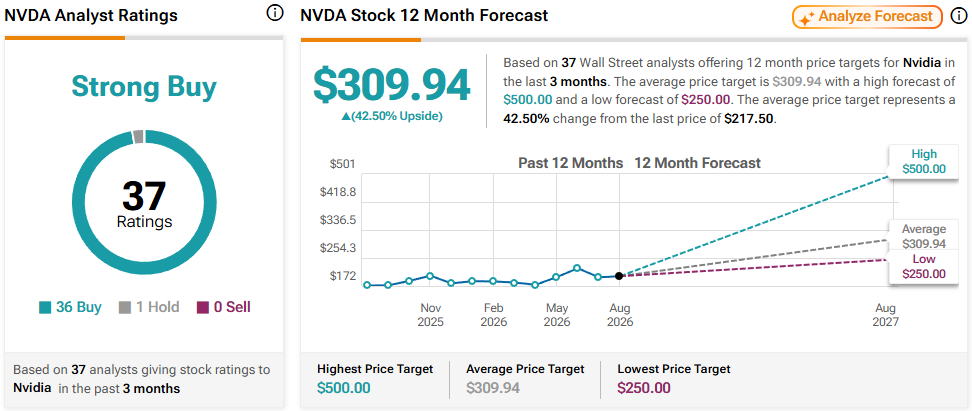
According to Tipranks data, the vast majority of Wall Street analysts are optimistic about Nvidia. The consensus rating is “Strong Buy”. The average target price is $309.94, which is 42.5% higher than the latest closing price.