


Wall Street strategists are unlikely to be more divided than they are now as to whether the Federal Reserve will choose to return to raising interest rates next month. However, one thing is undisputed: the US CPI inflation report released on Wednesday will largely determine the Fed's next move.
The Zhitong Finance App learned that according to the swap market transaction situation, the probability of 25 basis points of interest rate hikes currently included by traders is about 50%. After the unexpected weakening of non-farm payrolls in July, Wall Street almost formed an extreme 50:50 split price on whether the Federal Reserve raised interest rates by 25 bp in September, and the Federal Reserve under Walsh's leadership clearly reduced forward-looking guidance, making the market have to rely again on hard data to determine the policy path.
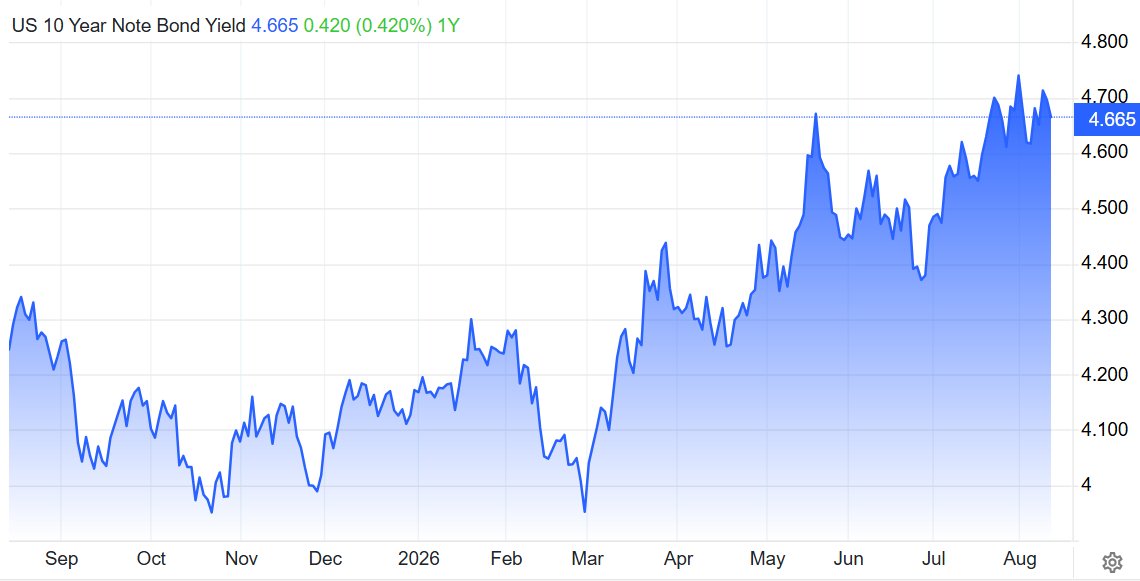
Therefore, the impact of July's CPI is clearly asymmetrical — that is, moderate inflation data can further weaken the reasons for interest rate hikes, but data that exceeds expectations and is more likely to quickly turn the September rate hike back into the benchmark scenario. As far as the 10-year US bond yield, the “anchor of global asset pricing,” the current bond market risk-return is actually clearly skewed in the pricing direction of “July's moderate CPI driving a rapid decline in yield”, mainly because macro data and the CTA bond market position structure are positively resonating.
There is a very dangerous convex sign or position amplifier in the bond market at this stage: a data compiled by UBS shows that the low allocation of CTA funds at the end of July has increased to 3 times that of two weeks ago. The 10-year US bond yield moved by 1 bps, and the impact on CTA portfolio profit and loss reached about 300 million US dollars, the highest since data was available in 1990. Therefore, if the core CPI hovers around the 0.15% to 0.20% range, the market will not only lower the probability of interest rate hikes in September, but may also trigger mechanical feedback of “falling yield — CTA stop-loss recovery bonds — further decline in yield”. If the yield on 10-year US bonds, which have the title of “anchor of global asset pricing,” continues to decline, it can be a major positive catalyst for risky assets such as global stock markets that are fighting back.
Inflation data took over the main line of market transactions, and CPI became the “winner and loser” of the September interest rate hike
Molly Brooks, an American market interest rate strategist from TD Securities, said that if the inflation data is significantly higher than the market's unanimous expectations, the probability of the Fed's interest rate hike may rise sharply; and if moderate inflation readings appear again, it will give policy makers room to continue to wait.
“We think this data is critical for September,” Brooks said. She added that the market reaction is likely to be asymmetrical — if the data is higher than expected, the impact on the probability of interest rate hikes will be far greater than the impact of lower-than-expected data.
Economists agree that the core CPI will rise slightly by 0.2% month-on-month, after the previous reading had unexpectedly declined by 0.4%. According to Bloomberg Economics forecast data, the US core CPI growth rate in July will fall to 2.4% year on year, which means it is expected to hit the lowest level since March 2021.
During the pre-market session of US stocks on Wednesday, the price of US Treasury bonds did not change much, and the market waited for the inflation report to be released. The 10-year US Treasury yield, which is the benchmark for the bond market, fell 1 basis point to 4.68%, and the 30-year US Treasury yield fell to 5.23%.
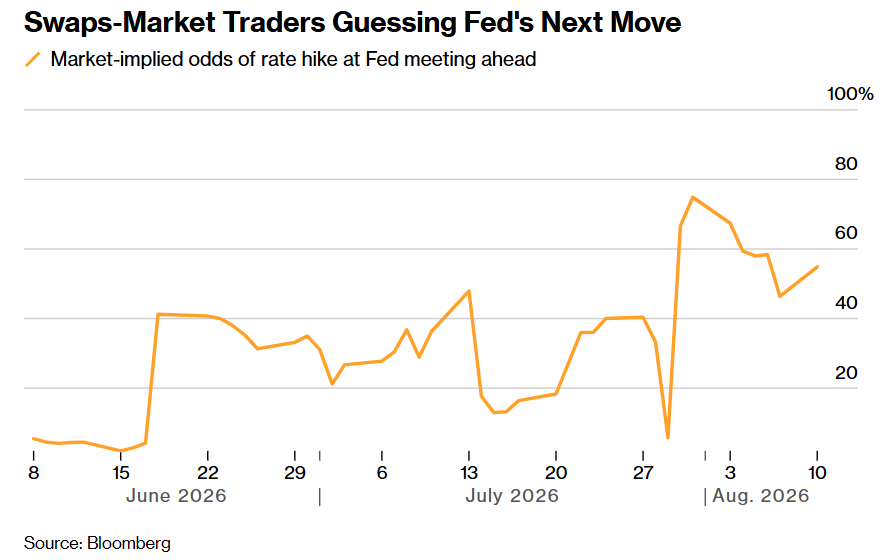
As shown in the chart above, swap market traders are ramping up to price the Federal Reserve's next move. Some US Treasury traders believe that the market's hawkish pricing of the Federal Reserve has exceeded the level that economic fundamentals can support, so they are betting that the upcoming data will force the market to re-evaluate this view.
Ruben Hovhannisyan, fixed income portfolio manager at TCW Group, said: “We anticipate a steeper bull market as extreme hawkish pricing on the front end of the yield curve is lifted.” He said, “Our overmatch is basically concentrated at the front end of the yield curve.”
However, recently released data also shows how rapidly the economic landscape may change. The CPI report released last month showed that after inflation fell for the first time since 2020, two-year US Treasury yields fell 14 basis points. The employment report released last week showed that US employers unexpectedly cut jobs in July, prompting traders to further lower their expectations for the Federal Reserve's interest rate hike during the year.
Interest rate strategists at Goldman Sachs said in a report last Friday that the slowdown in employment growth “may raise the threshold that core CPI needs to reach” so that the September rate hike “clearly becomes the most likely outcome” that the market believes will occur.
Over the past few weeks, several Fed policymakers, including Dallas Federal Reserve Chairman Lorie Logan and Minneapolis Federal Reserve Chairman Neel Kashkari, publicly warned that if they act too late in dealing with inflation, there is a risk that they will have to take more aggressive policy measures in the future.
Kelsey Berro, portfolio manager at J.P. Morgan's Asset Management division, said: “The real story now is inflation, not the labor market.” “This is an unusual situation — the economy is still expanding, yet the core PCE is running significantly faster than all other indicators,” she said.
Berro said that the front-end pricing of the US Treasury yield curve is currently reasonable for pricing potential interest rate hikes. If Wednesday's CPI data is significantly higher than the market's agreed expectations, it will further increase the possibility of interest rate hikes in September and further ignite the market's bets on recent interest rate hikes.
As Federal Reserve Chairman Kevin Warsh (Kevin Warsh) tried to reduce the central bank's early disclosure of forward-looking guidance on future policy intentions and breaking the recent practice of releasing policy signals in advance before making formal decisions, the importance of various economic data has once again increased significantly. After the Federal Reserve kept interest rates unchanged last month, long-term US Treasury yields soared to the highest level in nearly 20 years.
Bilal Hafeez, founder and head of market strategy at Macro Hive, said: “The market is telling the Federal Reserve that it is facing an inflation problem, but the Fed's current view is that recent data is weak enough, so there is no need to raise interest rates yet.”
“Given the current extreme negative positions and the significant increase in yield since this quarter, even if the long-term bearish outlook for US Treasury bonds remains unchanged, from a risk-return perspective, long-term bonds may be more conducive to a round of tactical rebound.” Ven Ram, cross-asset strategist at Bloomberg Strategists, said.
George Catrambone, head of fixed income at DWS Americas, said he expects the CPI report to indicate the future monetary policy path outlook for the Federal Reserve more clearly than the Jackson Hole Global Central Bank Seminar to be held later this month.
Catrambone said, “The threshold for overall CPI to once again experience negative growth is very high, but after the non-farm payrolls data is weak, as long as the core CPI falls below 0.2% month-on-month, it should be enough to keep the Fed on hold.” He said, “It may be difficult for the market to understand Walsh, but the data should be more persuasive than any hawkish or dovish rhetoric in Jackson Hole.”
DWS tends to hold two to five year US Treasury bonds because the agency does not expect the Federal Reserve to choose to raise interest rates this year. Catrambone added: “The yield curve between federal funds rates and two-year and five-year treasury bonds is quite steep, so this period looks very attractive for investment.”
CTA hits record shorting and inflation cools down, and the bond market may become a new booster for global risk assets
The 10-year yield was about 4.68% before the CPI was announced, and already included a considerable amount of “higher and longer+possible re-interest rate hike+fiscal period premium+oil price risk” pricing; however, Goldman Sachs believes that although the extremely weak CPI in June had incidental elements, the weakening margins of tariff transmission, the subside of some war shocks, and the weakening of AI-related price statistics effects should gradually weaken future monthly inflation. The biggest upward risk is still oil prices.
According to data compiled by UBS, the low allocation of CTA funds at the end of July has tripled to two times that of two weeks ago. The 10-year US bond yield moved by 1 bps, and the impact on the portfolio profit and loss of CTA strategies (commodity trading advisors) with the title of “fast money” reached about 300 million US dollars, the highest since data was available in 1990. Therefore, if the core CPI hovers around the 0.15% to 0.20% range, the market will not only lower the probability of interest rate hikes in September, but may also trigger mechanical feedback of “falling yield — CTA stop-loss recovery bonds — further decline in yield”. If the yield on 10-year US bonds, which have the title of “anchor of global asset pricing,” continues to decline, it can be a major positive catalyst for the global stock market that is fighting back.
The continued decline in US bond yields is particularly important for global stock markets that are re-invading, because the CPI decision to be announced tonight in Beijing time is not only about the market's outlook on the Fed's monetary policy path, but also determines whether the risk-free discount rate in the global stock valuation model continues to rise or has reached an inflection point.
The US stock market has just experienced a strong rebound: in the week ending August 7, the S&P 500 rose 3.58%, NASDAQ rose 5.19%, and S&P once again reached an all-time high; at the same time, 85.1% of the 436 S&P 500 companies that have published financial reports have exceeded expectations, which means that the current stock market does not simply rely on valuation expansion, but has strong profits as an underlying support.
Therefore, if a combination of “core CPI is significantly less than 0.2% + employment has weakened but profits have not collapsed” appears tonight, it is almost equivalent to the market's most preferred Goldilocks (Goldilocks) pricing model: 10-year US bond yields falling — pressure on equity risk premiums falling — long-term cash flow present values rising — long-term AI technology, software, small-cap growth, REITs, and emerging Asian markets continue to receive valuation repairs, while the dollar's interest rate advantage falls further improving global financial conditions.
If the core CPI falls below about 0.2%, the current global stock market may usher in a rare triple benefit of “fundamentals+policy expectations+position technology”; if it is significantly higher than 0.25%, then 10-year US bonds, the “anchor of global asset pricing,” will re-tighten global financial conditions and launch a real valuation stress test for risk assets that have just recovered to near historical highs.
From a theoretical perspective, the 10-year US Treasury yield is equivalent to the risk-free interest rate indicator r on the denominator side of the DCF valuation model, an important valuation model in the stock market. Other indicators (especially the molecular side's cash flow expectations) have not changed significantly — for example, during the earnings season, the molecular side is in a vacuum due to lack of active catalysts. At this time, if the denominator level is higher or continues to operate at historically high levels, the valuations of risky assets such as technology stocks, high-yield corporate bonds, and cryptocurrencies closely linked to AI are facing a collapse.
According to the latest scenario analysis on the J.P. Morgan Chase trading desk, if the core CPI data is 0.15% to 0.20%, the S&P 500 index is expected to rise by about 0.5% to 1%; even within the 0.20% to 0.25% benchmark range, it is still expected to rise by about 0.25% to 0.75%. However, J.P. Morgan predicts that if the core CPI falls between 0.25% and 0.30%, the S&P 500 may fall by about 0.5% — 1.25%. This is why the biggest potential market event in this data is not the CPI itself, but may be a rapid easing of global financial conditions created by “cooling inflation+lifting of hawkish pricings+record bond short compensation”.