


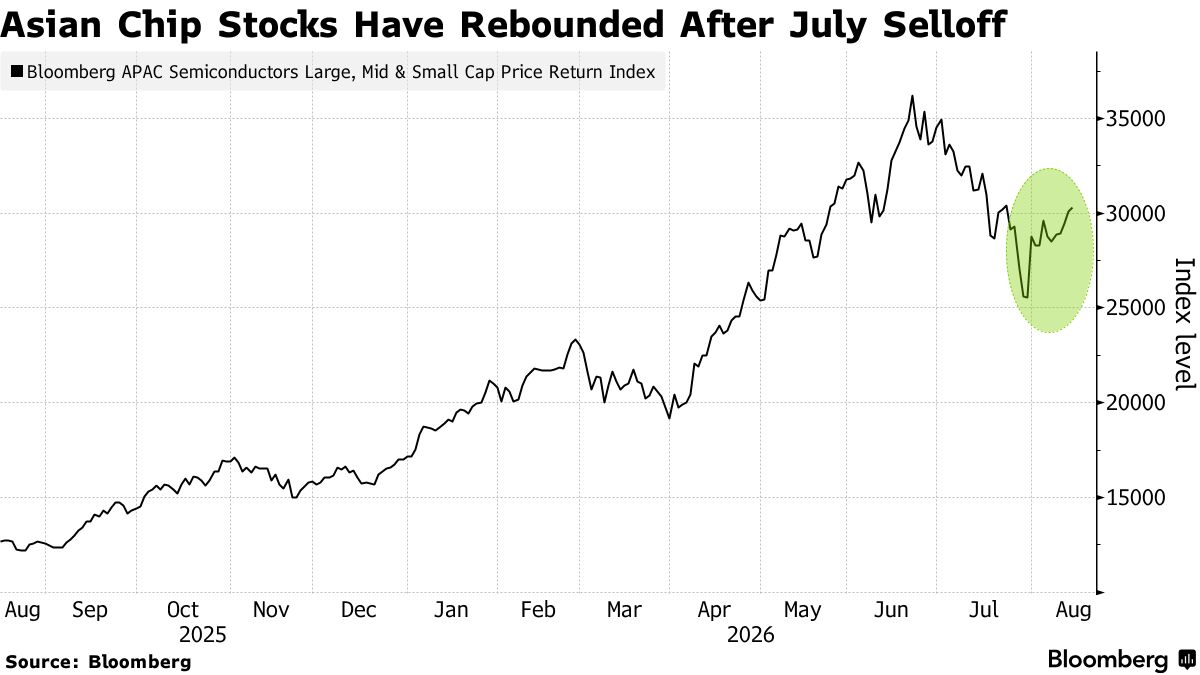
The Zhitong Finance App learned that Asian memory chip stocks rose on Friday, thanks to the optimistic performance outlook given by SanDisk (SNDK.US) on Investor Day 2026, which strengthened the market's confidence that the artificial intelligence (AI) boom will have a long-term positive impact on the industry. The Bloomberg Asia Semiconductor Stock Index once rose 1.6% and is expected to rise for the fifth consecutive trading day; the index is currently up more than 19% from its July low and has recovered from last month's sharp sell-off. In terms of individual stocks, South Korean memory chip giant SK Hynix rose nearly 3%; SanDisk's partner and Japanese chip giant Kioxia once rose nearly 9%, up more than 4% as of press time.
On Thursday, SanDisk announced its long-term financial model on Investor Day 2026, proposing a series of financial targets to be achieved from FY2028 to FY2030. Including this period, the company's revenue will maintain medium to high double-digit growth. SanDisk also clarified the market's concerns about the growth of bitcoins, suggesting that the amount of bits available for sale will be adjusted according to profit optimization needs, and promised that 100% of the remaining cash will be returned to shareholders after completing the business investment.
After the news was announced, the market quickly “voted with its feet,” and US memory chip stocks rose across the board. SanDisk closed up more than 13%, Western Digital (WDC.US) and SK Hynix (SKHY.US) rose more than 7%, Seagate (STX.US) rose nearly 5%, and Micron (MU.US) rose more than 4%.
What has received the most attention from the market on this Investor Day is undoubtedly the long-term financial model proposed by SanDisk. The company anticipates that during the 2028-2030 fiscal year, revenue will maintain medium to high double-digit growth, which matches the increase in bit shipments; at the same time, under non-GAAP, gross margin is expected to remain around 80% and operating profit margin of about 75%.
Under this financial model, SanDisk expects operating expenses to account for about 5% of revenue, and other revenue and expenses will not have a significant impact. Even after accounting for taxes, capital expenses, and working capital needed to support business growth, the company still expects an adjusted free cash flow margin of approximately 50%.
For the previously highly cyclical NAND storage industry, this set of goals is particularly aggressive. SanDisk is actually conveying a clear judgment to the market: the increase in demand for AI-driven storage is expected to keep the company's revenue growth and profitability well above the average of traditional storage cycles in the next few years.
One important reason why SanDisk has shown strong confidence in the long-term financial model described above is that the company is changing the business model of the traditional NAND industry. The company revealed that it has now signed new business model (NBM) agreements with 8 customers. These agreements include committed procurement volumes, binding contract frameworks, minimum financial guarantees, and structured pricing mechanisms, which can enhance the match between customer needs and company capacity plans, and reduce the impact of cyclical fluctuations in the traditional storage industry.
More importantly, the coverage of these agreements is already quite impressive: the NBM agreement currently signed covers about 50% of FY2027 bit shipments and about two-thirds of FY2028 bit shipments. SanDisk believes that this model can lead to more predictable revenue, greater visibility into cash flow, and longer-lasting profit growth.
Memory chip stocks, including SanDisk, are among the biggest beneficiaries of this year's expanding AI deals. However, the volatility of these stocks is still high, as investors still remember the previous industry cycle — after a sharp rise in product prices, there was often a sharp decline.
Andrew Jackson, head of Japanese equity strategy at Ortus Advisors, wrote in the report: “Even a few years ago, it was unimaginable that a NAND memory chip manufacturer could give such accurate long-term predictions. Compared to the more volatile spot pricing of memory chips, long-term agreements may help smooth out traditional boom-bust cycles.”