


- In recent months, Federal National Mortgage Association (Fannie Mae) has faced renewed scrutiny as new condo mortgage rules tighten underwriting standards and raise borrowing costs, while investors reassess its mortgage financing and credit risk management activities across single-family and multifamily segments.
- At the same time, investor debates over how Fannie Mae should be valued relative to Freddie Mac, against a backdrop of arguments for closer valuation parity, are putting fresh emphasis on how regulatory shifts and earnings durability feed into perceptions of the company’s longer-term role in U.S. housing finance.
- We will now examine how this renewed focus on Fannie Mae’s valuation versus Freddie Mac influences the company’s existing investment narrative and assumptions.
Find 50 companies with promising cash flow potential yet trading below their fair value.
Federal National Mortgage Association Investment Narrative Recap
To own Fannie Mae, you need to believe its core role in U.S. housing finance and its US$4.1 trillion guaranty book can keep generating durable fee and interest income, even as credit and regulatory pressures ebb and flow. The latest tightening in condo mortgage rules may weigh on near term loan volumes, but it does not materially change the main near term catalyst, which is how investors reassess its valuation versus Freddie Mac, or the key risk around credit costs and capital demands.
Among recent developments, the recurring Connecticut Avenue Securities tender offers stand out in this context. These transactions directly affect how much mortgage credit risk Fannie Mae retains versus shares with investors, which links closely to current debates over its earnings quality, capital intensity and valuation gap with Freddie Mac. As investors digest stronger recent quarterly net income alongside evolving credit transfer activity, views on what constitutes a fair multiple for Fannie Mae could shift again.
Yet behind the apparent value opportunity, there is a less visible risk that investors should be aware of if multifamily credit losses stay elevated...
Read the full narrative on Federal National Mortgage Association (it's free!)
Federal National Mortgage Association's narrative projects $32.1 billion revenue and $169.4 thousand earnings by 2029. This requires 5.7% yearly revenue growth and a $67.9998 million earnings decrease from $68.0 million today.
Uncover how Federal National Mortgage Association's forecasts yield a $10.50 fair value, a 69% upside to its current price.
Exploring Other Perspectives
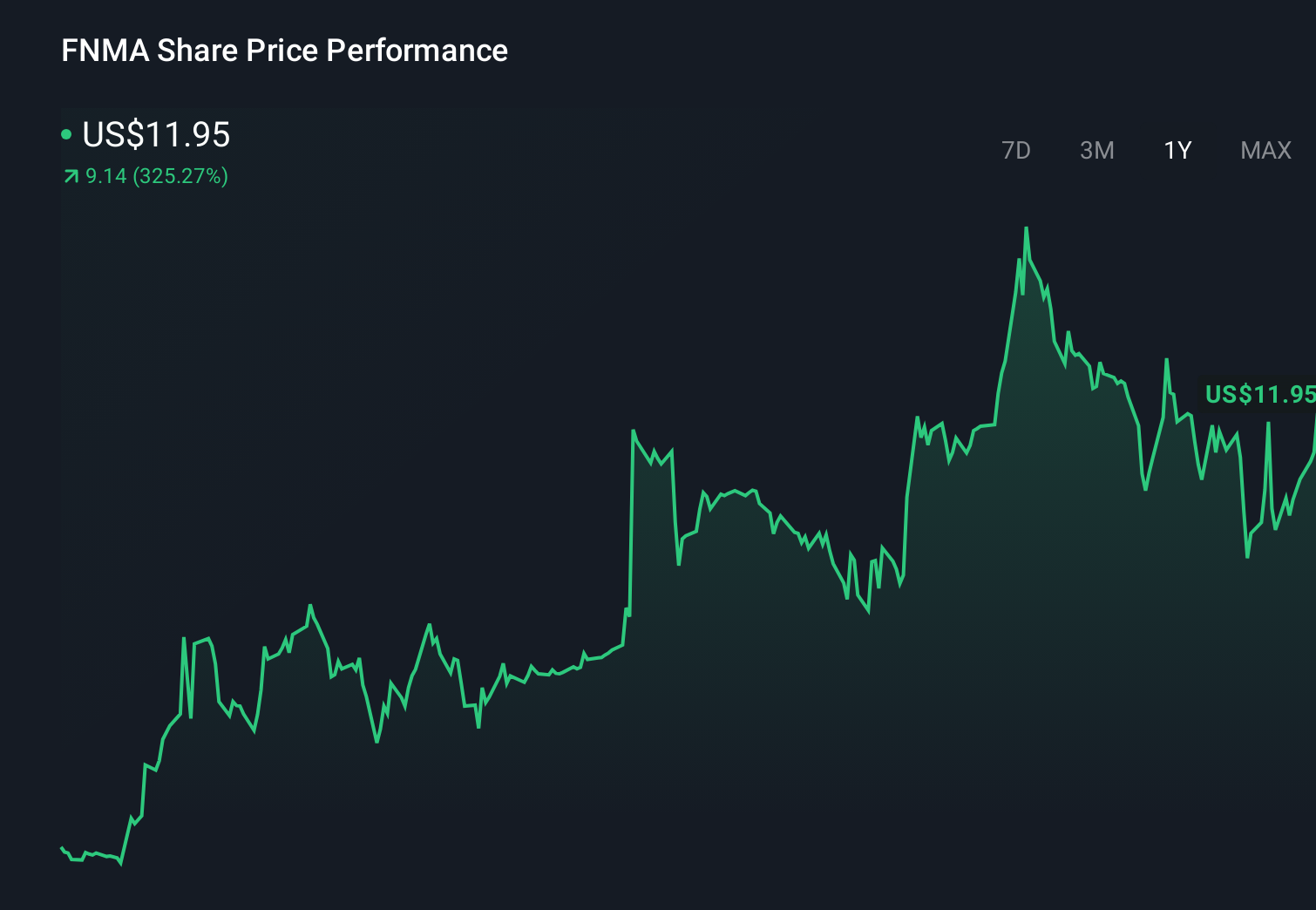
Before this condo rule news, the most pessimistic analysts were already cautious, assuming only 4.9% annual revenue growth and US$29.4 billion of earnings by 2029, which shows just how far opinions can differ and why it may be worth comparing several competing views on where Fannie Mae’s credit and capital story could go from here.
Explore 9 other fair value estimates on Federal National Mortgage Association - why the stock might be worth just $9.59!
Form Your Own Verdict
Disagree with existing narratives? Extraordinary investment returns rarely come from following the herd, so go with your instincts.
- A great starting point for your Federal National Mortgage Association research is our analysis highlighting 3 key rewards and 2 important warning signs that could impact your investment decision.
- Our free Federal National Mortgage Association research report provides a comprehensive fundamental analysis summarized in a single visual - the Snowflake - making it easy to evaluate Federal National Mortgage Association's overall financial health at a glance.
No Opportunity In Federal National Mortgage Association?
Don't miss your shot at the next 10-bagger. Our latest stock picks just dropped:
- Rare earth metals are the new gold rush. Find out which 28 stocks are leading the charge.
- This technology could replace computers: discover 24 stocks that are working to make quantum computing a reality.
- AI is about to change healthcare. These 44 stocks are working on everything from early diagnostics to drug discovery. The best part - they are all under $10b in market cap - there's still time to get in early.
This article by Simply Wall St is general in nature. We provide commentary based on historical data and analyst forecasts only using an unbiased methodology and our articles are not intended to be financial advice. It does not constitute a recommendation to buy or sell any stock, and does not take account of your objectives, or your financial situation. We aim to bring you long-term focused analysis driven by fundamental data. Note that our analysis may not factor in the latest price-sensitive company announcements or qualitative material. Simply Wall St has no position in any stocks mentioned.
Have feedback on this article? Concerned about the content? Get in touch with us directly. Alternatively, email editorial-team@simplywallst.com