


[Editor-in-chief Guan Shi]
Entering August, the trend of the Hang Seng Index was not that smooth. After going double in the early stages, it fell all the way down, and was recently adjusted to the 30-day line.
The Middle East is once again in a difficult pattern, and the straits are once again blocked, putting continued pressure on the global economy.
The Federal Reserve will announce the minutes of the July 28-29 meeting at 14:00 EST on August 19. The latest non-agricultural data is breaking, and if hawkish voices continue to be portrayed, it will have a negative impact on the market.
Currently, the main influence on market sentiment is performance. What we need to be wary of is that consumer leaders Maotai (600519.SH) and JD Group (09618) are all slowing down, so real estate has become one of the few directions where policy strength can be observed.
After the technology sector fell indiscriminately last month, some varieties began a restorative rise from the bottom. On August 14, Guangdong Province's first special financial product “Token Loan” was officially released in Haizhu District of Guangzhou, and the supporting policy “Eight Terms” was unveiled simultaneously. The real innovation of “Token Loans” is to transform tokens from a technical unit of measurement into an asset that can be recognized by banks and pledged for financing. DeepSeek officially announced the new pricing for the entire V4 series, and the token price was confirmed at the bottom. Token concept stocks have been strengthened, and computing power stocks have strengthened again due to policy support.
There is a lot of robot catalysis. Yushu Technology is expected to be listed in late August (18-24), and the 2026 World Robotics Conference will be held in the Beijing Economic and Technological Development Zone from August 19 to 23. The theme is “Human-robot symbiosis, integration of production and demand”. It mainly depends on the varieties that have performed well.
Frictions between China and Japan have resumed. On August 16, Japan's revised “Export Trade Management Order” officially came into effect. The control is divided into three layers: ultra-high precision five-axis CNC machine tools, core components such as grating scales/precision turntable/electric spindles, debugging and upgrades, and original factory maintenance technology. Exports were changed from “volume licensing” to “one single review”. The approval cycle was extended from about 15 days to 45-180 days, and the rejection rate for sensitive areas exceeded 80%; old orders were only suspended until the end of 2026. Supply cuts are forcing domestic substitutions to speed up. At the same time, the countermeasure direction is expected to follow suit simultaneously.
Hang Seng Index will announce the results of the Hang Seng Index series review for the second quarter of 2026 on August 21, 2026 (Friday). It is expected to be included in the variety or cause hype.
[This week's gold stocks]
Insilicon Smart (03696)
In the past month, Insilicon has successively nominated 2 PCC pipelines for potential FIC. Both pipelines have benefited from the discovery of AI enabling innovation mechanisms. Following the TNIK target, Insilicon continues to verify the reproducibility, accuracy, and scalability of the company's end-to-end AI platform around two new target mechanisms and a new pipeline in the field of diseases. At the same time, the ability of AI to enable innovation mechanisms continues to strengthen; and both pipelines focus on larger disease tracks, which is expected to open up space for the company's future growth potential.
A Target Z/ISM9528: Targeting the 100 billion dollar market for pain, Target Z is an innovative mechanism of action of non-opioid and non-ionic channels discovered with the aid of Pandaomics, showing therapeutic potential comparable to or even surpassing existing treatment options including morphine for TargetZ drug candidates.
The other is Target Y/ISM9077: Target Y plays a key role in the biological mechanisms of aging and various aging-related diseases. Target Y inhibitors developed on an AI platform have the potential to be multi-effective. The nominated ISM9077 is used to treat ophthalmic diseases such as dry senile macular degeneration (Dry AMD), and its innovative mechanism of action supports expansion into a wider range of treatment fields, including various inflammation-related diseases such as Parkinson's disease, MASH, and obesity. In terms of some key evaluation indicators, it showed a curative effect of about three times that of the already marketed treatment plan, and also showed better histopathological improvement effects.
The progress of the company's external licensing cooperation has exceeded expectations. In 2026, it has reached 9 major agreements, with payments exceeding 250 million US dollars, and the company's annual performance growth is very certain. The company is expected to continue to expand cooperation in the second half of 2026, while promoting multiple PCC nomination projects to further enhance the certainty of short-term revenue growth and long-term pipeline value creation capabilities.
[Industry Watch]
Yushu Technology is about to enter A-shares and become the first humanoid robot machine.
The company's core advantages are fully self-developed hardware and strong motion control capabilities: core components such as joint modules, encoders, and drivers are highly customized, using high-torque motors with low deceleration ratio planetary reducer routes to replace traditional harmonic solutions. The cost of core components is reduced by 60%-70% compared to external procurement, which not only supports robots to complete difficult actions, but also greatly shortens product delivery. In 2025, the company sold more than 5,000 humanoid robots, with a gross margin of 63%; four-legged robots sold more than 20,000 units, with a gross profit margin of 57%, which was significantly higher than the manufacturing average.
At the industry level, humanoid robot hardware already has a basic foundation for large-scale implementation, and the real core point of industrialization lies in large models. Currently, the industry is in the “1 to 10” development stage. Motion control capabilities alone cannot support long-term commercialization. Large models are needed to give robots the ability to generalize interaction and independently complete complex long-term tasks without fixed programs. Yushu's current listing has raised nearly half of its capital in model research and development, which also confirms the core direction of this industry.
In terms of technological evolution, the large model of humanoid robots progressed along the three main lines of rich modes, increased motion output frequency, and enhanced generalization capabilities. The technology route gradually evolved from the Transformer architecture to iteration of generative, fast and slow brain systems. Google's latest Gemini Robotics Two achieved breakthroughs in full-body joint coordination control and simulation data training, but insufficient fine force control and lack of tactile modality are still common shortcomings in the industry.
Currently, the industry has fallen into a cycle of “insufficient intelligence - no implementation scenarios - lack of real data - slow iteration”, and various regions are breaking the game by accumulating high-quality data through the construction of digital collection centers. In the future, the industry will upgrade towards tactile multi-modal integration, world model research and development, and the integration of virtual and real data.
The Hong Kong stock market focuses on the best choice in the field of complete machines (09880); Hesai (02525) /Sagiteng Juchuang (02498) /Sanhua Intelligent Control (02050) /Jinli Permanent Magnet (06680) /Dechang Electric Holdings (00179); direct participation in industrial capital Meituan (03690) /Xiaomi (01810) /Shoucheng Holdings (00697), etc.
[Data View]
According to data released by the Hong Kong Stock Exchange, the total number of outstanding contracts in the Hang Seng Futures Index (August) was 10,8872, and the net number of outstanding positions was 31,354. Hang Seng Futures refers to the settlement date of August 28, 2026.
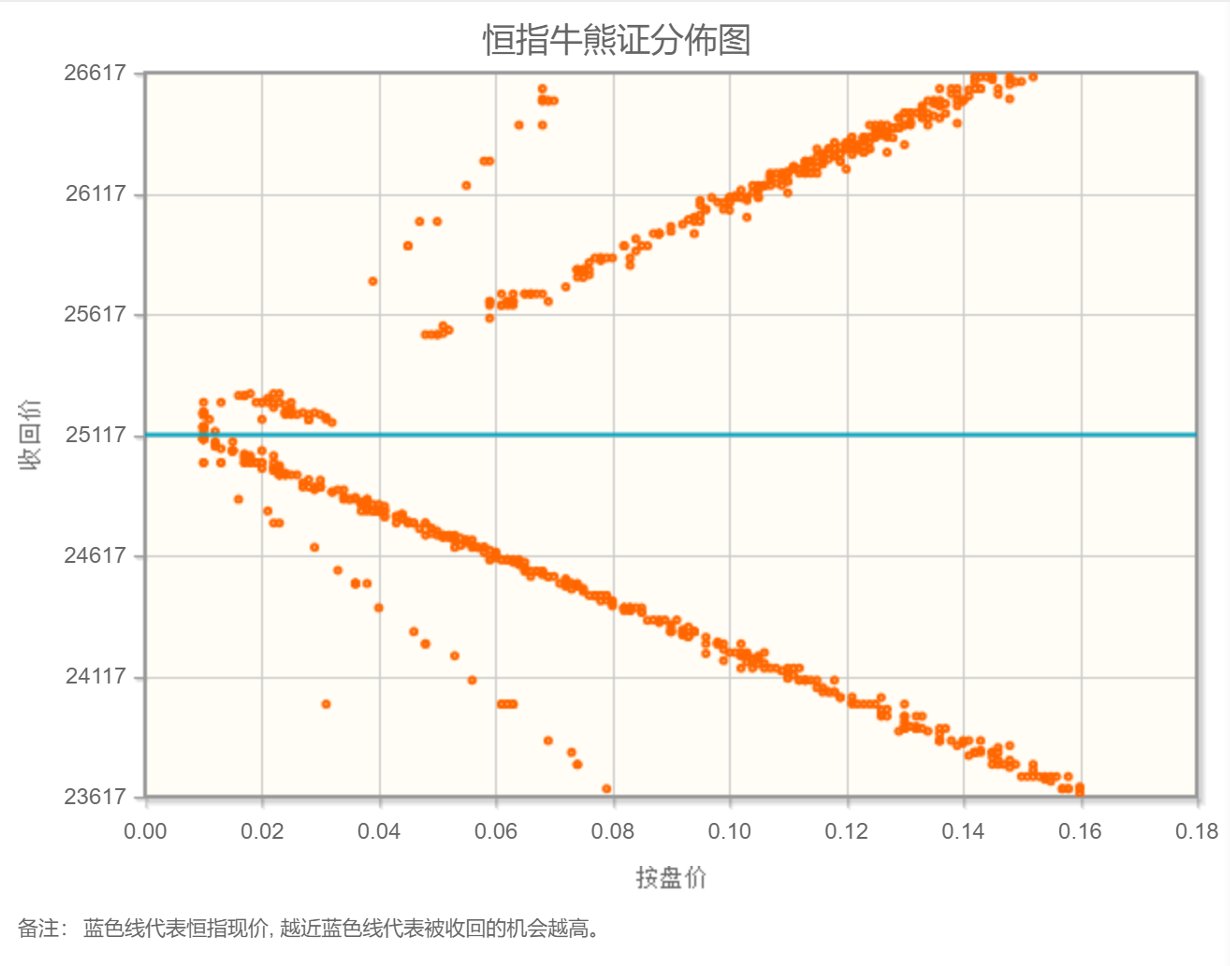
The Hang Seng Index is at 25,117 points. The area where bullish stocks are concentrated below is close to the central axis, the upper bears deviate, and Hong Kong stocks are motivated to go short. Wall Street traders adjusted their expectations for the Federal Reserve's interest rate hike. The Hong Kong stock sector switched highs and lows, and the Hang Seng Index was bearish this week.
[Editor's Testimonial]
After experiencing a rapid rebound of about 12% since the end of June, Hong Kong stocks are likely to switch from a “fast rate of valuation repair” to a “slow phase of profit verification”. Volatility and differentiation will be the main tone in the future.
This round of rise is driven by undervaluation repairs, short recovery, and cross-market capital rebalancing. Currently, the Hang Seng Index PE has returned to near the long-term average. The “easy phase” of general growth has basically come to an end. Subsequent upward breakthroughs in the market must rely on substantial improvements in corporate profits. The current mid-reporting season is a key window for verifying the success of the market. In particular, the progress of AI commercialization of Hang Seng Technology's shares and the pace of profit margin restoration will directly determine whether the growth sector can take over the rise.
At the same time, the Hang Seng Technology Index is about to be expanded and revised, broadening the coverage of technology themes and increasing the number of constituent stocks from 30 to 50. In the long term, it is beneficial to increase the index's representation and capital carrying capacity, but in the short term, it may also cause disturbances in component stock position adjustments and style rebalancing.
On the capital side, the stage of domestic and foreign investment joining forces to push up has passed. The pace of active foreign capital inflows is slowing down, and southbound capital also tends to be cautious, and market stratification will further intensify: core assets with strong profit certainty will gradually realize their value, while a large number of small-cap stocks that lack fundamental support are still full of “downward investment” joint stock supply traps, making it easy for ordinary investors to step on the pit.
Overall, the bottom of Hong Kong stocks is clear, but a complete reversal is still early. Next, instead of betting on index space, it is better to follow the profit improvement main line layout, focus on AI applications, pharmaceuticals, high dividends, etc., and at the same time resolutely avoid small-market targets without performance support, and maintain certainty in a fragmented market.