


The Zhitong Finance App learned that due to the uncertainty caused by the geopolitical conflict in the Middle East, Japan's capital expenditure continued to be sluggish, and Japan's economic growth unexpectedly slowed in the three months ending June. This result may complicate the Bank of Japan's policy communication when weighing the timing of the next rate hike. According to a data report released by Japan's Cabinet Office on Monday, Japan's real gross domestic product (GDP) grew by 1.1% on an annualized basis in the second quarter (that is, an annualized quarterly rate). This growth rate is far lower than the revised 1.9% in the previous quarter, and seriously falls short of the 2% annualized quarterly rate predicted by Japanese economists, but it still marks the third consecutive quarter of expansion of the Japanese economy.
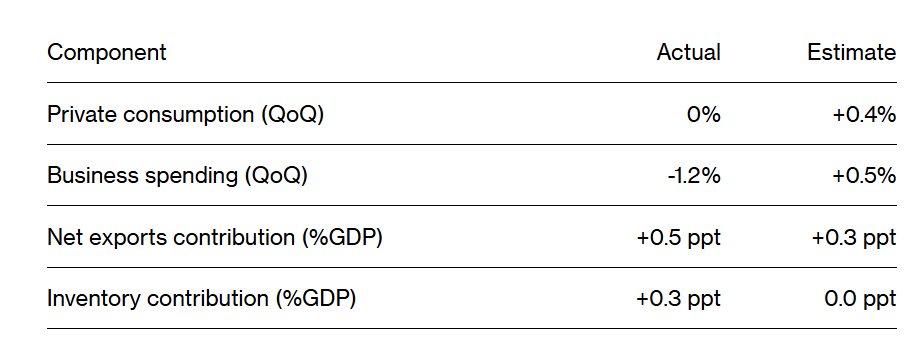
Furthermore, capital investment in Japan fell by 1.2% in the second quarter on a non-annualized basis. The decline was significantly greater than the 1% revised increase in the previous quarter, and also significantly lower than the 0.5% increase expected by the market.
This GDP data marginally weakened the Bank of Japan's “growth license” to immediately raise interest rates in September, but it was not enough to overturn the main line of interest rate hikes. Japan's GDP grew by only 1.1% annualized in the second quarter, lower than market expectations of 2.0%. Private consumption remained flat month-on-month, and capital expenditure fell 1.2%, indicating that domestic demand, especially corporate investment, is being impacted by high energy costs and the Middle East conflict; therefore, if the Bank of Japan only considers the demand side, it has every reason to postpone the next rate hike until October or even later.
However, the problem is that the Bank of Japan is currently facing not a typical overheating of demand, but rather a weak yen, an impact on imported energy, rising corporate prices, and rising inflation expectations; previously, on August 14, media reported that the Bank of Japan had discussed raising interest rates again from September 17 to 18 as soon as possible, and the market had previously included about 80% of the probability of the Bank of Japan's interest rate hike in September; weak GDP is more likely to change the September interest rate hike from a “high-certainty transaction” to a data-dependent decision.
What is even more alarming is that the yield on 10-year Japanese treasury bonds has once again hit about 2.90% in the context of weak GDP, hitting the highest region since September 1996. This shows that the rise in long-term interest rates is no longer just a “bet on the Bank of Japan's interest rate hike,” but is also trading inflation risks, fiscal supply, and more extreme term premiums at the same time.
Naoki Hattori, chief Japanese economist at Mizuho Research Institute, said, “As far as capital expenditure is concerned, our basic view is that investment remains steady, particularly in fields such as artificial intelligence and data centers. However, some small and medium-sized enterprises may have stood still or adopted a wait-and-see attitude. The heightened uncertainty brought about by the tense situation in the Middle East may cause some companies to put their investment plans on hold.”
The Japanese economy unexpectedly “hit the brakes”! Bank of Japan's “September rate hike” shifts from deterministic transactions to data games
Keiji Kanda, chief economist at the Yamato Research Institute, said: “Consumption is quite weak. The decline in non-durable goods was greater than expected. Considering that consumer performance was not as strong as expected and capital expenditure was weak, I don't think the overall results were particularly strong.”
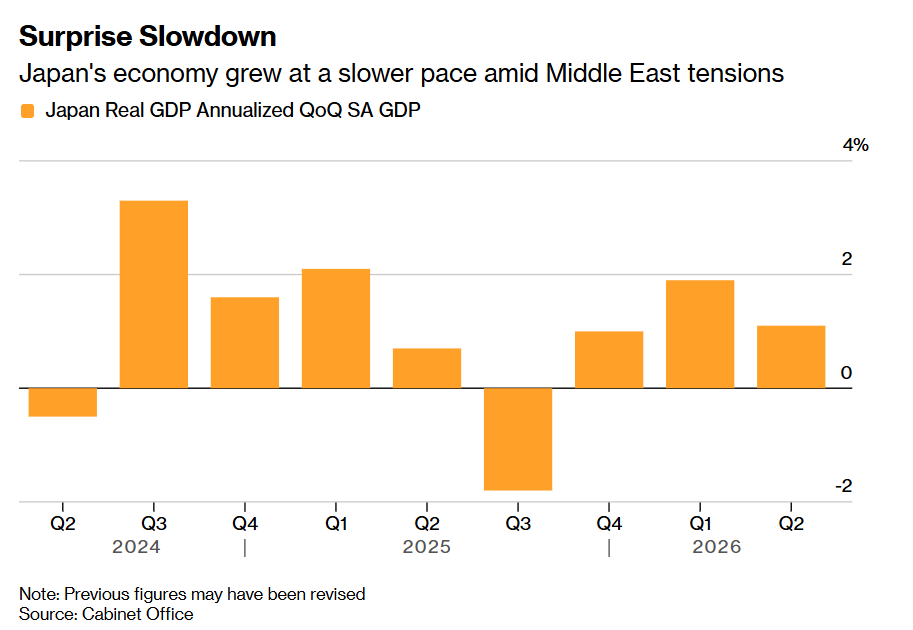
As shown in the chart above, Japan's economy has unexpectedly slowed — Japan's economic growth is slowing at a time of tension in the Middle East.
At the time this set of data was released, the Japanese economy was facing the impact of the Middle East conflict. The conflict in the Middle East has boosted the prices of fuel and petroleum products, while also disrupting parts of the supply chain. This unexpected slowdown may complicate the Bank of Japan's policy communication, as the Bank of Japan is weighing the timing of the next rate hike.
According to overnight swap market pricing, as of Monday morning, interest rate futures traders think the probability that the Bank of Japan will raise the benchmark interest rate the next time it makes a monetary policy decision on September 18 is 80%.
Among other factors dragging down economic growth, private consumption remained flat month-on-month, falling short of the 0.4% increase generally expected by the market; private consumption increased 0.5% after correction in the previous quarter. This result is likely to reflect a general decline in consumers' willingness to shop in the face of rising living costs.
Japanese Prime Minister Sanae Takaichi will be worried about signs of weak domestic demand. She just won an overwhelming election victory about six months ago, but her approval rating has begun to decline as consumers continue to be pressured by rising prices for daily necessities such as food. The Takashi government has introduced subsidy measures to limit the rise in utility costs, and is now planning to reduce the food consumption tax to 1% for a period of two years starting next April.
“Japan's GDP growth rate in the second quarter was higher than the potential growth rate, but the specific composition weakened the reason for the Bank of Japan's interest rate hike in September — and this rate hike had previously been increasingly factored into the price by the market. The decline in capital expenditure may indicate that companies are becoming more cautious about future growth prospects under the crude oil price squeeze caused by the war in Iran.” Taro Kimura, a senior economist at Bloomberg Economics, said.
The GDP data contrasts to a certain extent with a series of generally optimistic corporate data for the same period. According to a brief survey by the Bank of Japan, with AI computing power demand and AI infrastructure in full swing, the business confidence of major Japanese manufacturers rose to the highest level since 2018 in June, while the confidence index of large non-manufacturers surrounding servers remained near the strongest level since 1991.
Since the end of the first quarter, Japan's industrial output has been growing month by month, and related forecasts indicate that output will rise further in July and August; at the same time, the Japanese manufacturing purchasing managers' index (PMI) remains high. Previously, the index rose to its highest level in 12 years in April.
Although corporate profits are still relatively strong, business investment has declined. Previously, in the three months ending March, the year-on-year increase in current profits of Japanese companies significantly exceeded market expectations.
Admittedly, businesses are facing higher operating costs. In July, corporate commodity prices continued to rise at a high rate, rising 7.2% year on year, forcing companies to bear the pressure to further pass on costs to customers and increase sales prices.
While the Strait of Hormuz is actually still closed, the Japanese government has been trying to ease the tension in the energy market by diversifying energy sources. According to June trade data, crude oil supplied by the US already accounts for nearly one-third of Japan's oil imports. In contrast, in February, this ratio was only about 7%.
Looking ahead, the Japanese economy faces both favorable and unfavorable factors. However, economists said that steady wage increases and government subsidy measures brought about by annual wage negotiations are expected to still support household consumption expenses.
Kanda said, “Consumption performance was weaker than expected, but employee compensation increased compared to the previous quarter, and real wages continued to grow year over year. So, taking these factors into account, I don't think the potential recovery trend of the Japanese economy has been disrupted.”
After the data was released, the yen strengthened slightly, rising from a level of around 159.21 before publication to 159.04. Since the US and Japanese governments intervened to support the yen at the end of July, the yen's rise has narrowed, and is still far below its 10-year average of 126.09.
GDP unexpectedly cooled, but the yield on 10-year Japanese Treasury bonds reached a 30-year high!
This GDP data marginally weakened the Bank of Japan's “growth license” to immediately raise interest rates in September, but it was not enough to overturn the main line of interest rate hikes. Japan's GDP grew by only 1.1% annualized in the second quarter, lower than market expectations of 2.0%. Private consumption remained flat month-on-month, and capital expenditure fell unexpectedly sharply by 1.2%, indicating that domestic demand, especially corporate investment, is being impacted by high energy costs and the conflict in the Middle East; therefore, if the Bank of Japan only considers the demand side, there is every reason to postpone the next rate hike until October or even later.
However, the problem is that the Bank of Japan is not facing a typical overheating of demand, but rather a weak yen and the impact of imported energy due to the geopolitical conflict in the Middle East, combined with rising corporate prices and rising inflation expectations. The Bank of Japan has discussed raising interest rates again from September 17 to 18 as soon as possible. The market previously included a probability of about 80% of the September rate hike.
Weak GDP is more likely to turn the September rate hike from a “high-certainty deal” into a data-dependent decision rather than ending the austerity cycle itself. The benchmark risk-free yield index for the Japanese bond market — the 10-year Japanese treasury yield once again strongly hit about 2.90% in the context of weak GDP, reaching the highest region since September 1996. This also shows that rising long-term interest rates are no longer just “betting on the Bank of Japan's interest rate hike,” but also trading inflation risks, fiscal supply, and term premiums at the same time.
The expansionary fiscal plan of the Takaichi government, public debt exceeding 200% of GDP, energy import costs, and the Bank of Japan's continued reduction in debt purchases all require investors to claim higher maturity premiums to hold long-term Japanese bonds. Around 3% is already seen by some market participants as a key threshold that could trigger a new round of sell-off. *Weak GDP may lower expectations of short-term interest rate hikes, but not necessarily lower long-term yields — Japan is experiencing the typical steeper risk of “slowing growth, policies still need to be hawkish, and fiscal and inflation premiums driving up long-term debt.” If the September rate hike is delayed but the 10-year yield remains high at 2.8% to 3%, it means that bond market concerns have escalated from the “central bank interest rate” to a repricing of Japan's long-term fiscal and inflation credibility.