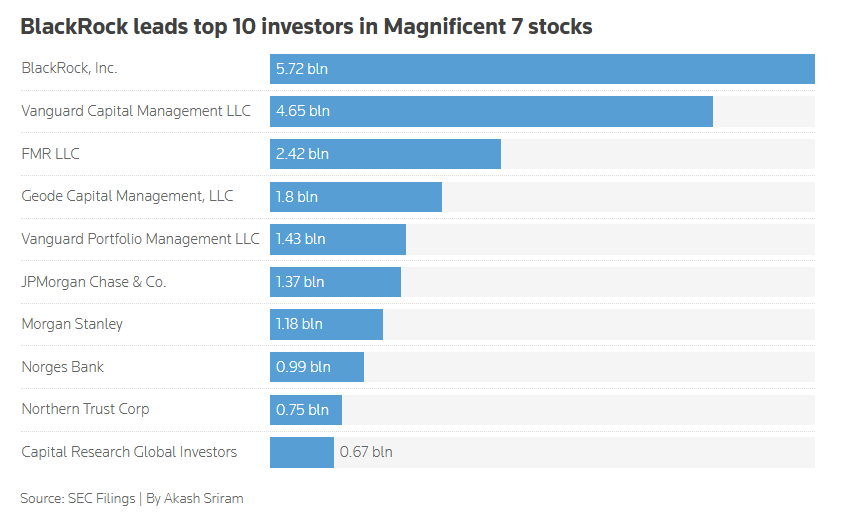
The Zhitong Finance App learned that the quarterly 13F documents disclosed by the US Securities and Exchange Commission (SEC) show that in the second quarter of this year, institutional investors slightly reduced their holdings in key sectors such as semiconductors, artificial intelligence (AI) infrastructure, and large technology stocks, and there were no obvious signs of one-way large bets.
After analyzing the 13F documents submitted by 6,371 pension funds, hedge funds, wealth management agencies and other institutional investors, it was found that there was not much difference between the number of institutions that increased their holdings and reduced their holdings, but in many cases, the one that reduced their holdings had a slight advantage.
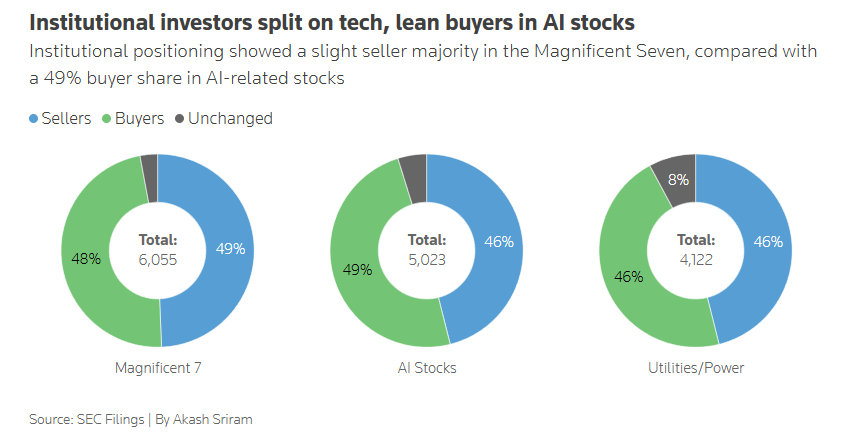
In the group of supertech stocks known as the “Big Seven” (including Microsoft (MSFT.US), Meta Platforms (META.US), etc.), about 44% of reporting institutions cut their positions, while 42% of institutions chose to create or increase their holdings. The remaining institutions did not disclose changes in shareholding. This group of tech giants has always been an important force driving the stock index upward in this round of the bull market.
The relevant documents cover the quarterly position situation up to June 30, and the declaration data on which the analysis was based was as of last Friday afternoon (according to the SEC website).
The position file does not disclose the specific logic behind the position adjustment. However, some market participants pointed out that this data may reflect more of the current situation where many institutions have established large positions in these sectors rather than their judgment on the fundamentals of related companies — at the same time, it also helps explain some recent changes in market momentum.
Shaia Hosseinzadeh, founder of hedge fund OnyxPoint Global Management, said, “When buyers and sellers are so close, we think this indicates that the market has not reached a consensus. No one is questioning the scale of (AI) spending.” But he added that the parties disagree about which companies can actually benefit in the end, which has brought uncertainty.
For many funds that have held large shares in these companies for a long time, risk factors have also become an important consideration.
Interactive Brokers market strategist Steve Sosnick pointed out, “What you're probably seeing is that some large institutions have reached or are close to their maximum positions based on their own risk parameters or investment policies.” He added, “This also explains why shares of some companies that are performing well weaken after earnings reports are released — those with large positions that usually buy when the news is positive are unable to further increase their holdings.”
The 13F data also showed that by the end of the second quarter, institutional investors were still too numerous in the semiconductor sector as a whole. Of the declared funds, 48% were net buyers, and only 34.5% were net sellers.
The 20 largest software company groups, including Adobe (ADBE.US) and Datadog (DDOG.US), also showed a similar narrow gap: 28.2% of institutional investors were net sellers, and 26.3% were net purchases.
Tiger Global reduced its holdings of the “Big Seven”
At least one high-profile hedge fund, Tiger Global Management, revealed that it cut its holdings in several “Big Seven” companies such as Microsoft, Nvidia (NVDA.US), and Meta in the second quarter, and reduced its holdings in Alphabet (GOOGL.US) by 45.4% to 5.8 million shares. The fund also reduced its holdings of TSM.US (TSM.US) (SoftBank Group also reduced its holdings), but also increased its holdings of Intel (INTC.US).
This operation may have cost some hedge funds a heavy price in July — a wave of technology-related transactions at the time seriously hampered returns. J.P. Morgan Chase pointed out in a report released at the beginning of this month that technology stock positions are highly congested, making it particularly difficult for speculators such as hedge funds to lock in previous profits when trying to exit the transaction.
Investors showed an overall trend of increasing their holdings in AI-themed stocks in the second quarter. Of all institutions that have submitted 13F documents, 36% disclosed that they had net purchases of AI concept stocks such as CoreWeave (CRWV.US), Arista Networks (ANET.US), and Broadcom (AVGO.US).
Bruno Schneller, managing partner of the multi-family office Erlen Capital Management, said that in the second quarter, various AI-related stocks, from memory chips to data centers, “evolved from a fundamental growth story to highly leveraged kinetic energy transactions.” He added that the decline in many relevant individual stocks in July “was more due to typical crowded trading positions being amplified by insufficient leverage and risk control, rather than the market's denial of long-term AI logic.”
Despite the rise in crude oil prices in the second quarter, institutional investors overall had little interest in the energy sector. 40.3% of reporting agencies said they were net sellers of 12 major energy companies, while net buyers only accounted for 28%.
OnyxPoint — a hedge fund that invests in upstream and downstream AI companies such as metal mining and energy — increased its exposure to some energy assets in the second quarter. The fund established new positions in British Petroleum (BP.US), Devon Energy (DVN.US), and geothermal supplier Fervo Energy (FRVO.US), while also building positions in data center company Keel Infrastructure (KEEL.US).
Overall, institutional investors have a wait-and-see attitude towards the data center sector. The ratio of net buyers to net sellers is almost exactly the same, each accounting for 24.3% of the declared institutions.