


The Zhitong Finance App learned that on August 17, in the Hong Kong stock market, Beishui traded a net purchase of HK$3,077 billion. Among them, Hong Kong Stock Connect (Shanghai) had a net purchase of HK$1,974 billion, and Hong Kong Stock Connect (Shenzhen) had a net purchase of HK$1,103 billion.
The individual stocks that Beishui Net bought the most were SMIC (00981), Zhiguo (02513), and Tencent (00700). The individual stocks sold the most by Beishui Net were Huahong Hongli (01347) and Jiantao Laminate (01888).
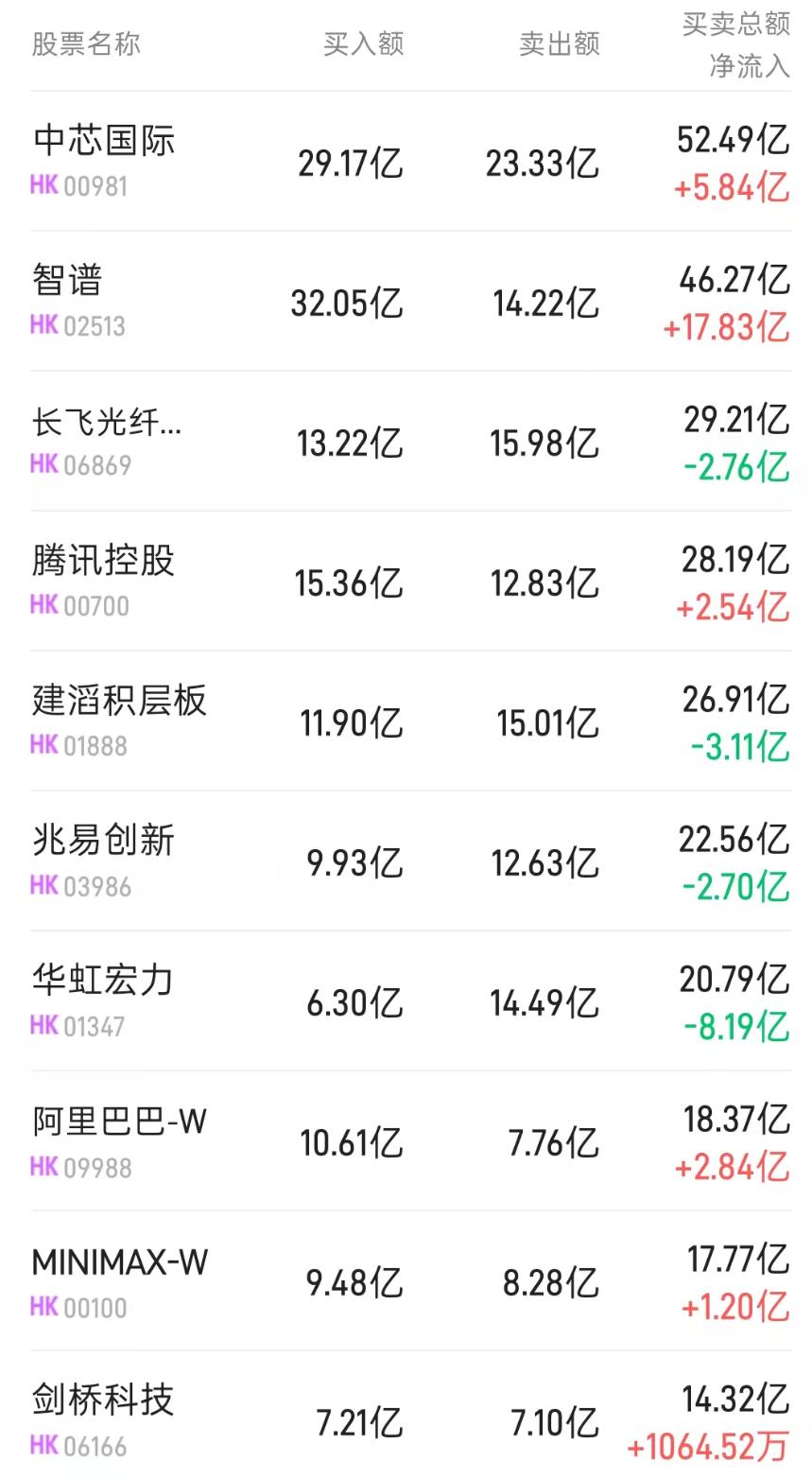

Hong Kong Stock Connect (Shanghai) active trading stocks
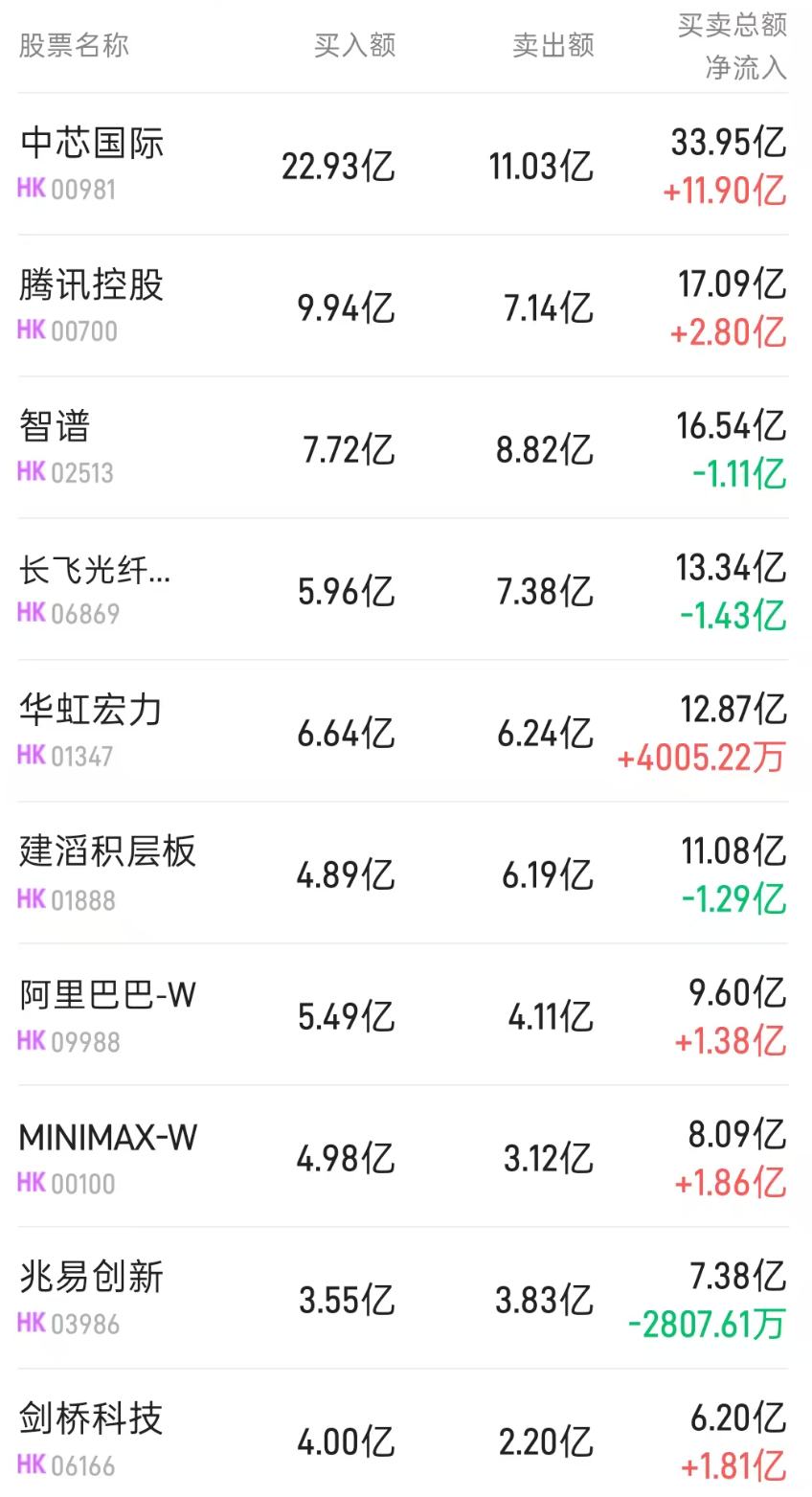
Hong Kong Stock Connect (Shenzhen) active trading stocks
SMIC (00981) received a net purchase of HK$1,774 million, while Huahong Hongli (01347) received a net sale of HK$778 million. SMIC Huahong's post-performance differentiation was mainly due to a “scissor gap” between market expectations and actual performance. Huahong Hongli's net profit for the second quarter was US$38.6 million, slightly lower than market expectations of US$39.4 million. Combined, the third-quarter revenue guidance fell short of expectations, triggering a profit settlement after the benefits were realized; not only did SMIC's second-quarter performance completely exceed expectations, but gross margin guidance continued to rise in the third quarter, and several institutions actively raised ratings.
Smart Spectrum (02513) and MINIMAX-W (00100) received net purchases of HK$1,672 million and HK$306 million respectively. On August 8, DeepSeek announced that it would drastically raise the API price. Morgan Stanley interpreted this move as a positive sign of improved pricing discipline in the industry. The bank believes that the industry is shifting from price competition to commercialization driven by intelligent capabilities, and three major structural changes are occurring simultaneously: pricing is becoming more rational, open source licensing is being tightened, and the scale of model parameters is rising.
Tencent (00700) received a net purchase of HK$533 million. Yamato said that although short-term capital expenditure may remain high, Tencent believes that current AI spending can be rationalized with attractive long-term returns. Management pointed out that computing power can already be monetized through resale, but the company still prioritizes the AI program because it believes it can create greater long-term value. The bank expects that the real benefits of WorkBuddy and Xiaowei will gradually become apparent, requiring investors to wait patiently.
Alibaba-W (09988) received a net purchase of HK$422 million. Alibaba announced that it will officially open source the Qwen3.8 series model on August 14. All developers, research institutions and enterprises can freely download, deploy, and use it. The new open source Qwen 3.8-27B is a native multi-modal dense (Dense) model. With only 27 billion parameters, the overall level surpasses Qwen 3.7-Plus.
Changfei Optical Fiber Cable (06869) had a net sale of HK$418 million. According to Jefferies statistics, the world has announced an additional 19,400 tons of optical fiber prefabricated rod production capacity in 2026-2028. 2026 may still be in a period of tight supply, and the risk window is 2027-2028. Nomura previously suggested that if new entrants can successfully develop high-end products (that is, air core fiber and multi-core optical fiber) and successfully implement capacity expansion plans, market competition will intensify, and existing participants may face pressure to expand profit margins.
Additionally, Cambridge Technology (06166) received a net purchase of HK$191 million. Meanwhile, Zhaoyi Innovation (03986) and Jiantao Laminate (01888) received net sales of HK$297 million and HK$439 million respectively.