


The Zhitong Finance App learned that the issuance scale of US investment-grade bonds has set a monthly historical record for three consecutive months, highlighting that at a time when artificial intelligence computing power infrastructure construction expenses are driving large-scale corporate borrowing, the US high-rated bond market is continuing the fastest issuance pace in history. As Google's parent company Alphabet and AI hyperscalers (Hyperscalers) such as Amazon and Meta set a record amount of debt issuance, the unprecedented AI investment boom has seen an extremely important paradigm shift: from “tech giants using their own continuous strong free cash flow to build AI” to a stage where “global capital markets work together to finance AI gigafactories for big tech giants”, yet this AI financing boom is also driving long-term US bond yields to continue to rise for 10 to 30 years.
According to the latest statistics compiled by Bloomberg News, as of this Monday, the supply of high-rated US bonds reached US$145.2 billion in August, surpassing the monthly record of US$136 billion set in August 2020. Earlier this year, January, June, and July all set records for the highest-level bond issuance in their respective months, and another 3 months recorded the second-busiest high-rated corporate bond issuance scale in their respective history.
Looking more broadly, AI hyperscalers such as Alphabet, Amazon, and Meta have issued nearly 220 billion US dollars in bonds since this year, which is more than double the full year of 2025 of 108 billion US dollars. Judging from current comparable data, it can be called “a record high for the same period or a record issuance pace during the same period.”
Notably, 2025 itself is already far above historical normal—according to Bank of America data, the five largest Hyperscalers issued $121 billion in US corporate bonds throughout 2025, while the average annual scale from 2020 to 2024 was only about $28 billion. In other words, the issuance scale in the first eight months of 2026 alone has significantly exceeded the normal level of any previous full year, so judging from the speed of issuance and cumulative scale, it is the highest and unprecedented AI debt financing cycle in the same period.
Furthermore, Wall Street financial giant Morgan Stanley expects global AI-related debt financing to be close to $570 billion in 2026. This data not only strengthens the financial certainty of AI infrastructure investment, but also means that capital costs, 10-year or more long-term US bond yields, and ROIC will be the core stress tests for the next phase of the AI bull market.
From Alphabet to AMD, the wave of AI burning money has exploded the credit market! AI arms race pushes the bond market into a “record making machine”
The torrent of bond issuance has prompted investors to be more critical when deciding which bonds to buy and at what price. This was particularly evident last week: the proportion of initial subscription orders that were eventually withdrawn rose sharply. But that hasn't stopped companies from continuing to finance in the debt market, and an additional $9.1 billion in bonds are scheduled to be issued on Monday. There were 12 transactions on the day, including 2 issues from private credit funds.
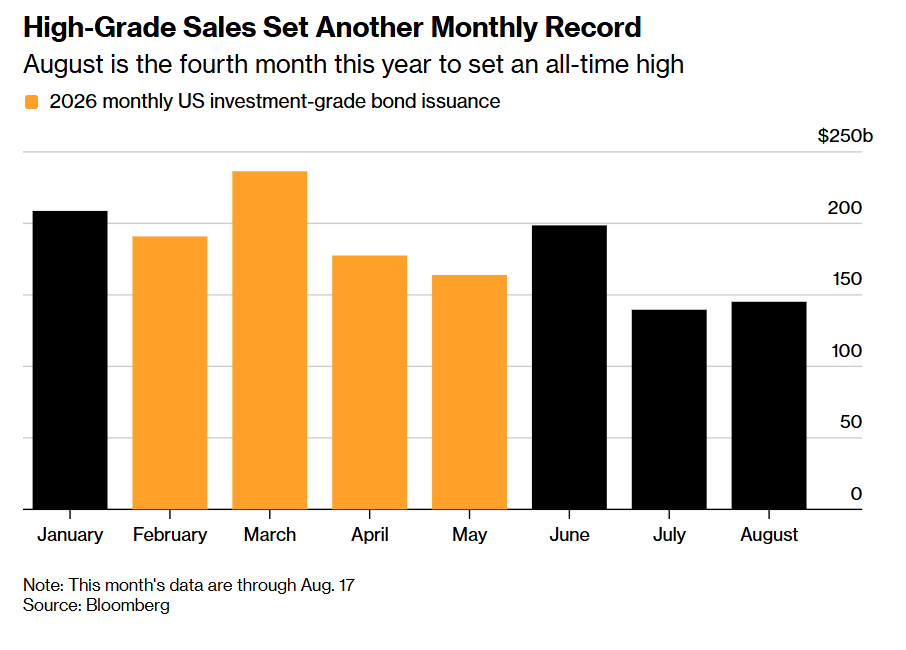
As shown in the chart above, the issuance of high-rated bonds hit another monthly record — August became the fourth month this year to reach a record high.
This month's issuance was mainly led by Google's parent company Alphabet Inc.'s $25 billion bond issuance. This is the eighth bond issue of 25 billion US dollars or more this year, and the data shows that all 8 deals are from technology companies. More releases are coming soon. J.P. Morgan recently raised its forecast for the 2026 issuance scale of technology, media and telecommunications (TMT) corporate dollar bonds by about 20% to $540 billion.
According to a rough sum of the amounts recently disclosed by the media, Alphabet raised 31.51 billion US dollars in the US dollar, pound, and Swiss franc markets in February this year, issued 9 billion euros (about 10.6 billion US dollars) +85 billion Canadian dollars (about 6.2 billion US dollars) +576.5 billion yen (about 3.6 billion US dollars), and completed another 25 billion US dollar bonds in August. That is, before the proposed Australian dollar bonds are included, public bond financing has reached about 76.9 billion US dollars in 2026; Google's parent company Alphabet's latest news shows that the company is preparing to enter an Australian dollar-denominated company for the first time The bond market has an issuance period of up to 20 years.
August also included the $10 billion bond issue by US healthcare giant AbbVie Inc. (AbbVie Inc.) to finance the acquisition, and the $6.75 billion bond issue by financial giant HSBC Holdings Plc (HSBC Holdings Plc.). Last week, the AI chip and PC chip giant AMD, one of Nvidia's strongest competitors in the AI chip field, raised $4.75 billion, setting a record for the largest dollar bond issuance in the history of the chipmaker.
The debt capital market usually becomes more active in early September, especially after the US Labor Day holiday is over. The bond supply since this year has reached 1.46 trillion US dollars, 8.5% higher than the same period in 2020; in that year, the trend of bond issuance driven by the pandemic set a record for the whole year. Global debt financing activities also heated up sharply in 2026, and the cumulative sales scale of bonds issued by public syndicates reached 5 trillion US dollars at an unprecedented rate.
Tech giants hit a flood of debt and the US government's ever-expanding fiscal deficit. The yield on 30-year US bonds hit a new high since 2007
As described above, the unprecedented AI investment boom has seen an extremely important paradigm shift in financing: from “tech giants using their free cash flow (Free Cash Flow) to build AI” to a new stage of “global capital markets jointly finance AI factories”.
According to data compiled by Bloomberg News, the issuance of US investment-grade bonds reached 145.2 billion US dollars in August alone, setting a new record for the same month. This series of recent debt issuance data is not only a strong verification of AI computing power requirements and capital expenditure certainty, but also means that AI has upgraded from a “stock market theme” to a macro-capital cycle capable of changing the price of capital in the global credit market.
What is really alarming is that this AI financing boom is generating an endogenous countereffect — “the more capital the AI training/inference super frenzy requires, the more expensive the capital itself is likely to be.” On August 17, the yield on US 30-year Treasury bonds rose to 5.3103%, the highest since 2007. The core driving force behind it includes not only the US fiscal deficit and energy/inflation risk of about 1.9 trillion US dollars, accounting for 6% of GDP, but also the long-term supply (Duration Supply) formed by AI companies issuing large numbers of long-term corporate bonds; the US 30-year real yield is also close to the 18-year high of 3%.
The economic mechanism is very straightforward: the US Treasury competes with Alphabet, Amazon, Meta, etc. for global long-term capital at the same time — investors demand higher term premiums (Term Premium) and actual returns — long-term risk-free interest rates rise — enterprise weighted average cost of capital (WACC) rises — the minimum return threshold for AI data centers/GPU clusters and power and network infrastructure is raised. Wall Street asset management giant BlackRock (BlackRock) directly refers to this phenomenon as capital competition/capital scarcity (Capital Scarcity), which is rare in recent years. As a result, AI CapEx (AI capital expenditure) is not only generating economic growth and semiconductor orders, but may also increase the discount rate of the entire financial system through bond supply — this is the most noteworthy macro-feedback loop of the current AI supercycle.
But this does not mean that the AI investment cycle is about to end with high interest rates; on the contrary, it means that there will be a very obvious “stratification of financing capabilities” in the next phase. Top hyperscalers such as Alphabet can finance across the US dollar, the euro, the British pound, the Swiss franc, the Canadian dollar, the Japanese yen, and even the Australian dollar, which itself proves that global bond investors are still willing to support their AI infrastructure construction with long-term capital; in February, Alphabet's 20 billion US dollar bonds alone attracted more than 100 billion US dollars in orders, indicating that top credit entities still have strong financing capabilities. Moreover, the latest corporate profits and demand for AI cloud computing have eased some markets' concerns about AI returns, and Wall Street institutional investors seem to be shifting from “whether AI CapEx is too high” to finding “who can eventually continue to turn these CapEx into strong profits.”
Therefore, the real AI capital expenditure watershed in the future is no longer “who has the ambition to spend the most money to deploy AI”, but who has the lowest financing cost+the strongest operating cash flow+highest GPU lease/sale utilization rate+clearest AI monetization capabilities: cloud computing platforms with strong balance sheets such as Microsoft, Alphabet, and Amazon may further expand their advantages, while AI infrastructure-related technology companies that are highly dependent on external financing, high customer concentration, and negative free cash flow for a long time will first feel the pressure of long-term interest rates above 5%.
The current AI investment boom is more suitable to be defined as a “capital cost stress test of the AI supercycle” rather than a signal of the bursting of the AI bubble. From a short-term perspective, the issuance of record bonds means that the funding sources for strong orders related to AI data center construction, such as data centers, GPU/ASIC, HBM/DRAM/NAND storage components, optical interconnects, power and liquid cooling systems, and energy storage systems, are more determined, and the fundamentals of the AI computing power industry chain continue to be strengthened.
In the medium to long term, however, we must focus on a dangerous self-feedback chain: “AI CapEx rises — AI debt issuance increases — long-term real yield and term premiums rise — technology companies' discount rates and financing costs rise — market requirements are higher ROIC — marginal AI projects are being eliminated. Some analysts have even pointed out that real yields may continue to rise until high financing costs begin to actually curb demand for borrowing and risky assets. In other words, the biggest enemy in the next phase of the AI superbull market may no longer be “no demand for AI computing power,” but it is just that demand for computing power is so strong that it is starting to compete with the US government for global capital — ultimately pushing the capital market price itself too high.