


The Zhitong Finance App notes that the $31 trillion US Treasury bond market is experiencing continued sell-off, opening the door to a potentially lucrative deal that profits from pricing changes between derivatives and their underlying spot bonds.
The yield on long-term US Treasury bonds has soared to more than 5%, a new high in nearly two decades, and has remained above this level for the longest time since 2007. Although sharp fluctuations in yield are likely to disrupt the Chicago Mercantile Exchange (CME) US bond futures market, they have also created an arbitrage window — traders can short CME futures contracts while buying lowest-cost (CTD) spot bonds.
Participants who engage in this type of spread trading can profit from so-called “conversion options,” as abrupt changes in yield may shift the cheapest delivery securities to cheaper bonds. Traders with short positions can identify these securities from a package of bonds that have been successfully delivered and switch to the next bond that has recently dropped in price, thereby earning a profit between the price difference between the two CTD bonds.
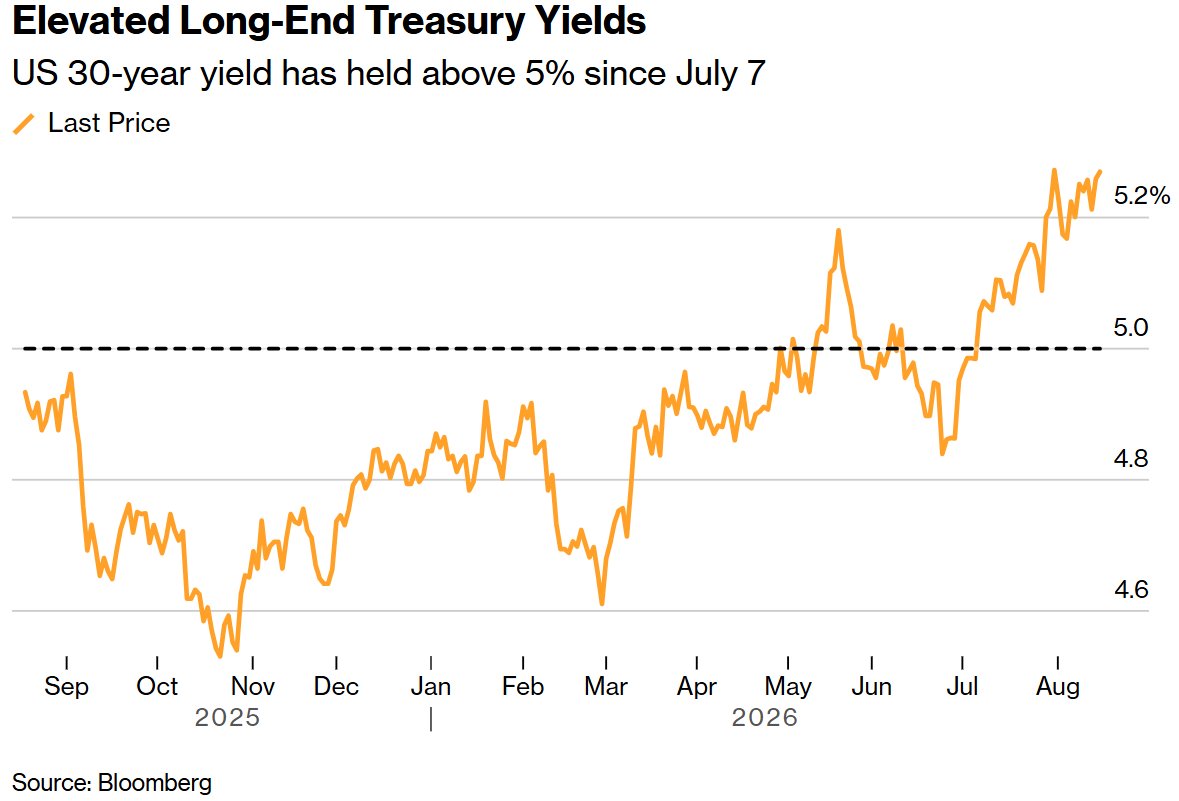
Long-term US Treasury yields are high
As US debt (especially the long end of the yield curve) comes under pressure again, this strategy is likely to be sought after. This week's busy corporate bond issuance schedule collided with the 20-year US bond auction and the sale of long-term inflation-protected securities (TIPS), driving 30-year US Treasury yields to 19-year highs on Monday.
In this context, the conversion of underlying securities is likely to occur rapidly. Data analysis shows that for every 10 basis points increase in long-term yields, the cheapest securities will be switched from the current 4.875% bonds due in August 2045 to 2.5% bonds due in February 2046. And if there is a larger sell-off, leading to a 30 basis point increase in yield from current levels, CTD Securities will switch to 2.25% bonds due in August 2049.
Barclays Bank's interest rate strategists emphasized the value of options emerging in the current high-yield environment. Strategists Andres Mock and Amrut Nashkar wrote in a recent report: “When the long-term yield is above 5.0%, there is a risk of conversion in US Treasury contracts.” They added that a “massive sell-off” could cause CTD to extend further in the delivery pool, while a rebound would shorten its duration.
The time points and transaction costs involved in using the cheapest delivery bond options may erode the profits of margin arbitrage trading. The conversion between delivery bonds will also force futures traders to recalculate how many futures contracts they need to short or long to hedge and buy or sell based on this, which may further disrupt the market.
Although this type of arbitrage trading is relatively limited, the current rise in oil prices and the background of the foggy policy path of the Federal Reserve provides more opportunities for traders (especially those tracking the longest term US bonds).