


The Zhitong Finance App learned that despite high gasoline and food prices, American consumers have shown surprising consumer spending resilience since this year. But Goldman Sachs economists warn that this strong resilience may soon be tested. The newly released set of consumer data, including inflation and retail sales, is marginally favorable for reducing expectations of the Federal Reserve's interest rate hike and even a significant boost to the US economy's “soft landing (soft landing)” prospects, but only if the current slowdown stops at “normalizing demand” rather than sliding towards recession.
A team of economists led by Goldman Sachs senior economist Jan Hatzius wrote in the latest report that sales of US companies to consumers maintained healthy growth in the second quarter. Driven by a higher tax refund scale than the original plan, second-quarter sales of non-essential consumer goods companies in the S&P 500 index increased 5.9% year over year, and the median sales of essential consumer goods companies increased 3.9% year over year.
The strong performance of consumer spending is widespread. For businesses targeting both low- and high-income consumers, same-store sales metrics — a key indicator for the retail industry — are all growing at an accelerated pace. At the same time, retail sales fell 0.6% month-on-month in July, the biggest drop in 14 months. Control-group Sales (Control-Group Sales), which is more related to GDP accounting, fell 0.4%; however, there were technical factors such as Prime Day being brought forward to June and previous excessive tax rebates and overdraft consumption, and the actual US GDP still grew 1.5% per annum in the second quarter, while personal consumption expenditure increased by 3.2%.
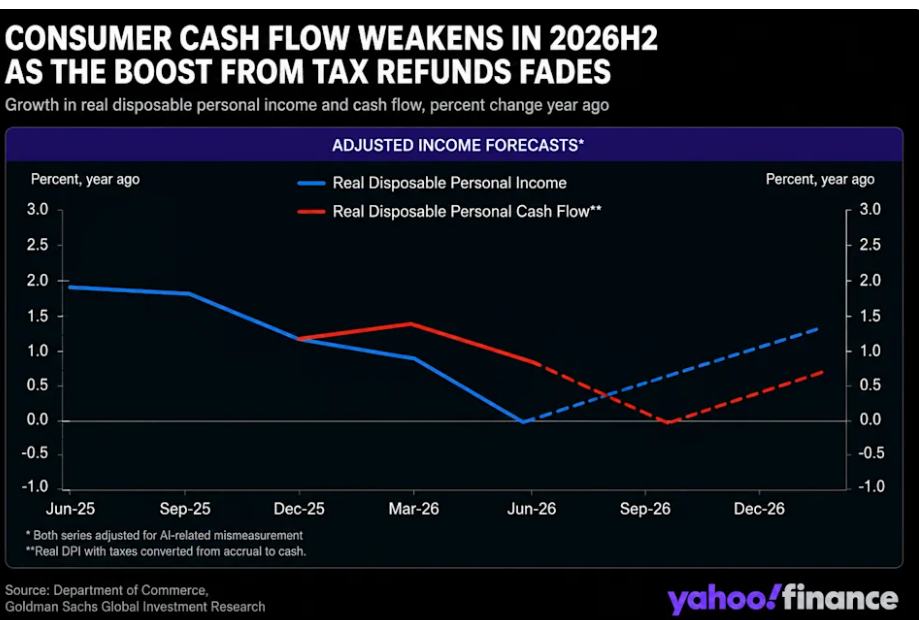
A team of Goldman Sachs economists led by Jan Hatzius predicts that actual consumption growth will drop to 1% to 1.5% in the second half of the year, essentially falling back from an unusually strong tax rebate drive in spring to a more sustainable level.
The retail giant earnings season, which will begin this week, is one of the most important micro windows for verifying whether the US economy can continue to move towards a “soft and unabated” soft landing path or economic trajectory.
Tax refund dividends are ebbing, will US consumer spending “slow down” soon?
However, there are already clouds ahead. Economists led by Hatzius wrote, “We expect consumer spending growth to be weak in the future. Although the July retail sales decline announced last Friday partly reflects the negative impact of Amazon Prime Day being held earlier than in previous years, the revised month-on-month path is now more in line with our judgment. That is, the strong performance of actual consumer spending in spring is only a temporary by-product of the surge in tax rebates. As actual cash flow stagnates, we expect real consumer spending growth to slow to 1% — 1.5% in the second half of the year.”
It is important to note that the US economy grew by only 1.5% on an annualized basis in the second quarter (that is, the annualized quarterly rate benchmark), which is a further slowdown from the 2.1% growth rate in the first quarter.
Despite a slowdown in overall economic growth, individual consumer spending accelerated to 3.2% on an annualized basis, higher than the unexpectedly weak 0.5% in the first quarter, and became the main growth engine for domestic demand from lower-level private individuals.
Household spending is also being driven by increased consumption of goods and services, with spending on prescription drugs, motor vehicles, and food services rising particularly significantly.
In an interview with a media program in late July, P&G Chief Financial Officer Andre Schulten said, “The overall spending situation of American consumers is quite good and generally stable.”
However, Schulten explained that P&G is observing a trend of differentiation among consumers in different income groups. High-income consumers are still willing to spend heavily on P&G's latest innovations; yet low-income consumers who depend on a monthly wage to make ends meet remain cautious when supplementing daily necessities and deciding which products to buy from the shelves.
Goldman Sachs's judgment on the “slowdown in consumer spending in the second half of the year” will be tested by important financial reports and performance prospects from Home Depot (HD.US), Lowe's (LOW.US), Walmart (WMT.US) and Target (TGT.US) this week. Of all these companies, Walmart and Target's performance is likely to receive the most attention from the market, especially their outlook for the third quarter.
Deutsche Bank analyst Krisztina Katai wrote in a report on US retail supergiant Walmart (Walmart): “In a context where consumers are cautious and promotions are likely to be more frequent, it may become more difficult to achieve a further pace of sales growth that exceeds expectations.”
Retail, employment, and inflation have cooled down three times. Goldman Sachs is betting that interest rates will not be raised in September, and the “soft landing deal” will get fuel again
This latest batch of economic and consumption-level data is marginally beneficial to America's “soft landing,” but only if the current slowdown stops at “normalizing demand” rather than sliding towards recession. As far as the asset pricing system is concerned, the ideal outcome is not a retail “explosion”, but “moderate consumption and stable profits” — this will maximize the soft landing and continue to suppress the Federal Reserve's hawkish interest rate hike deals.
Retail sales fell 0.6% month-on-month in July, the biggest drop in 14 months. The sales of the control group, which is more related to GDP accounting, fell 0.4%; however, there were technical factors such as Prime Day being brought forward to June and previous excessive tax rebates and overdraft consumption. At the same time, the real GDP of the US still grew by 1.5% per annum in the second quarter, and personal consumption expenditure increased by 3.2%.
The ideal scenario for the Federal Reserve and risk assets is exactly the “(soft and unabated)” economic growth trajectory, where consumption is weak enough, but can reduce demand-driven inflation; yet it is not weak enough to trigger an overall deterioration in corporate profits, employment, and credit cycles.
The more obvious change is in interest rate expectations: retail, employment, and CPI/PPI are forming a chain of evidence that is increasingly unfavorable to hawkish interest rate hikes. In July, CPI rose only 0.1% month-on-month, and core CPI rose 0.2%, falling to 2.5% year-on-year; then PPI was 0.0% month-on-month, significantly lower than market expectations of +0.2%, falling from 5.5% to 4.7% year on year; compounded by the 23,000 reduction in non-farm accidents in July, the reason why the Federal Reserve “must be tightened again immediately” weakened significantly.
As of August 17, the probability of a CME interest rate hike in September has dropped to about 33%, compared to 51.2% a month ago; the vast majority of economists surveyed by Reuters on August 12-17 expect the policy interest rate to remain unchanged for the rest of 2026. This is highly consistent with Hatzius' judgment that “unless there is a dramatic reversal in the August data, the September rate hike is highly unlikely.” In other words, the Federal Reserve's FOMC hawkish poll and three votes against interest rate hikes still posed a risk at the end of the policy, but the market is shifting back to “how long can the Federal Reserve stand still and watch” from when to raise interest rates.
As far as the global stock market is concerned, this is exactly the most ideal macro-combination of AI/growth stocks at the moment, but it also needs to grasp the border the most: growth cools down to reduce the right-hand risk of policy interest rates and discount rates, yet AI capital expenditure and corporate profits have not collapsed at the same time. Therefore, weak retail sales alone will not increase the huge demand for cloud computing associated with GPU, HBM, or AI reasoning. Its effect on the AI bull market is mainly to reduce the upward risk of risk-free interest rates and financing costs, and increase the present value of future cash flow for long-term technology assets; this is also the reason why the stock market can interpret “weak data” as a benefit after recent moderate CPI/PPI.
However, the investment boundaries in the stock market are also becoming more clear: if US consumer spending falls further from moderate growth of 1% to 1.5%, and employment continues to shrink, then the “interest rate cut/no interest rate hike favors valuation” logic will eventually be replaced by a “profit decline”; conversely, as long as employment does not stall, corporate capital expenditure and AI profits continue to be strong, the script that currently favors risk assets is — consumption cools moderately, inflation continues to decline, and the profit cycle continues to expand. If the latest performance and outlook of retail giants such as Walmart prove that the residential sector is only slowing down and not stalling, then what the market is getting is the favorite combination of risk assets: consumption no longer creates inflationary pressure+corporate profits have not collapsed + the Federal Reserve does not need to continue raising risk-free interest rates. This is particularly friendly to long-term technology stocks and AI computing power infrastructure technology assets.