


The Zhitong Finance App learned that as French politicians prepare for a fierce game over the 2027 budget, and next year's presidential election is getting closer, investors are turning bearish on French government bonds. According to bond futures trading data, investors are establishing new short positions on French treasury bonds — the number of outstanding French 10-year treasury bond futures contracts due next year has jumped to the highest level since the beginning of June, and this contract has been the most actively traded French treasury bond futures contract since the beginning of June.
A team of Barclays Group strategists headed by Mark Kitson said that the market's bearish bets on French treasury bonds seem to have been increasing throughout the summer. The bank's strategist wrote in an August 12 report that investors are “seeking to lay out ahead of time for upcoming domestic political catalysts,” with “the most notable ones being the budgeting process this fall and the presidential election in April next year.”
Marie-Anne Allier, fixed income fund manager at Carmignac Gestion, stated, “We are facing a general election, and it is likely that there will be a lot of political instability until 2027. You are in a dynamic environment that is very unfavorable to France.” She is currently working on French treasury bonds in the air, while also increasing German, Italian, and Spanish treasury bonds.
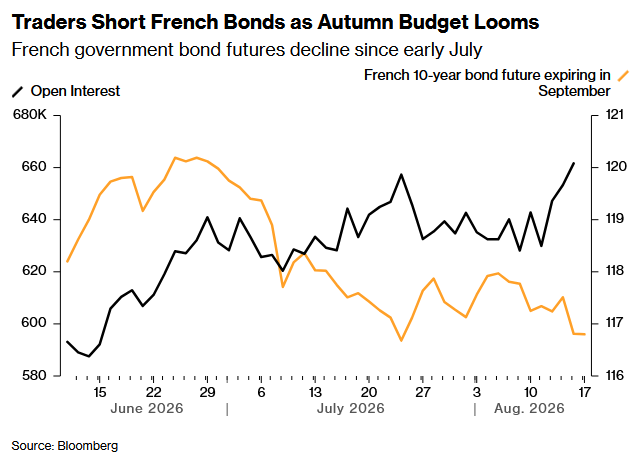
Fall Budget Approaches, Traders Shorted French Treasury Bonds
Starting in September, French Prime Minister Sébastien Le Corny will have to deal with a divided parliament, while his government is drawing up a 2027 budget with the goal of reducing the fiscal deficit to less than 5%. He warned that if no agreement can be reached, the adoption of the fiscal plan may be delayed until very late next year, and the fiscal deficit rate may rise to 6.5%. Meanwhile, various candidates are also making plans for next year's presidential election. The presidential election will be held in two rounds, on April 18 and May 2, 2027, respectively.
Polls show that the far-right populist politician Marina Le Pen is currently leading the presidential election next year. The rise in Le Pen's approval ratings may make it more difficult for Le Corney's government to push for fiscal austerity policies to receive support. In the extreme left wing, candidate Jean-Luc Mélenchon proposed increasing spending and canceling part of the national debt held by the Bank of France.
The yield on French 30-year treasury bonds surged 12 basis points last Friday and rose slightly again to 4.86% on Monday, the highest level since 2008. The yield premium required for investors holding French 10-year treasury bonds to German treasury bonds soared to 84 basis points last Friday, the highest level since October last year, indicating that the pressure on French treasury bonds is increasing.
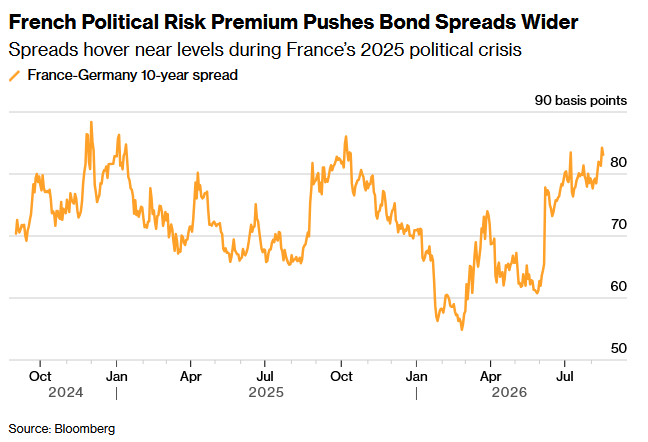
France's political risk premium pushes up interest spreads on French-German bonds
Theophile Legrand, an interest rate strategist at the French Foreign Trade Bank, said that its index that measures risk in specific countries shows that about 25 basis points of the widening interest rate spread between French treasury bonds and German treasury bonds can be attributed to such specific risks. “This is the highest level since the tension related to the budget in December 2025.”
There are already some clues about what the next budget might include. In an interview in July, Le Corney said he didn't want to raise taxes. Meanwhile, the losses caused by forest fires, high temperatures, and droughts that swept through France this summer are becoming another major strain on public finances. In a letter to farmers over the weekend, Le Corney promised to introduce new measures in 2027 to support people affected by the disaster.
Last month, French Finance Minister Roland Lescure lowered the government's forecast for economic growth in 2026 from 0.9% to 0.7%, and said that the goal of reducing the fiscal deficit rate from 5.1% to 5% in 2025 now seems “difficult.”
Mediolanum portfolio manager Neil Scanlon said he would like to see the spread between French 10-year treasury bonds and German treasury bonds widen further before starting to buy French treasury bonds. Scanlon said, “If this spread is close to the upper limit of 90 basis points, we may start buying French treasury bonds in small amounts and overbalance German treasury bonds at this level.”
France's credit rating will also be closely watched again this fall, which could lead to increased volatility in the bond market. S&P Global Ratings, Morningstar DBRS, and Fitch Ratings all downgraded France's debt rating last fall due to difficulties for minority governments to pass the budget. Moody's Ratings, on the other hand, lowered France's rating outlook. The French debt management agency expects that various rating agencies will announce French credit rating decisions one after another starting August 28, and that evaluations by other agencies will continue until the end of the year.