


- GitLab recently reported continued strength in annual revenue and annual recurring revenue growth, underpinned by multi‑year customer commitments and a high‑margin DevSecOps platform.
- An interesting element is how the company’s single-application approach and strong gross margins are helping it win share despite ongoing losses.
- We’ll now examine how GitLab’s accelerating recurring revenue traction fits with its AI-focused DevSecOps roadmap and long-term investment narrative.
Rare earth metals are the new gold rush. Find out which 28 stocks are leading the charge.
GitLab Investment Narrative Recap
To own GitLab, you need to believe its single-application DevSecOps platform can keep consolidating developer workloads, support premium pricing, and translate expanding ARR into eventual profitability despite ongoing losses. The latest revenue and ARR strength supports the near term catalyst of AI driven upsell and seat expansion, but it does not remove the key risk that intensifying competition and slower new customer adds could still weigh on future growth and margins.
Among recent announcements, the Q1 2026 results and FY 2027 revenue guidance stand out as most relevant here, with revenue reaching US$264.16 million and losses narrowing to US$4.97 million. This underlines how GitLab’s AI focused DevSecOps roadmap and high gross margin profile are already showing up in the financials, which matters for investors weighing the trade off between continued operating losses and the potential upside from recurring revenue scale.
Yet, against this progress, investors should still be aware of how rising competition in AI tools could...
Read the full narrative on GitLab (it's free!)
GitLab's narrative projects $1.5 billion revenue and $186.3 million earnings by 2029. This requires 15.3% yearly revenue growth and a $211.4 million earnings increase from -$25.1 million today.
Uncover how GitLab's forecasts yield a $33.61 fair value, a 17% downside to its current price.
Exploring Other Perspectives
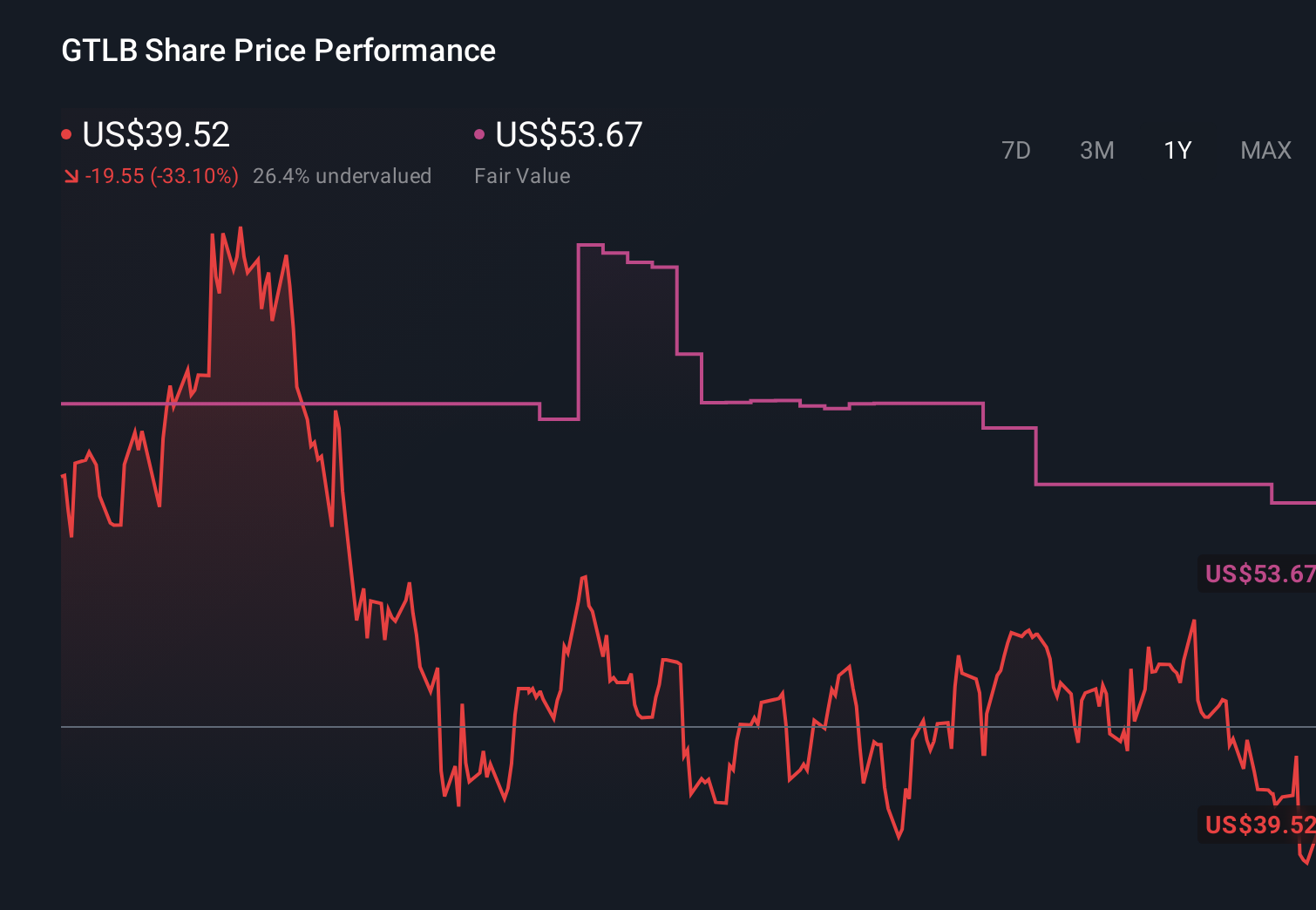
Some of the lowest estimate analysts were already cautious, assuming roughly 14.5% annual revenue growth and no profitability within three years, so this new ARR strength may lead you to reassess how much weight you give their more pessimistic view versus the consensus.
Explore 7 other fair value estimates on GitLab - why the stock might be worth 38% less than the current price!
Form Your Own Verdict
Don't just follow the ticker - dig into the data and build a conviction that's truly your own.
- A great starting point for your GitLab research is our analysis highlighting 1 key reward and 1 important warning sign that could impact your investment decision.
- Our free GitLab research report provides a comprehensive fundamental analysis summarized in a single visual - the Snowflake - making it easy to evaluate GitLab's overall financial health at a glance.
Contemplating Other Strategies?
Opportunities like this don't last. These are today's most promising picks. Check them out now:
- Find 53 companies with promising cash flow potential yet trading below their fair value.
- The future of work is here. Discover the 37 top robotics and automation stocks leading the charge in AI-driven automation and industrial transformation.
- Invest in the nuclear renaissance through our list of 92 elite nuclear energy infrastructure plays powering the global AI revolution.
This article by Simply Wall St is general in nature. We provide commentary based on historical data and analyst forecasts only using an unbiased methodology and our articles are not intended to be financial advice. It does not constitute a recommendation to buy or sell any stock, and does not take account of your objectives, or your financial situation. We aim to bring you long-term focused analysis driven by fundamental data. Note that our analysis may not factor in the latest price-sensitive company announcements or qualitative material. Simply Wall St has no position in any stocks mentioned.
Have feedback on this article? Concerned about the content? Get in touch with us directly. Alternatively, email editorial-team@simplywallst.com