


Cirrus Logic stock has delivered a 51.5% gain over the past three years, yet current checks suggest the shares may still trade below an intrinsic value estimate based on a Discounted Cash Flow (DCF) approach and earnings multiples that both point to undervaluation.
- Cirrus Logic has returned 51.5% over three years, which puts recent short term pullbacks into the context of a solid medium term gain.
- Record revenue supported by demand for custom components in smartphones can help underpin expectations for future cash flows. Any slowdown in that demand or delays in expanding into new applications may weigh on what investors are willing to pay.
- The broader checks lean cheap, with Cirrus Logic screening as undervalued in 5 of 6 valuation measures.
The issue now is whether Cirrus Logic’s recent share price weakness has created a genuine discount to its intrinsic value, or if the upside signalled by the models already reflects most of what investors can reasonably expect.
Find out why Cirrus Logic's 6.1% return over the last year is lagging behind its peers.
Does Cirrus Logic Look Undervalued on Cash Flow?
The Discounted Cash Flow (DCF) method values Cirrus Logic by projecting the cash the business can generate for shareholders and discounting it back to today.
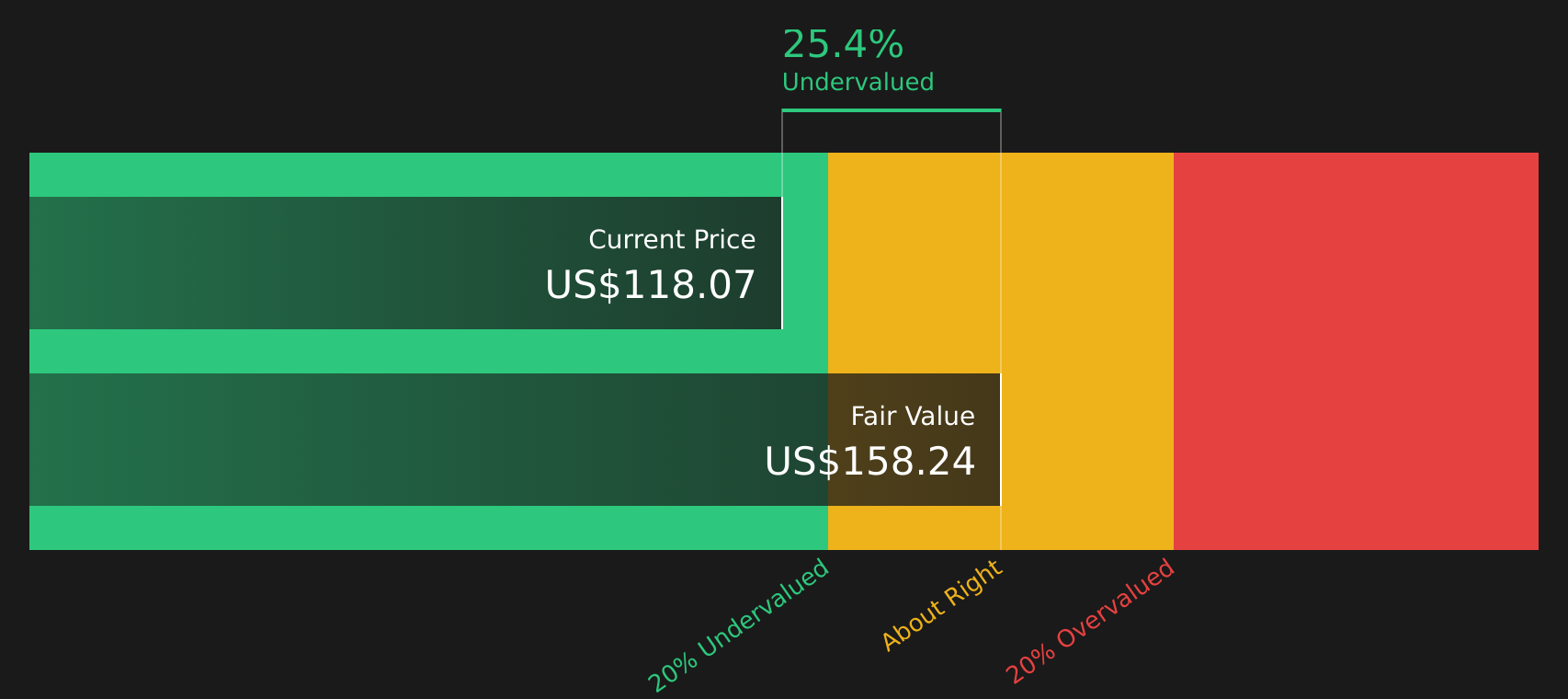
Cirrus Logic has latest twelve month free cash flow of about $568.6 million, and the model assumes that these cash flows grow over time rather than shrink. On that basis, the 2 Stage Free Cash Flow to Equity model points to an estimated intrinsic value of about $158 per share, which is 24.1% above the current share price. That gap implies the stock screens as undervalued on cash generation alone.
Because Cirrus Logic recently reported record quarterly revenue from custom smartphone components, the DCF result suggests the market is not fully reflecting the cash flows implied by that performance. The key question for investors is whether this level of free cash flow can be sustained as the company targets new applications.
On this Discounted Cash Flow view, Cirrus Logic stock currently looks undervalued relative to its estimated intrinsic value.
Our Discounted Cash Flow (DCF) analysis suggests Cirrus Logic is undervalued by 24.1%. Track this in your watchlist or portfolio, or discover 53 more high quality undervalued stocks.
Does Cirrus Logic Look Undervalued on Earnings?
The P/E ratio is a useful cross check for Cirrus Logic because earnings are a key focus for many investors in profitable semiconductor companies. Cirrus Logic currently trades on a P/E of about 14.0x. This is well below the broader semiconductor industry average of 53.6x and also below a peer group average of 32.8x.
On Simply Wall St’s fair P/E estimate of 17.6x, which reflects the company’s profile rather than just raw sector averages, Cirrus Logic trades at a discount. The current multiple is lower than this fair ratio, which suggests the market is pricing the stock below what that framework indicates for its earnings. Taken together with the wider gap to the industry and peer benchmarks, the stock appears inexpensive on this earnings measure.
Overall, Cirrus Logic appears undervalued on its P/E multiple compared with both tailored and broader market benchmarks.

See what the numbers say about this price — find out in our valuation breakdown.
The Cirrus Logic Narrative: What Would Justify Today's Price?
Simply Wall St Narratives for Cirrus Logic pick up where this valuation puzzle leaves off and spell out what future growth, margins and earnings would need to look like for the stock to justify a meaningfully higher or lower price than today. Rather than relying on a single multiple or model output, each Narrative lays out the assumptions that underpin its fair value so you can compare those expectations with Cirrus Logic's actual results over time on the Community page.
One of the top community narratives on Cirrus Logic: 8% undervalued
"Heavy reliance on major smartphone customers and slow diversification leaves the company vulnerable to fluctuating device demand and stalled long-term growth..."
Read one of the top narratives on Cirrus Logic
Do you think there's more to the story for Cirrus Logic? Head over to our Community to see what others are saying!
The Bottom Line
The valuation work on Cirrus Logic points in the same direction. The Discounted Cash Flow (DCF) view and the earnings multiple checks both suggest the stock screens as undervalued rather than fully priced. With most signals lining up, the key debate now is whether cash flows tied to custom smartphone components hold up and extend into new applications. The durability of that demand, more than the current discount itself, will determine whether today’s pricing ultimately represents an opportunity or a value trap.
This article by Simply Wall St is general in nature. We provide commentary based on historical data and analyst forecasts only using an unbiased methodology and our articles are not intended to be financial advice. It does not constitute a recommendation to buy or sell any stock, and does not take account of your objectives, or your financial situation. We aim to bring you long-term focused analysis driven by fundamental data. Note that our analysis may not factor in the latest price-sensitive company announcements or qualitative material. Simply Wall St has no position in any stocks mentioned.
Have feedback on this article? Concerned about the content? Get in touch with us directly. Alternatively, email editorial-team@simplywallst.com